The global elderly population is growing faster than healthcare systems can adapt. Smart care facilities now face mounting pressure to improve patient safety while maintaining quality care. As a result, artificial intelligence has emerged as a critical tool for monitoring residents and reducing risks. At the center of this transformation are keypoint skeletal annotation services, which help AI systems understand human movement with remarkable precision. Healthcare organizations increasingly rely on keypoint skeletal annotation services to build intelligent monitoring solutions. These solutions can identify falls, assess mobility patterns, and detect behavioral changes before serious incidents occur. Many organizations also partner with an experienced image annotation company to create accurate datasets that support these advanced healthcare applications.
The growing demand for healthcare AI has also accelerated image annotation outsourcing initiatives worldwide. Smart care providers require large volumes of accurately labeled data to train reliable models. Therefore, specialized annotation teams now play a vital role in helping AI systems understand posture, movement, and physical activity in elderly populations. According to the United Nations, the number of people aged 65 and older is expected to double globally by 2050. This demographic shift creates new challenges for healthcare providers and long-term care facilities. Technology alone cannot solve these challenges. However, AI powered by precise skeletal annotation can significantly improve outcomes while reducing operational burdens.
Key Points
- Fall detection AI for elderly care requires skeletal keypoint annotation that accurately captures subtle posture changes preceding a fall event.
- Mobility monitoring systems trained on well-annotated skeletal data can detect early signs of physical decline before incidents occur.
- Annotation in care facility environments must handle poor lighting, furniture occlusion, and the slow, careful movements typical of older adults.
- Accurate skeletal annotation in healthcare settings directly translates to faster emergency response and improved resident safety outcomes.
Table of Contents
Why Keypoint Skeletal Annotation Services Matter in Elderly Care
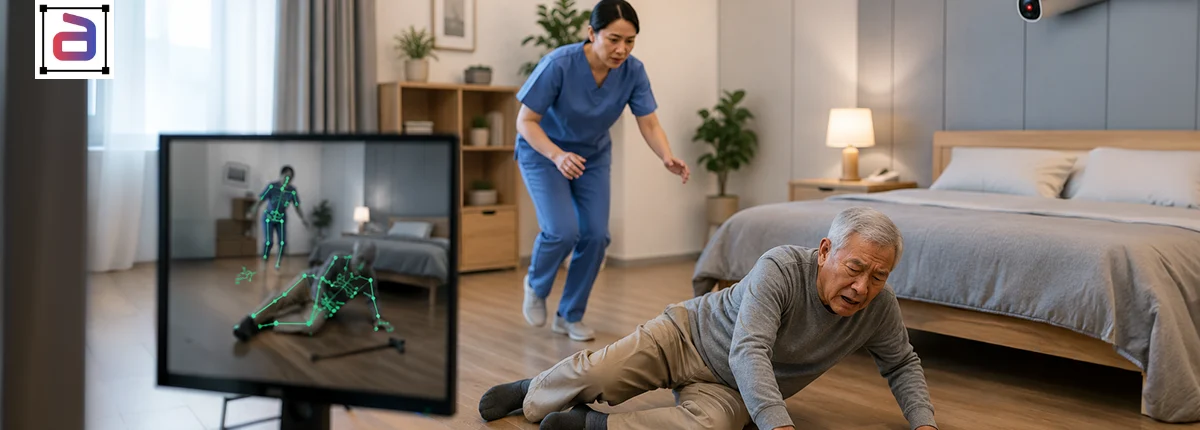
Traditional video surveillance systems can record incidents. However, they often fail to interpret what is happening in real time. Skeletal annotation changes this dynamic by teaching AI systems to recognize human body structures through connected keypoints representing joints and limbs. Unlike basic object detection, skeletal annotation focuses on movement mechanics. The system identifies body positions and tracks changes over time. Consequently, AI can distinguish between normal activities and dangerous situations such as falls.
A resident bending to pick up an object may resemble a fall in conventional computer vision models. Yet skeletal analysis can identify movement sequences and determine whether the action presents a risk. This level of contextual understanding significantly improves monitoring accuracy. Healthcare providers increasingly view skeletal annotation as a strategic investment rather than a technical requirement. The ability to understand motion patterns creates opportunities for predictive care instead of reactive intervention.
Image Annotation Company Expertise Drives Better Fall Detection Systems
Falls remain one of the leading causes of injury among older adults. According to the U.S. Centers for Disease Control and Prevention, millions of older adults experience falls annually, resulting in significant healthcare costs and long-term complications. The challenge extends beyond detecting the fall itself. Care providers need systems that recognize warning signs before incidents occur. This is where collaboration with a specialized image annotation company becomes essential.
Annotated skeletal datasets allow AI models to analyze walking speed, balance changes, posture irregularities, and gait instability. These indicators often emerge before serious accidents happen. Therefore, healthcare facilities can intervene proactively rather than responding after injuries occur. Researchers from the Massachusetts Institute of Technology have repeatedly emphasized the importance of movement analytics in preventive healthcare.
As healthcare innovator Eric Topol stated: “The future of medicine is about prediction and prevention, not just reaction.”
This principle perfectly aligns with skeletal annotation applications in elderly care environments. A practical example emerged from several assisted living facilities that implemented AI-based fall monitoring systems. These solutions reduced response times because staff received immediate alerts when suspicious movements occurred. Faster interventions often translated into improved patient outcomes. Furthermore, skeletal models offer privacy advantages compared to traditional facial recognition systems. Since AI focuses on body structure rather than personal identity, facilities can balance monitoring effectiveness with resident dignity. Skeletal and keypoint labeling techniques provide deeper contextual understanding of human movement, enabling more accurate activity recognition and behavioral analysis in AI systems.
Image Annotation Outsourcing for Mobility Monitoring and Predictive Healthcare
Mobility serves as one of the strongest indicators of overall health among elderly populations. Small changes in movement patterns often reveal emerging medical conditions. Consequently, continuous monitoring has become increasingly valuable. Building mobility monitoring systems requires thousands of annotated images and video sequences. For this reason, many healthcare technology providers choose image annotation outsourcing to scale data production efficiently.
Outsourcing enables organizations to access trained annotation specialists who understand human anatomy, motion tracking, and skeletal labeling requirements. The result is higher-quality training data and more reliable AI performance. Through skeletal annotation, AI systems can measure subtle variables such as stride length, joint movement range, walking symmetry, and posture stability. These metrics help identify mobility decline long before traditional assessments reveal concerns. Imagine a resident whose walking speed gradually decreases over several weeks. Human caregivers may not immediately notice the change. However, AI systems trained with precise skeletal annotations can detect these trends automatically. Therefore, care teams gain valuable opportunities for early intervention. The implications extend beyond fall prevention. Mobility intelligence can support rehabilitation programs, physical therapy initiatives, and personalized care planning.
From Reactive Care to Predictive Intelligence Through Skeletal Annotation
Healthcare leaders increasingly discuss predictive care models. The objective is simple yet transformative. Prevent problems before they become emergencies. Skeletal annotation enables this shift by converting movement data into actionable intelligence. AI systems can identify behavioral anomalies, recognize recurring mobility challenges, and highlight emerging health risks. For example, changes in sitting behavior may indicate discomfort or pain. Altered walking patterns may suggest muscular weakness or neurological concerns. Repeated balance corrections may signal elevated fall risk. These insights create measurable business value for care providers. Reduced hospitalizations, improved resident safety, and enhanced operational efficiency contribute directly to organizational performance. There is also a practical reality worth mentioning. Human caregivers cannot watch every resident every second of every day. Even the most dedicated professionals need support. AI acts as a continuous monitoring partner rather than a replacement for human care.
One healthcare executive humorously described the technology by saying, “The AI never asks for a coffee break.” While lighthearted, the statement captures an important truth. Intelligent monitoring systems provide uninterrupted observation that human teams cannot realistically maintain. Organizations that invest in high-quality annotation workflows today position themselves for future innovation. Accurate skeletal datasets become the foundation for next-generation healthcare applications, including digital twins, personalized rehabilitation systems, and advanced predictive analytics.
Conclusion
The future of elderly care depends on technologies that improve safety without compromising dignity. Keypoint skeletal annotation services provide the data foundation necessary for AI systems to detect falls, monitor mobility, and identify health risks before serious incidents occur. As healthcare organizations pursue smarter and more proactive care models, partnerships with a trusted image annotation company become increasingly important.
At the same time, image annotation outsourcing enables scalable dataset development that accelerates innovation. By transforming movement into meaningful intelligence, skeletal annotation is helping smart care facilities move from reactive response toward predictive, patient-centered healthcare. Ready to build smarter elderly care solutions? Partner with Annotera for high-precision keypoint skeletal annotation Services that enhance fall detection, mobility monitoring, and AI-driven patient safety in modern care facilities.
A closely related read: Training Humanoid Robots with Image Skeletal Data.
A closely related read: Human Movement Analysis with Skeletal Annotation.