Sports and fitness are entering a new era where artificial intelligence can analyze movement, identify performance patterns, and deliver insights that were once possible only through expert observation. From tracking an athlete’s biomechanics to correcting exercise form in real time, computer vision is transforming how movement is measured and understood. At the center of many of these innovations is keypoint and pose estimation annotation. By labeling anatomical landmarks across images and video frames, organizations can train AI models to recognize body positions, understand motion, and analyze complex human activities. As sports technology and fitness AI continue to evolve, high-quality training data is becoming a competitive advantage.
Key Points
- Keypoint and pose estimation annotation enables AI models to understand human posture, body positioning, and movement for advanced sports analytics and fitness applications.
- High-quality video annotation helps AI systems track movement across frames, supporting athlete performance analysis, exercise recognition, form correction, and motion tracking.
- Data annotation outsourcing provides scalable access to skilled annotators and quality-control workflows, helping organizations manage complex sports and fitness AI datasets efficiently.
- Annotera’s annotation expertise helps businesses build accurate, consistent, AI-ready datasets for pose estimation, human activity recognition, sports analytics, and next-generation fitness AI.
What Is Keypoint and Pose Estimation Annotation?
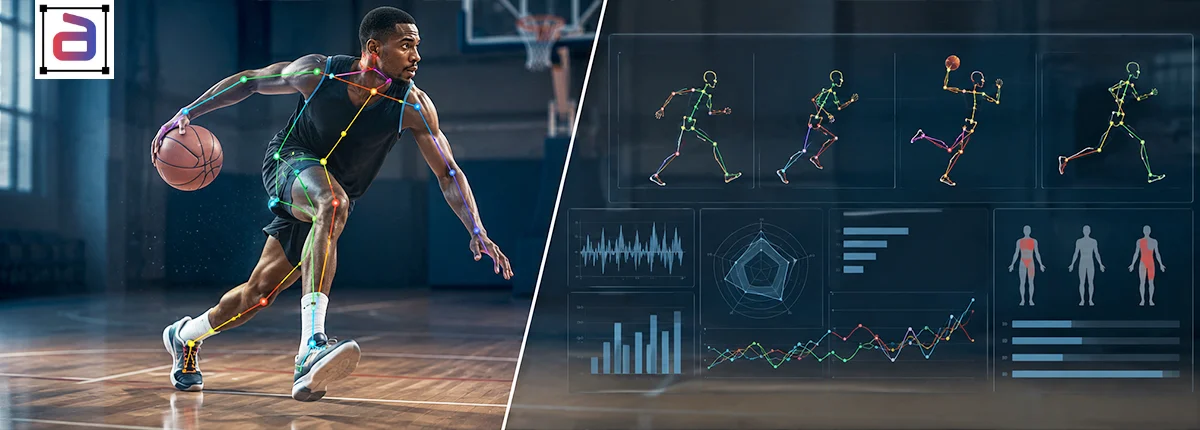
Keypoint annotation involves identifying specific points on the human body and assigning precise coordinates to them. Depending on the application, these points can include the head, shoulders, elbows, wrists, hips, knees, ankles, and other joints. When these landmarks are connected, they create a skeletal representation of a person’s posture or movement. Pose estimation models can then use this information to understand how the body is positioned and how it changes over time.
This makes pose annotation particularly valuable for applications where movement—not simply object recognition—is the primary subject of analysis. For example, an AI fitness application could analyze a user’s squat by tracking hip, knee, ankle, and shoulder positions. Similarly, a sports analytics platform could evaluate an athlete’s running stride, golf swing, tennis serve, or basketball shot. For organizations managing large datasets, data annotation outsourcing offers a practical way to access specialized expertise, improve annotation consistency, and scale projects efficiently.
“AI can recognize movement only when it has been trained on data that accurately represents how humans move.”
How Pose Annotation Is Transforming Sports Analytics
Professional sports increasingly rely on data to improve athlete performance. Traditional statistics provide useful information, but computer vision can reveal much more detailed insights into how an athlete performs. Annotated pose data enables AI systems to examine:
- Joint angles and body alignment
- Athlete posture and balance
- Movement trajectories
- Acceleration and deceleration
- Range of motion
- Technique consistency
- Player positioning
- Interactions between athletes
Consider a tennis serve. A computer vision model can analyze shoulder rotation, elbow positioning, trunk movement, and leg extension throughout the action. Coaches can use these insights to identify technical patterns and compare movements across training sessions or athletes. In team sports, pose estimation can also support player tracking and tactical analysis. Models can interpret body orientation and positioning to help understand player behavior within dynamic game environments. This demonstrates why pose annotation is more than simple labeling—it converts visual information into structured movement intelligence.
The Role of Pose Estimation in Fitness AI
Fitness applications are increasingly moving beyond basic workout tracking toward intelligent, personalized coaching. AI-powered fitness platforms can use pose estimation to recognize exercises, count repetitions, evaluate technique, and provide feedback. However, these capabilities depend heavily on training data that accurately represents human movement. A model designed to recognize a squat, for example, needs exposure to different users, body proportions, camera positions, clothing, lighting conditions, and exercise variations. High-quality keypoint annotation helps models learn relationships between anatomical landmarks and movement patterns. Potential applications include:
- Real-time exercise form analysis
- Automated repetition counting
- Exercise recognition
- Posture assessment
- Movement-quality scoring
- Range-of-motion analysis
- Personalized fitness feedback
- Rehabilitation and mobility applications
“The goal isn’t simply to detect a pose; it is to teach AI the movement patterns that make the pose meaningful.”
Why Video Annotation Matters for Movement Intelligence
Static images can teach models where body landmarks are located, but sports and fitness are inherently dynamic. A model must understand how a body moves from one frame to the next. This is where video annotation outsourcing becomes particularly valuable. Specialized annotation teams can label keypoints across consecutive frames while maintaining temporal consistency. This allows AI systems to learn movement trajectories rather than treating every frame as an isolated image. Video annotation is especially useful for:
- Athlete performance analysis
- Exercise recognition
- Motion tracking
- Sports technique analysis
- Gesture recognition
- AI coaching systems
- Human activity recognition
For instance, labeling the position of an athlete’s knee throughout an entire running sequence allows a model to learn more than knee location. It can learn the progression, direction, and relationship of that movement over time.
Key Challenges in Pose Annotation
Human movement is complex, and real-world video rarely provides ideal annotation conditions.
Occlusion
Athletes may partially block their own limbs, while equipment or other players can obscure important landmarks.
Motion Blur
Fast actions such as sprinting, jumping, or swinging can make individual body parts difficult to identify accurately.
Complex Movements
Sports often involve unconventional poses and rapid transitions that require skilled annotators to interpret correctly.
Multiple People
Team sports introduce additional challenges because annotators must distinguish between multiple individuals and maintain identity consistency.
Camera Variation
Training datasets may contain footage from smartphones, fixed cameras, drones, broadcast systems, or wearable devices, creating substantial variation in perspective.
Annotation Consistency
Even small inconsistencies between frames can affect how effectively a model learns movement patterns. Clear annotation guidelines and multi-stage quality assurance are therefore essential. These challenges make choosing the right data annotation company an important part of an AI development strategy.
Why Data Annotation Outsourcing Makes Sense
Building an internal annotation operation can become resource-intensive when projects require millions of frames, specialized labeling expertise, and strict quality standards. Through data annotation outsourcing, AI companies can access trained annotation teams and scalable workflows without having to build an entire labeling operation from scratch. A capable annotation partner should offer:
- Experienced annotators
- Detailed labeling guidelines
- Multi-level quality assurance
- Scalable production capacity
- Consistent annotation across video sequences
- Support for complex computer vision datasets
- Secure data-handling processes
For sports and fitness AI companies, domain-specific understanding is equally important. Annotators need to recognize anatomical landmarks and follow project-specific instructions consistently.
Why Annotera for Keypoint and Pose Annotation?
Annotera helps businesses transform raw visual data into structured datasets designed for computer vision development. As an experienced data annotation company, Annotera supports specialized image and video annotation workflows that can be adapted to the requirements of AI and machine learning projects. For sports analytics and fitness AI, this can include keypoint labeling, human pose annotation, frame-by-frame video annotation, and quality-control workflows designed to maintain consistency across large datasets. As an established video annotation company, Annotera focuses on helping AI teams scale annotation while maintaining the accuracy and consistency their models require.
“High-quality annotation is not a back-office task—it is an essential part of building reliable computer vision.” — Annotera
The Future of Sports and Fitness AI
The next generation of sports technology will increasingly move from simply recording performance to understanding it. Pose estimation can help AI systems interpret body mechanics, identify movement patterns, compare techniques, and deliver increasingly personalized insights. In fitness, this could mean smarter virtual coaching and real-time form correction. In professional sports, it could mean more sophisticated performance analytics and biomechanics-driven decision-making. However, these systems are only as capable as the datasets used to train them. Diverse, accurately labeled, temporally consistent data will remain fundamental to building reliable models. As sports and fitness organizations expand their use of computer vision, partnering with specialized annotation providers can help them scale this critical foundation.
Build Better Movement AI With Annotera
Developing a sports analytics platform or fitness AI solution? Don’t let inconsistent training data become a bottleneck. Annotera provides scalable image and video annotation solutions to help organizations build high-quality datasets for computer vision, pose estimation, human activity recognition, and movement analytics. From keypoint annotation to complex video labeling workflows, Annotera can help turn your raw movement data into AI-ready training datasets. Ready to accelerate your sports or fitness AI project? Contact Annotera today to discuss your annotation requirements and build the high-quality training data your computer vision models need.
A closely related read: Keypoint Annotation for Hand and Finger Tracking in Industrial Glove-Based Interfaces