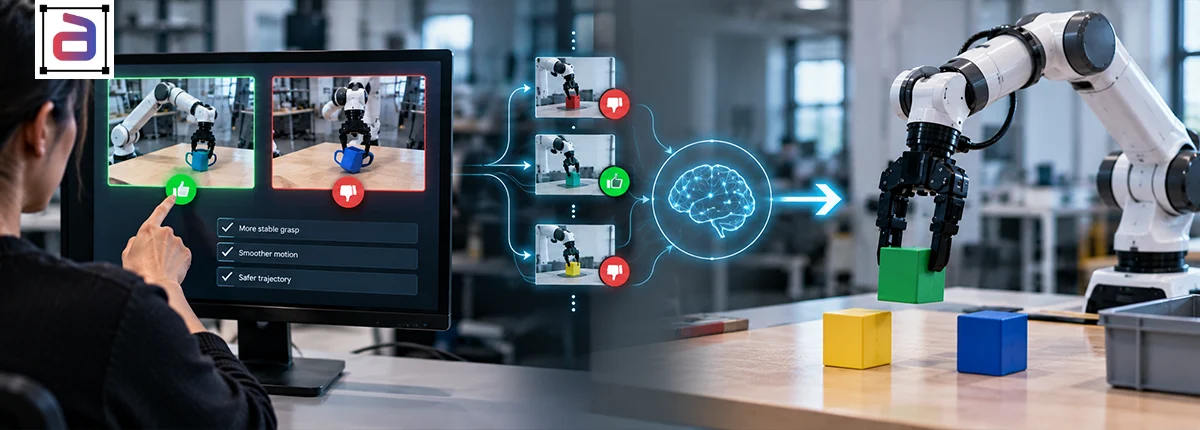
Robots are moving beyond controlled industrial environments and entering warehouses, hospitals, homes, retail spaces, and other human-centric settings. In these environments, simply completing a task is no longer enough. Robots must understand context, evaluate alternatives, respond safely, and choose actions that align with human expectations. Consider a robot asked to deliver an object across a busy room. It may have several ways to reach its destination. One path may be the fastest, another may be safer around people, while a third may involve smoother and more predictable movements. Which behavior should the robot choose? This is the decision-making challenge that robot preference annotation can help address. By converting human judgments into structured training signals, preference annotation enables reinforcement-learning systems to distinguish between merely successful behavior and genuinely desirable behavior. For organizations building embodied intelligence, this makes preference data an increasingly important component of RLHF for Physical AI. At Annotera, we help organizations create high-quality annotation pipelines that transform complex robotic data into actionable training signals for the next generation of intelligent machines.
Key Points
- Robot preference annotation helps robots learn which actions are safer, more efficient, and better aligned with human expectations—not just whether a task is completed.
- RLHF for Physical AI uses human preference data to train reward models and improve robotic decision-making in real-world environments.
- Data annotation outsourcing enables robotics companies to scale high-quality preference datasets with structured guidelines, trained annotators, and rigorous quality control.
- Annotera transforms human judgments into reliable training signals, helping organizations build smarter, safer, and more capable robotic systems.
From Task Completion to Better Decisions
Traditional robotics training often focuses on whether a robot successfully completes a predefined task. The result can be represented relatively simply: success or failure. But real-world robotics is rarely binary. A robot can successfully pick up an object while using excessive force. It can reach a destination while taking an unnecessarily dangerous route. It can interact with a person successfully while moving unpredictably or too aggressively. These behaviors may technically satisfy the task objective, but they do not necessarily represent good robotic behavior. Preference learning introduces a more nuanced approach. Instead of asking only, “Did the robot succeed?”, developers can ask: “Which of these behaviors would a human prefer?” That distinction is fundamental.
“The goal is not simply to teach robots what to do, but to help them learn which actions are preferable in context.”
Preference annotation provides the data required to make that distinction measurable.
What Is Robot Preference Annotation?
Robot preference annotation involves comparing multiple robot behaviors, trajectories, actions, or outcomes and identifying which one is preferable according to defined criteria. For instance, an annotator may receive two trajectories generated by a robotic system performing the same task. The annotator could determine that Trajectory A is preferable because it:
- Maintains greater distance from a nearby person
- Uses smoother movements
- Avoids unnecessary object contact
- Completes the task efficiently
- Follows the intended instructions more closely
These comparisons can be aggregated into preference datasets and subsequently used to train reward models. The advantage is significant: instead of manually specifying every desirable behavior, developers can use human feedback to help models discover patterns associated with preferred outcomes.
How Preference Annotation Supports RLHF
Reinforcement Learning from Human Feedback (RLHF) has gained significant attention in AI because it enables models to incorporate human preferences into their learning process. The same principle becomes particularly powerful—and considerably more complex—when applied to physical systems. In RLHF for Physical AI, the system must learn preferences over actions that have real-world consequences. The feedback may concern safety, efficiency, physical interaction, social acceptability, or task-specific performance. A simplified workflow looks like this: Robot generates behaviors → Humans compare behaviors → Preference data is collected → Reward model learns preferences → Robot policy is optimized → Improved behavior is evaluated Preference annotation therefore acts as a bridge between human judgment and machine learning. Instead of relying entirely on predefined reward functions, robotics teams can use human comparisons to capture qualities that may be difficult to express through conventional programming.
Why Human Preference Matters in Physical AI
Physical environments contain countless variables that are difficult to anticipate. A warehouse robot may encounter a worker suddenly crossing its path. A household robot may need to decide whether to move an object around an obstacle or temporarily reposition another item. A collaborative robot may have several ways to hand an object to a human. In each case, multiple actions may be technically possible. Human preferences help establish which behavior is better. For example, humans may naturally prefer robots that:
- Move predictably around people
- Minimize unnecessary force
- Avoid fragile objects
- Take efficient but cautious routes
- Recover gracefully from errors
- Follow instructions without creating additional risks
These subtle preferences can become valuable training signals.
“Good robotic behavior is contextual. The best action is not always the fastest action—it is the action that best balances the objectives of the environment.”
Building High-Quality Preference Datasets
The quality of an RLHF system depends heavily on the quality of its human feedback. Poorly defined annotation criteria can result in inconsistent preferences. Ambiguous instructions can cause annotators to prioritize different factors. Insufficient quality control can introduce noise into the training dataset. A scalable preference annotation program therefore requires a carefully designed framework. At Annotera, annotation workflows can be structured around the specific requirements of each robotics application. Depending on the project, annotators may compare:
- Robot trajectories
- Manipulation sequences
- Navigation paths
- Human-robot interactions
- Object-handling behaviors
- Force or motion patterns
- Task outcomes
- Simulated versus real-world behaviors
Detailed guidelines, annotator training, consensus mechanisms, review processes, and quality audits can further improve consistency. This is particularly important when preference data is being used to influence a robot’s future decision-making. Annotating multi-turn conversations captures evolving intent, contextual references, response consistency, and dialogue quality. These context-rich labels help create preference datasets that enable generative AI models to produce more relevant, coherent, and instruction-aligned responses across complex interactions.
The Role of Data Annotation Outsourcing
Generating large preference datasets internally can place significant operational demands on robotics teams. Annotation requires people, training, quality assurance, project management, and infrastructure—all of which must scale as the dataset grows. This is where data annotation outsourcing can provide strategic value. Working with a specialized data annotation company enables robotics organizations to scale annotation capacity without building every operational component internally. However, robotics data cannot always be handled using generic annotation approaches. Physical AI datasets often require an understanding of temporal relationships, spatial context, object interactions, trajectories, and task-specific objectives. Annotera combines scalable annotation operations with structured quality processes to help organizations develop datasets aligned with their AI training requirements.
Preference Annotation Across the Robotics Ecosystem
The potential applications extend across numerous robotic systems.
- Humanoid robots: Preference data can help evaluate natural movement, safe human interaction, and task execution.
- Industrial robots: Comparisons can help optimize efficiency, precision, safety, and collaborative behavior.
- Autonomous mobile robots: Annotators can evaluate navigation strategies based on safety, efficiency, and predictability.
- Service robots: Human feedback can help determine preferred approaches to object handling and interaction.
- Healthcare robotics: Preference-based evaluation can support careful, predictable, and user-oriented robotic behavior.
As robots become more autonomous, the ability to learn from nuanced human feedback will become increasingly valuable.
Annotera: Turning Human Judgment Into Training Signals
The future of robotics depends on more than bigger models and better hardware. Intelligent machines also require datasets that capture the complexity of human expectations. That is where Annotera can make a difference. By supporting structured robot preference annotation, scalable data annotation outsourcing, and quality-focused annotation workflows, Annotera helps AI teams transform human judgments into useful training data. Our approach is designed to support the evolving requirements of embodied AI—from evaluating individual robotic actions to building large-scale preference datasets for reinforcement learning.
“Better decisions begin with better training signals.”
As robotics moves toward greater autonomy, preference data can help machines understand not only whether an action works, but whether it is the right action for the situation.
Build Smarter Robots With Better Preference Data
The next generation of Physical AI systems will need to operate intelligently in environments that are unpredictable, dynamic, and shared with humans. Teaching these systems what people prefer can be a critical step toward safer and more capable autonomy. With the right annotation strategy, human feedback becomes more than a collection of labels—it becomes a structured learning resource. Ready to strengthen your robotic RLHF pipeline? Partner with Annotera to build scalable, high-quality preference datasets tailored to your Physical AI and robotics applications. Contact Annotera today and turn human feedback into better robotic decisions.
A closely related read: Choosing the Right Human-Feedback Strategy.