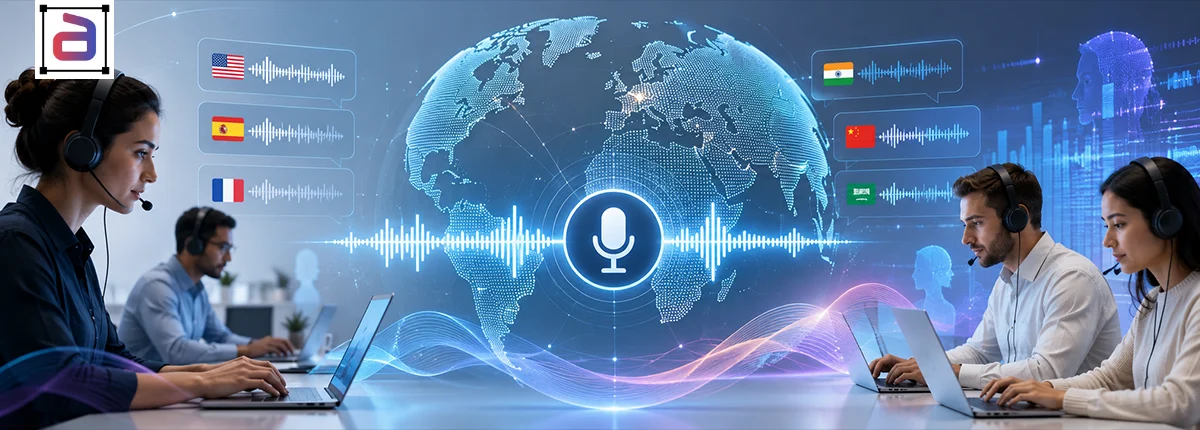
In a world where billions of people speak thousands of languages and dialects, voice AI cannot afford to understand only a select few. The future belongs to AI that listens, comprehends, and responds naturally—regardless of language, accent, or region. That future begins with high-quality speech transcription and multilingual data annotation. Dialect coverage is one of the hardest parts of building globally robust speech AI — regional audio annotation for ASR dialect robustness covers the data strategies that close performance gaps for underrepresented regional speech varieties. From intelligent virtual assistants and multilingual customer support bots to automotive voice systems and healthcare documentation, today’s AI applications rely on speech data to deliver seamless user experiences. However, scaling voice AI globally isn’t simply about collecting more audio—it’s about creating accurately annotated, linguistically diverse datasets that enable models to perform consistently across real-world scenarios. At Annotera, we empower AI innovators with enterprise-grade audio annotation services, helping organizations transform raw voice recordings into high-quality training data that fuels multilingual AI at scale.
Key Points
- Multilingual speech transcription is the foundation of global voice AI, enabling AI systems to accurately understand diverse languages, accents, dialects, and real-world conversations.
- Human-powered audio annotation services significantly improve AI accuracy by adding high-quality transcripts, timestamps, speaker labels, emotion tags, and contextual annotations that automated tools alone cannot achieve.
- Data annotation outsourcing helps organizations scale voice AI faster and more cost-effectively, providing access to multilingual experts, robust quality assurance, and flexible annotation workflows.
- Partnering with an experienced data annotation company like Annotera ensures enterprise-grade speech datasets that accelerate AI development and deliver reliable, production-ready voice applications across global markets.
Why Speech Transcription Is the Backbone of Global Voice AI
Voice AI has evolved far beyond simple speech-to-text applications. Modern AI systems are expected to understand:
- Regional accents
- Multiple languages
- Code-switching conversations
- Emotional tone
- Background noise
- Domain-specific terminology
- Natural conversational flow
None of this is possible without accurate speech transcription and comprehensive annotation. According to Grand View Research, the global speech and voice recognition market was valued at USD 20.25 billion in 2023 and is projected to grow at a compound annual growth rate (CAGR) of over 14% through 2030, driven by rapid adoption across healthcare, automotive, banking, retail, and enterprise automation. Meanwhile, Statista estimates there are now more than 8 billion digital voice assistants worldwide, highlighting how voice has become one of the primary interfaces between humans and AI. The message is clear: organizations developing global AI products need multilingual datasets that reflect how people actually speak—not how machines expect them to.
Andrew Ng, Founder of DeepLearning.AI and one of the world’s leading AI experts, famously observed:
“Rather than focusing on the code, companies should focus on the data.”
This statement perfectly captures today’s AI landscape. Even the most sophisticated speech recognition model cannot compensate for inconsistent, poorly transcribed, or biased training data. High-quality datasets remain the single biggest differentiator between average AI systems and production-ready solutions. That is why enterprises increasingly partner with a trusted data annotation company to ensure every transcript, timestamp, and label meets enterprise quality standards.
Why Multilingual Speech Annotation Is So Challenging
Creating multilingual datasets involves far more than translating spoken words. Every language carries unique phonetics, accents, cultural expressions, and conversational behaviours. Consider just a few challenges:
Regional Accents
English spoken in London differs significantly from English spoken in Mumbai, Sydney, Johannesburg, or Texas. Similar variations exist across Spanish, Arabic, French, Portuguese, Mandarin, and countless other languages. AI must learn these differences to provide reliable speech recognition.
Code-Switching
Millions of speakers naturally alternate between languages during conversations. For example:
- Hindi + English
- Spanish + English
- French + Arabic
- Mandarin + English
Capturing these transitions accurately is essential for multilingual conversational AI.
Noisy Environments
Real-world recordings rarely occur in silent environments. Datasets frequently include:
- Traffic
- Wind
- Music
- Office conversations
- Home environments
- Public transport
Proper annotation helps AI distinguish speech from environmental sounds.
Low-Resource Languages
Many regional and indigenous languages lack sufficient publicly available datasets. Human annotators play a critical role in creating high-quality corpora that expand AI accessibility across underserved linguistic communities.
Beyond Speech Transcription: What Enterprise Annotation Really Includes
High-performing voice AI depends on multiple annotation layers—not just transcripts. Professional audio annotation services typically include:
- Verbatim transcription
- Timestamp alignment
- Speaker diarization
- Language identification
- Accent classification
- Emotion annotation
- Intent labelling
- Background noise categorisation
- Named entity annotation
- Audio quality assessment
Together, these annotation layers give machine learning models richer contextual understanding, enabling more accurate predictions in production.
Why Human Expertise Still Matters
Automatic Speech Recognition (ASR) has improved dramatically, but automation alone is not enough. Machines continue to struggle with:
- Heavy accents
- Medical terminology
- Industry-specific vocabulary
- Overlapping speakers
- Poor audio quality
- Emotional speech
- Rare dialects
Human annotators resolve these ambiguities with linguistic expertise and contextual understanding that automated systems simply cannot replicate. As computer scientist and AI pioneer Fei-Fei Li has said:
“The strength of AI depends on the quality of the data that trains it.”
For organizations building global voice applications, this means human-in-the-loop validation remains essential for achieving enterprise-grade accuracy.
Why Enterprises Choose Data Annotation Outsourcing
Building multilingual annotation teams internally requires significant investments in recruitment, infrastructure, training, quality assurance, and project management. This is why many leading AI companies embrace data annotation outsourcing. Outsourcing enables organizations to:
- Scale annotation projects rapidly
- Access native-language experts
- Reduce operational costs
- Maintain consistent quality standards
- Accelerate AI development timelines
- Focus internal teams on model innovation
Instead of managing thousands of annotators across multiple geographies, businesses can rely on experienced annotation partners with established workflows and rigorous quality controls.
How Annotera Delivers Scalable Multilingual Speech Annotation
At Annotera, we understand that voice AI is only as intelligent as the data behind it. As a trusted data annotation company, we combine linguistic expertise, advanced quality assurance frameworks, and scalable delivery models to create multilingual speech datasets tailored to your AI objectives. Our audio annotation services include:
- Speech transcription
- Speaker diarization
- Timestamp annotation
- Language identification
- Accent classification
- Emotion annotation
- Intent labelling
- Audio segmentation
- Quality validation
- Custom annotation workflows
Whether your project involves thousands of customer support recordings or millions of multilingual conversations, our scalable annotation operations ensure consistent quality without compromising turnaround time. Every dataset undergoes rigorous multi-level quality assurance, enabling your speech models to perform reliably across diverse languages, accents, and environments. Regional audio annotation helps AI systems recognize accents, dialects, pronunciation, and speech patterns unique to different regions. Annotera supports diverse datasets with region-specific labeling, enabling more accurate speech recognition, transcription, voice assistants, and conversational AI across multilingual markets.
Industries Powering the Next Generation of Voice AI
Accurate speech transcription is transforming AI across industries:
- Healthcare: Clinical documentation, telemedicine, and medical dictation.
- Automotive: Voice-controlled navigation and in-car assistants.
- Customer Service: Intelligent virtual agents and multilingual contact centres.
- Financial Services: Voice authentication, compliance monitoring, and fraud detection.
- Retail & E-commerce: Conversational shopping assistants.
- Education: Language learning and AI tutoring platforms.
- Media: Automated captioning, subtitling, and content localisation.
As these applications expand globally, multilingual annotation becomes a strategic advantage—not merely an operational requirement.
Build Smarter Voice AI with Annotera
The next generation of AI will not be judged solely by how fast it responds, but by how well it understands every user, regardless of language or accent. That capability starts with exceptional training data. At Annotera, we help organizations unlock the full potential of multilingual voice AI through scalable speech transcription, expert audio annotation services, and flexible data annotation outsourcing solutions designed for enterprise AI. Whether you’re building conversational AI, automatic speech recognition systems, voice assistants, or multilingual foundation models, our experienced annotation teams ensure your datasets are accurate, diverse, and production-ready.
Ready to Scale Your Voice AI Globally?
Don’t let poor-quality training data limit your AI’s potential. Partner with Annotera to build multilingual speech datasets that improve recognition accuracy, accelerate model development, and deliver exceptional user experiences across global markets. Contact Annotera today to discover how our industry-leading audio annotation services, scalable speech transcription, and expert data annotation outsourcing solutions can help your next voice AI project succeed.
To go deeper on this topic, Speech Transcription vs Audio Annotation: Understanding the Difference for AI Training
A closely related read: Transcription Accuracy Guide to Reducing Word Error Rate.