As voice-enabled AI becomes an integral part of customer service, healthcare, automotive technology, and intelligent virtual assistants, the demand for high-quality audio data has never been greater. Yet many organizations embarking on AI projects make a critical mistake—they treat speech transcription and audio annotation as the same process. While both contribute to preparing audio datasets, they serve fundamentally different purposes. Transcription captures what was said, whereas audio annotation teaches AI how to understand what it hears. For organizations building reliable speech AI, selecting the right data preparation strategy can significantly impact model accuracy, scalability, and business outcomes.
Partnering with an experienced data annotation company like Annotera ensures your AI models learn from data that is accurate, context-rich, and production-ready. Speech Transcription vs Audio Annotation is more than a comparison of two audio processing techniques—it defines how AI learns from spoken data. While transcription captures spoken words, audio annotation enriches recordings with contextual information such as speaker identity, emotion, intent, and acoustic events, enabling AI systems to understand and respond more intelligently. Getting these labels right at scale is its own discipline, which is what our audio noise labeling services are built for.
The Growing Demand for High-Quality Audio Data
Voice AI is no longer a futuristic concept—it’s rapidly becoming part of everyday business operations. According to Grand View Research, the global speech and voice recognition market was valued at approximately USD 17.2 billion in 2023 and is expected to grow at a compound annual growth rate (CAGR) of over 14% through 2030, driven by increased adoption across healthcare, banking, automotive, retail, and smart consumer devices. Meanwhile, McKinsey & Company has consistently emphasized that organizations creating lasting AI value invest heavily in high-quality data pipelines because data quality directly influences AI performance and business impact.
That philosophy perfectly reflects today’s AI landscape. Sophisticated algorithms alone cannot compensate for poorly prepared training datasets. As voice-enabled technologies continue to evolve, the demand for high-quality audio data is rising rapidly. Consequently, organizations require accurately labeled datasets to train reliable AI models, improve speech recognition, enhance conversational intelligence, and deliver more context-aware user experiences across industries.
Understanding Speech Transcription
Speech transcription is the process of converting spoken language into written text. The objective is simple:
Transform speech into an accurate textual record.
Typical transcription projects include:
- Customer support calls
- Podcasts
- Interviews
- Medical dictation
- Court proceedings
- Online meetings
- Educational lectures
Example: Audio “I’d like to reschedule my appointment for next Monday.” Output “I’d like to reschedule my appointment for next Monday.” The transcript accurately captures the spoken words but tells us nothing about:
- Who spoke
- Their emotional state
- Background sounds
- Speaker changes
- Environmental context
- Intent
For many AI applications, that level of information simply isn’t enough. Speech transcription is the process of converting spoken language into written text with accuracy and consistency. While it forms the foundation of speech recognition systems, it primarily captures words rather than the context, emotion, or intent behind the conversation.
What Is Audio Annotation?
Audio annotation goes several steps further. Instead of only documenting spoken words, annotators enrich recordings with structured metadata that helps machine learning models understand speech, sound, and context. Audio annotation goes beyond transcription by adding meaningful labels and metadata to audio recordings. As a result, AI models can recognize speakers, emotions, intent, and environmental sounds, thereby improving their ability to understand and respond accurately in real-world scenarios.
Professional audio annotation services typically label:
- Speaker identity
- Speaker diarization
- Intent
- Emotion
- Language
- Accent
- Background noise
- Environmental sounds
- Music
- Silence
- Audio events
- Timestamp boundaries
- Sound localization
Example: Audio “I’d like to reschedule my appointment for next Monday.” Annotation Output
- Speaker: Customer
- Emotion: Calm
- Intent: Appointment Rescheduling
- Language: English
- Accent: British
- Background: Office ambience
- Timestamp: 00:03–00:07
Unlike transcription, annotation creates a multi-dimensional understanding of the recording—exactly what modern AI systems need to perform accurately in real-world environments.
Speech Transcription vs Audio Annotation
Speech Transcription vs Audio Annotation: While speech transcription converts spoken language into text, audio annotation adds contextual labels such as speaker identity, emotion, intent, and sound events, enabling AI models to interpret audio with greater accuracy and intelligence. Although both processes involve working with audio data, speech transcription and audio annotation serve different AI training objectives. Therefore, understanding their differences helps organizations choose the right approach for building accurate, context-aware, and high-performing AI models.
| Speech Transcription | Audio Annotation |
|---|---|
| Converts speech into text | Adds contextual metadata |
| Focuses on spoken words | Focuses on speech, sounds, speakers, and events |
| Supports Automatic Speech Recognition (ASR) | Supports speech understanding and audio intelligence |
| No emotion detection | Emotion labeling included |
| No intent classification | Intent classification included |
| Minimal contextual information | Rich contextual understanding |
| Limited AI training value | Comprehensive AI training data |
Think of it this way: Transcription teaches AI to read. Audio annotation teaches AI to understand.
Why Audio Annotation Is Becoming More Important
Today’s AI systems are expected to do much more than recognize words. As AI applications become increasingly sophisticated, audio annotation plays a more critical role in model training. Moreover, it provides the contextual insights needed for accurate speech understanding, enabling intelligent systems to recognize emotions, intent, speakers, and environmental sounds more effectively. As Acoustic AI continues to advance, acoustic event annotation has become increasingly important for training intelligent systems to recognize real-world sounds accurately. Moreover, high-quality audio annotation improves sound event detection, predictive maintenance, public safety monitoring, and smart city applications, enabling more reliable and context-aware AI models.
They must understand:
- Human emotions
- Customer intent
- Acoustic environments
- Multiple speakers
- Safety-critical sounds
- Contextual meaning
This is why audio annotation has become a strategic component of AI development. According to Gartner, organizations that prioritize high-quality AI data practices are significantly more likely to achieve successful AI deployments than those that overlook data quality. Accurate transcription for training AI is the foundation of effective audio annotation. By converting spoken conversations into structured text, it enables AI models to learn speech patterns, customer intent, and contextual language, improving automatic speech recognition (ASR), conversational AI, and intelligent customer support systems.
Real-World Applications
Audio annotation powers a wide range of AI applications across industries. For example, it enables systems to interpret speech, detect sound events, and understand context, thereby improving accuracy, decision-making, and user experiences in real-world environments.
Conversational AI
Conversational AI relies on accurately annotated speech data to understand user intent and dialogue context. Consequently, audio annotation helps virtual assistants and chatbots deliver more natural, responsive, and personalized interactions while improving overall communication accuracy. Virtual assistants and chatbots must understand:
- User intent
- Sentiment
- Interruptions
- Dialogue flow
- Speaker turns
Audio annotation makes these capabilities possible.
Contact Center Intelligence
Contact center intelligence leverages audio annotation to analyze customer interactions more effectively. As a result, AI can detect sentiment, intent, and agent performance, thereby enabling businesses to enhance customer satisfaction, optimize operations, and deliver more personalized support experiences.
Modern contact centers rely on AI to evaluate:
- Customer satisfaction
- Agent empathy
- Escalation risk
- Compliance
- Call intent
These insights require contextual annotations—not just transcripts.
Healthcare AI
Healthcare AI relies on accurately annotated audio data to analyze speech patterns and medical sounds. Consequently, audio annotation supports faster diagnostics, improved clinical documentation, and more reliable AI-powered healthcare applications while enhancing patient care and decision-making.
Medical AI systems analyze:
- Cough sounds
- Respiratory patterns
- Heart sounds
- Speech disorders
- Clinical conversations
Every acoustic signal contributes valuable diagnostic information.
Autonomous Vehicles
Autonomous vehicles depend on audio annotation to recognize critical sounds such as sirens, horns, and emergency alerts. Consequently, accurately labeled audio data improves situational awareness, enabling AI systems to make safer, faster, and more reliable driving decisions.
Autonomous driving systems need to distinguish between:
- Emergency sirens
- Vehicle horns
- Pedestrian warnings
- Construction activity
- Engine abnormalities
These sound events are identified through audio annotation rather than transcription.
Security & Surveillance
Security and surveillance systems rely on audio annotation to identify critical acoustic events such as alarms, gunshots, and glass breaking. As a result, AI can detect potential threats more accurately, enabling faster incident response and enhanced public safety.
AI-powered surveillance solutions detect:
- Gunshots
- Glass breaking
- Alarms
- Screams
- Explosions
- Suspicious environmental sounds
Rich annotations enable faster and more accurate event detection.
Why Human Expertise Still Matters
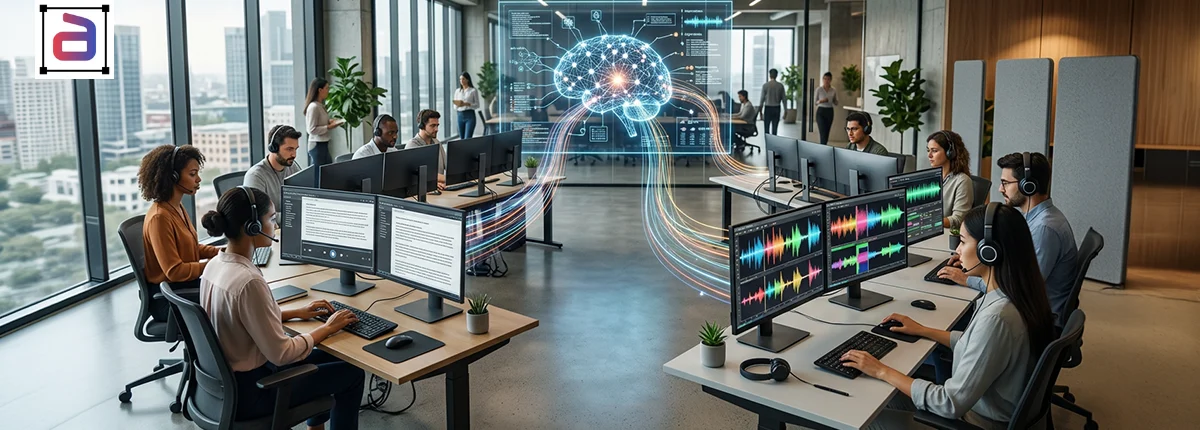
Automatic transcription technology has improved considerably, but automation alone cannot consistently interpret complex audio. Although automation has improved audio processing, human expertise remains essential for ensuring annotation accuracy and consistency. Furthermore, skilled annotators can interpret complex speech, emotions, accents, and contextual nuances that automated systems often fail to identify reliably. Although AI-powered tools have advanced significantly, human expertise remains essential for producing high-quality annotations. Moreover, skilled annotators can accurately interpret complex speech patterns, emotions, accents, and contextual nuances, ensuring reliable datasets for training robust and trustworthy AI models.
AI still struggles with:
- Heavy accents
- Cross-talk
- Overlapping speakers
- Poor recording quality
- Industry-specific terminology
- Emotional speech
- Background interference
As AI pioneer Fei-Fei Li has observed: “The strength of AI depends on the quality of the data we use to train it.”
That is why human-in-the-loop workflows remain indispensable. At Annotera, every annotation project combines trained human expertise with rigorous quality assurance processes, ensuring AI models receive consistent, accurate, and context-aware training data.
Why Businesses Choose Audio Annotation Outsourcing
Building an internal annotation team involves hiring specialists, establishing quality control processes, purchasing annotation tools, and scaling operations as data volumes grow. For most organizations, audio annotation outsourcing offers a more efficient and cost-effective path. Working with a trusted data annotation company like Annotera provides:
- Dedicated annotation specialists
- Scalable production teams
- Faster project delivery
- Human-in-the-loop validation
- Multi-language support
- Custom annotation guidelines
- Robust quality assurance
- Lower operational costs
Instead of managing complex annotation workflows internally, organizations can focus on developing AI models while experienced professionals prepare production-ready datasets. As AI datasets continue to grow, many organizations prefer audio annotation outsourcing to improve efficiency and scalability. Consequently, partnering with an experienced provider reduces operational costs while ensuring consistent quality, faster turnaround times, and access to skilled annotation professionals.
Why Annotera Is Your Trusted Audio Annotation Partner
At Annotera, we understand that successful AI starts with exceptional training data. Our specialized audio annotation services are designed to support organizations developing conversational AI, speech recognition systems, healthcare applications, automotive technologies, security solutions, and multilingual language models. Our expertise includes:
- Speech transcription
- Speaker diarization
- Emotion and sentiment labeling
- Intent classification
- Sound event detection
- Timestamp annotation
- Multi-speaker segmentation
- Language and accent annotation
- Human quality assurance
- Custom annotation workflows tailored to your AI objectives
Whether you’re training a next-generation voice assistant or building sophisticated audio analytics solutions, Annotera delivers scalable, high-quality datasets that accelerate AI development while maintaining exceptional accuracy. At Annotera, we combine industry expertise with rigorous quality assurance to deliver reliable audio annotation services. Moreover, our scalable, human-in-the-loop approach ensures high-quality training data that helps organizations build accurate, robust, and production-ready AI solutions.
Conclusion
Speech transcription and audio annotation may appear similar, but they solve very different challenges in AI development. Transcription captures spoken words, while audio annotation adds the contextual intelligence that enables AI systems to interpret intent, emotion, speakers, and environmental sounds. As voice technologies continue to reshape industries, investing in expertly annotated audio data is no longer optional—it’s a competitive necessity. By partnering with Annotera, businesses gain access to trusted audio annotation services, flexible audio annotation outsourcing, and the expertise of a leading data annotation company committed to delivering high-quality datasets that power smarter, more reliable AI.
Whether you’re developing speech recognition systems, conversational AI, healthcare applications, or intelligent audio analytics, Annotera is here to help you transform raw audio into high-quality training data. Contact Annotera today to discover how our scalable data annotation outsourcing solutions and expert audio annotation services can accelerate your AI initiatives, improve model accuracy, and help you bring production-ready AI to market with confidence.
For more on this, the full picture of audio and speech annotation.
A closely related read: Speech Transcription at Scale.