Artificial intelligence doesn’t watch the world one frame at a time—it understands motion, context, and continuity. Whether it’s an autonomous vehicle detecting pedestrians, a warehouse robot navigating obstacles, or a surveillance system tracking suspicious activity, AI must interpret events as they unfold over time. That’s precisely why temporal consistency has become one of the defining factors of high-quality video annotation services. The event tracking techniques Temporal continuity in bounding boxes is the specific challenge covered in temporal continuity in video bounding boxes. The event tracking techniques and temporal segmentation strategies that underpin that consistency at scale are explored in event tracking techniques for scalable video annotation.
At Annotera, we believe that accurate video annotation is more than drawing bounding boxes around moving objects. It is about preserving context, maintaining identity, and ensuring every annotation remains consistent across thousands of video frames. Without temporal consistency, even the most sophisticated AI models struggle to make reliable predictions in real-world environments. As organizations increasingly invest in computer vision, partnering with an experienced data annotation company has become essential for building datasets that deliver production-ready AI.
Key Points
- Temporal consistency is essential for accurate computer vision. Maintaining consistent annotations across video frames improves object tracking, motion prediction, and overall AI model performance while reducing errors like identity switching and annotation drift.
- High-quality video annotation directly impacts AI success. As industries increasingly adopt computer vision, consistent and accurate video annotation services provide the reliable training data needed for autonomous vehicles, robotics, surveillance, healthcare, and other AI applications.
- Human expertise combined with AI ensures annotation quality. Annotera leverages AI-assisted workflows, human-in-the-loop validation, standardized guidelines, and multi-level quality assurance to deliver temporally consistent, enterprise-grade datasets.
- Partnering with an experienced data annotation company accelerates AI development. Through scalable data annotation outsourcing, Annotera helps organizations reduce operational complexity while delivering high-quality video annotation datasets that improve model accuracy and speed up deployment.
Why Video Annotation Is More Challenging Than Image Annotation
Unlike images, videos contain an additional dimension—time. A single minute of high-definition video can contain more than 1,800 individual frames. Every object in those frames may change its position, size, orientation, visibility, and interactions with other objects. Annotators must ensure these changes are accurately reflected while maintaining consistency throughout the sequence. For AI, video annotation services are not a collection of independent images. It is a continuous story. If annotations suddenly shift, object IDs change unexpectedly, or segmentation masks flicker between frames, the model learns inconsistent patterns that directly impact performance. This is why temporal consistency is not simply a quality metric—it is the foundation of reliable computer vision datasets.
What Is Temporal Consistency?
Temporal consistency refers to maintaining stable, accurate, and logically connected annotations across consecutive video frames. For example:
- A pedestrian identified in frame one should retain the same identity throughout the sequence.
- A vehicle’s bounding box should move naturally instead of jumping between positions.
- Segmentation masks should evolve smoothly as objects move.
- Keypoints and skeletal landmarks should remain stable during human movement.
Rather than annotating isolated frames, temporal consistency preserves the continuity of objects throughout an entire video. The principle applies across:
- Object Tracking
- Bounding Box Annotation
- Polygon Annotation
- Semantic Segmentation
- Instance Segmentation
- Pose Estimation
- Action Recognition
- Lane Detection
- Human Activity Recognition
Why Temporal Consistency Matters for Computer Vision
AI models learn from patterns. If the training data contains inconsistencies, the model begins learning incorrect representations of movement and object behavior. The result is:
- Identity switching
- Poor object tracking
- Motion prediction errors
- Detection instability
- Reduced inference accuracy
- Increased false positives
Conversely, temporally consistent annotations enable AI to understand movement the way humans naturally perceive it. As renowned AI researcher Andrew Ng famously observed:
“Data is food for AI.”
Just as poor-quality ingredients produce poor-quality meals, inconsistent annotation produces unreliable AI models. High-quality data is not simply about volume—it is about precision and consistency.
Industry Trends Highlight the Need for Better Video Annotation
The growing demand for video intelligence is driving unprecedented investment in annotation quality. According to Grand View Research, the global computer vision market is expected to exceed USD 58 billion by 2030, fueled by adoption across automotive, healthcare, retail, manufacturing, and logistics. Meanwhile, MarketsandMarkets projects the video analytics market to surpass USD 22 billion by 2028, reflecting the increasing reliance on AI-powered video understanding across industries. Perhaps even more revealing is a widely cited insight from Google Research:
“Improving data quality frequently produces larger performance gains than increasing model complexity.”
For enterprises building production AI, these findings reinforce a simple truth: annotation quality directly determines model quality.
Common Annotation Problems Without Temporal Consistency
Object Identity Switching
Imagine a pedestrian receiving ID #15 in one frame and ID #27 in the next. Tracking algorithms interpret this as two different individuals, degrading model accuracy.
Bounding Box Flickering
Bounding boxes that continuously resize or shift despite stable object movement introduce unnecessary noise into the dataset.
Segmentation Instability
Segmentation masks that fluctuate between frames create unrealistic object boundaries, confusing segmentation models.
Occlusion Errors
Objects frequently disappear behind obstacles before reappearing. Maintaining the same identity after occlusion is essential for realistic tracking datasets.
Annotation Drift
Over long video sequences, annotations can gradually shift away from object boundaries if not regularly validated. Professional quality assurance prevents this cumulative error.
How Annotera Maintains Temporal Consistency
At Annotera, temporal consistency is built into every stage of our annotation workflow.
Human-in-the-Loop Validation
Automation accelerates repetitive tasks, but experienced annotators review every complex sequence involving motion blur, occlusions, dense traffic, or overlapping objects. Human expertise ensures context is never lost.
AI-Assisted Object Tracking
Advanced tracking tools automatically propagate annotations across frames while human reviewers verify every transition for accuracy. This hybrid workflow improves both speed and precision.
Standardized Annotation Guidelines
Consistency begins with clear standards. Every Annotera project includes comprehensive annotation guidelines covering:
- Object definitions
- Label hierarchy
- Identity assignment
- Occlusion handling
- Truncation rules
- Edge cases
- Boundary placement
This minimizes subjective interpretation between annotators.
Multi-Level Quality Assurance
Our review process includes multiple validation stages to detect:
- Identity inconsistencies
- Bounding box drift
- Missing annotations
- Frame skipping
- Segmentation instability
- Temporal anomalies
Every dataset undergoes rigorous inspection before delivery.
Industries That Depend on Temporally Consistent Annotation
Autonomous Driving
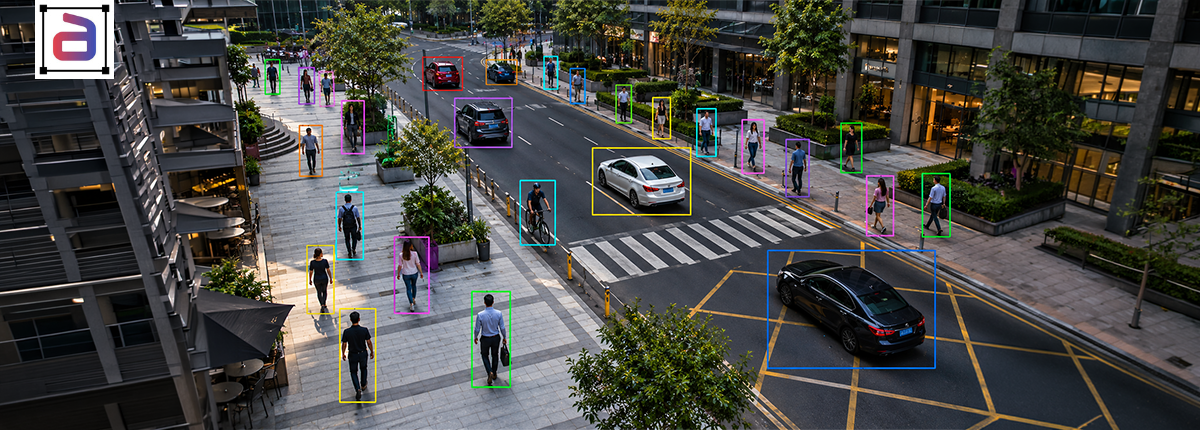
Self-driving vehicles must continuously track pedestrians, cyclists, vehicles, traffic lights, and road infrastructure across thousands of frames. Stable annotations improve object tracking and trajectory prediction.
Intelligent Surveillance
Security AI analyzes behavioral patterns rather than isolated images. Temporal consistency enables accurate people tracking and event detection.
Robotics
Warehouse robots and industrial automation systems rely on continuous perception to navigate safely around dynamic environments.
Healthcare AI
Medical imaging videos—including endoscopy and ultrasound—require consistent annotations to identify anatomical structures throughout procedures.
Sports Analytics
Player tracking, tactical analysis, and pose estimation all depend on uninterrupted object identities throughout entire matches.
Why Businesses Choose Annotera
Building enterprise-grade computer vision datasets requires more than annotation software. It requires a strategic annotation partner with scalable infrastructure, domain expertise, and uncompromising quality standards. As a trusted data annotation company, Annotera delivers:
- Expert-led video annotation services
- Human-in-the-loop quality assurance
- AI-assisted annotation workflows
- Highly scalable production teams
- Domain-specific annotation expertise
- Customized annotation guidelines
- Rapid turnaround without compromising quality
Organizations worldwide also rely on our data annotation outsourcing solutions to reduce operational overhead while accelerating AI development. Whether you’re training autonomous vehicles, surveillance systems, healthcare AI, or intelligent robotics, Annotera provides the high-quality datasets your models need to perform confidently in real-world scenarios.
The Competitive Advantage of Temporal Consistency
As computer vision models become increasingly sophisticated, the margin for annotation errors becomes increasingly small. Temporal consistency ensures that AI learns from realistic object behavior instead of noisy or disconnected labels. It reduces model confusion, improves tracking accuracy, strengthens motion prediction, and ultimately delivers more dependable AI systems. For organizations investing in enterprise AI, annotation quality is no longer just an operational task—it is a strategic advantage. At Annotera, we combine advanced annotation technologies with experienced human expertise to deliver temporally consistent datasets that power reliable computer vision applications at scale.
Ready to Build Better Computer Vision Models?
High-performing AI begins with high-quality training data. If your project requires accurate, scalable, and temporally consistent video annotation services, Annotera is ready to help. Our expert teams combine cutting-edge annotation tools, rigorous quality assurance, and deep industry expertise to create datasets that improve model accuracy and accelerate deployment.
Partner with Annotera today to transform your video data into high-quality training datasets that power the next generation of computer vision AI. Contact us today to learn how our data annotation outsourcing solutions can help your AI projects scale faster with confidence.
To go deeper on this topic, read ‘Why Temporal Video Annotation Is Critical for Action Recognition Models.’
A closely related read: Lane Detection Annotation Services for Autonomous Vision AI.