Autonomous driving technology is redefining the future of transportation. From intelligent lane detection to real-time pedestrian tracking, AI-powered vehicles are becoming increasingly capable of navigating complex environments with minimal human intervention. However, the success of these systems depends on one critical factor: the quality and precision of training data. Among the most advanced techniques used in computer vision today, video polygon annotation has become essential for improving the accuracy and reliability of autonomous driving AI. As self-driving systems evolve, automotive companies increasingly rely on Annotera to deliver the high-quality datasets required for safe and scalable AI deployment.
Key Points
- Polygon annotation in autonomous driving captures precise object boundaries — critical for lane geometry, obstacle clearance, and pedestrian proximity calculations.
- Pixel-accurate polygon labels for moving objects across video frames require annotators to adjust boundaries as objects rotate, deform, or partially occlude.
- Bounding boxes are insufficient for autonomous driving perception where knowing the exact edge of a vehicle or pedestrian determines safe stopping distance.
- Video polygon annotation programs for AV training require strict inter-annotator agreement monitoring because boundary errors accumulate across consecutive frames.
Table of Contents
Why Precision Matters in Autonomous Driving
Autonomous vehicles operate in unpredictable, high-risk environments where even minor detection errors can create significant safety concerns. AI models must recognize pedestrians, cyclists, traffic signs, lane markings, road barriers, and moving vehicles in real time while processing thousands of visual inputs every second. According to McKinsey & Company, advanced driver assistance systems and autonomous driving technologies could significantly reduce road accidents in the coming years, provided that perception systems achieve near-human accuracy. This is precisely where annotation quality becomes critical.
“Many companies are spending more time cleaning and labeling data than building AI models.” — Andrew Ng, Founder of DeepLearning.AI
The statement highlights a fundamental truth in AI development: even the most sophisticated algorithms cannot compensate for poor-quality training data.
What Is Video Polygon Annotation?
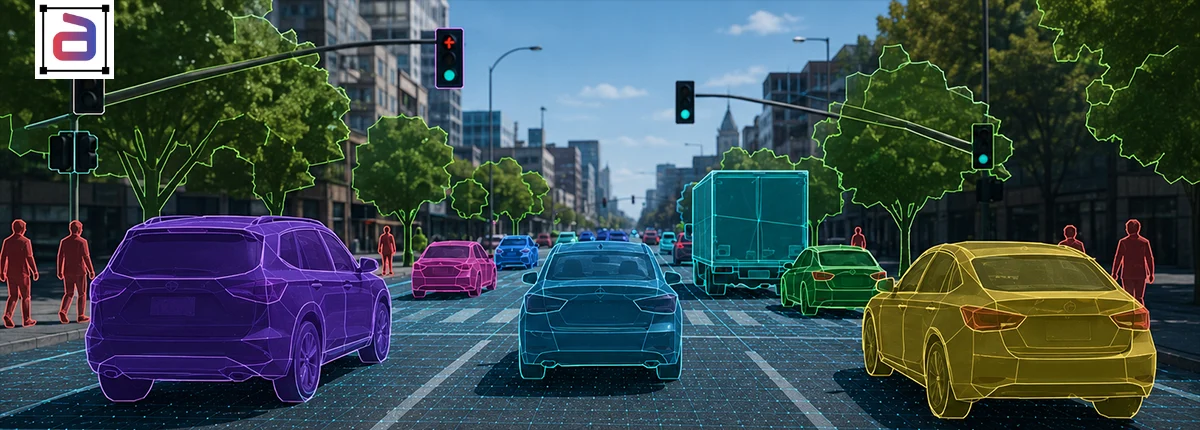
Video polygon annotation is an advanced image labeling technique used to outline objects with highly precise polygon shapes across video frames. Unlike traditional bounding boxes, polygon annotations closely follow the exact contours of objects, making them ideal for complex and irregular shapes commonly found in road environments. For autonomous driving AI, polygon annotation is used to label: Alongside polygons, drivable paths rely on lane detection with polylines.
- Vehicles
- Pedestrians
- Traffic lights
- Lane markings
- Road signs
- Construction barriers
- Cyclists
- Curbs and sidewalks
Because autonomous vehicles rely heavily on semantic segmentation and object detection, polygon-level precision helps AI systems interpret visual scenes with far greater accuracy. At Annotera, our annotation specialists create frame-by-frame polygon annotations that support high-performance perception models for automotive AI applications.
How Video Polygon Annotation Enhances AI Precision
Accurate Object Boundary Detection
Road environments are dynamic and visually complex. Objects frequently overlap, appear partially obscured, or move rapidly through scenes. Traditional rectangular bounding boxes often fail to capture these nuances effectively. Polygon annotation solves this challenge by tracing the exact boundaries of objects. This allows AI models to distinguish between nearby or overlapping entities with significantly higher precision. For example, separating a pedestrian from a bicycle or identifying lane boundaries during heavy traffic requires pixel-level accuracy that polygon annotation provides exceptionally well. As a result, autonomous systems become more reliable in:
- Collision avoidance
- Object recognition
- Road-edge detection
- Urban navigation
- Pedestrian safety analysis
Improved Semantic Segmentation Performance
Semantic segmentation is one of the most important components of autonomous driving AI. It enables the vehicle to classify every pixel within an image into categories such as road, vehicle, pedestrian, or obstacle. Polygon annotation directly improves semantic segmentation models because it provides highly detailed training data rather than approximate object locations. According to researchers at NVIDIA, high-quality annotated datasets remain one of the most important factors influencing deep learning performance in autonomous systems. Consequently, vehicles trained using polygon-annotated video data achieve better environmental understanding and safer real-time decision-making.
Better Tracking Across Video Frames
Unlike static image annotation, video polygon annotation captures object movement across sequential frames. This temporal continuity is essential for autonomous driving because vehicles must predict how surrounding objects move over time. For example:
- A cyclist may temporarily disappear behind a truck
- A pedestrian may move unpredictably across lanes
- A vehicle may change direction suddenly at an intersection
Video polygon annotation helps AI models maintain tracking consistency despite these visual interruptions. This significantly improves:
- Motion prediction
- Trajectory estimation
- Multi-object tracking
- Navigation planning
Therefore, autonomous systems trained with video polygon datasets become more adaptive in real-world driving environments.
The Growing Demand for Specialized Annotation Services
The autonomous vehicle industry is growing rapidly, and so is the demand for high-quality annotation support. According to Statista, the global autonomous vehicle market is projected to surpass trillions of dollars in value over the next decade. However, scaling annotation operations internally remains challenging for many automotive companies. Managing large datasets, maintaining consistency, and meeting aggressive AI development timelines often require dedicated annotation expertise. This has accelerated the adoption of data annotation outsourcing across the AI industry. As an experienced data annotation company, Annotera helps businesses scale annotation workflows efficiently while maintaining strict quality standards. Our teams combine human expertise with AI-assisted workflows to deliver accurate annotations for complex autonomous driving datasets.
Why Human Expertise Still Matters
Although automation tools continue to improve, human oversight remains essential for ensuring annotation quality. AI-assisted labeling systems can accelerate polygon creation, but skilled human annotators are still needed to:
- Validate object boundaries
- Handle occluded objects
- Correct segmentation errors
- Maintain frame consistency
- Review edge-case scenarios
“The real-world data problem is one of the biggest bottlenecks in AI.” — Fei-Fei Li, Co-Director of Stanford’s Human-Centered AI Institute
This is especially true in autonomous driving, where annotation precision directly impacts road safety and model reliability. At Annotera, our quality assurance workflows ensure every annotation project meets the demanding standards required for automotive AI systems.
Beyond Vision AI: The Role of Video Annotation
Modern autonomous systems increasingly integrate multimodal AI capabilities, combining computer vision with natural language processing and conversational intelligence. As a trusted video annotation company, Annotera also supports AI development through:
- Intent annotation
- Named entity recognition
- Conversational AI training
- Sentiment analysis
- Knowledge extraction
Consequently, organizations often combine visual annotation with video annotation outsourcing to build more comprehensive intelligent systems. Whether businesses require large-scale polygon annotation or advanced NLP training datasets, Annotera provides scalable and flexible solutions tailored to enterprise AI initiatives.
Why Businesses Choose Annotera
Annotera delivers industry-focused annotation services designed for high-performance AI applications. Our automotive annotation expertise includes:
- Video polygon annotation
- Semantic segmentation
- Object tracking
- Lane annotation
- Sensor fusion labeling
- Traffic sign annotation
As a reliable data annotation company, we prioritize:
- Annotation accuracy
- Scalable operations
- Rapid project turnaround
- Secure data handling
- Human-in-the-loop quality assurance
Additionally, our flexible data annotation outsourcing and video annotation outsourcing services help businesses reduce operational overhead while accelerating AI deployment timelines.
The Future of Autonomous Driving Starts with Better Data
Autonomous driving AI is only as effective as the data used to train it. As vehicles become smarter and road environments grow more complex, precise annotation will continue to play a foundational role in AI performance and safety. Video polygon annotation provides the accuracy needed for advanced perception systems to interpret real-world environments reliably. From semantic segmentation to motion tracking, this annotation method enables autonomous vehicles to make safer and more intelligent decisions. At Annotera, we help businesses build next-generation AI systems through precise, scalable, and enterprise-grade annotation solutions. Ready to Improve Your Autonomous Driving AI? Partner with Annotera to access high-quality polygon annotation, semantic segmentation, and AI data services tailored for autonomous vehicle development. Contact our experts today to accelerate your AI training workflows with precision-driven annotation solutions.
A closely related read: How To Label Human Actions in Video Datasets For AI Models.
A closely related read: 2D vs 3D Video Annotation: Which One Does Your AI Model Need?.