Artificial intelligence has become remarkably good at understanding digital information. It can interpret text, recognize images, generate code, and analyze enormous volumes of data. But the physical world presents a fundamentally different challenge. A robot cannot simply recognize a cup. It needs to understand that the cup is an object that can be grasped, that it occupies physical space, that it may break if dropped, and that moving it changes the state of the surrounding environment. This is the challenge of Physical AI—and increasingly, the answer begins with video.
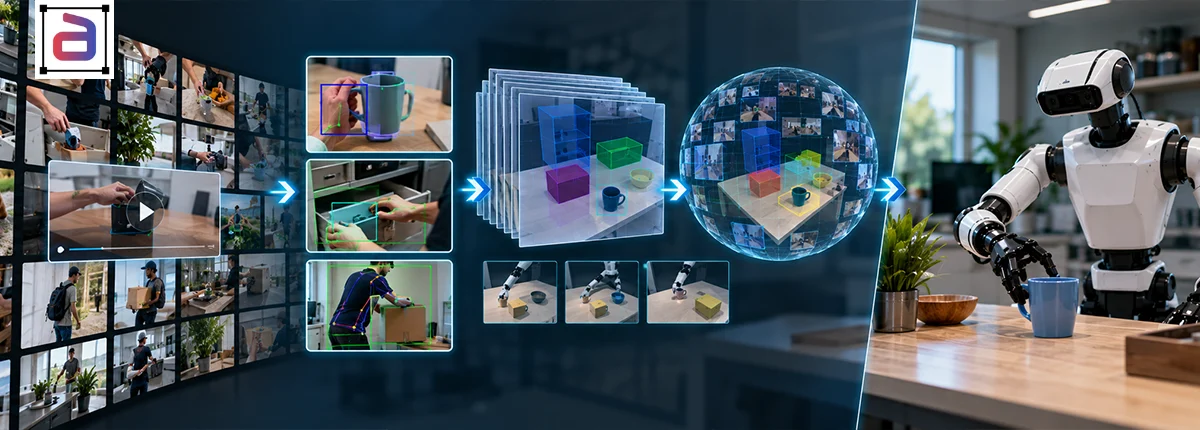
As robotics companies seek to build systems capable of perceiving, predicting, and acting in dynamic environments, internet and in-the-wild video are emerging as valuable sources of training data. Yet raw video alone is not enough. It must be intelligently selected, filtered, structured, and annotated so that AI models can learn meaningful representations of the physical world. This is where world model data curation becomes a critical component of the Physical AI pipeline.
“The world holds billions of hours of internet video but only a few hundred thousand hours of real robot manipulation data.”
The opportunity is enormous—but unlocking it requires the right data infrastructure. Annotera helps organizations transform unstructured visual information into high-quality, AI-ready datasets designed for the next generation of intelligent machines.
Key Points
- Curating and annotating internet and real-world videos helps AI models understand objects, actions, motion, causality, and changes in physical environments.
- Filtering unrealistic content and capturing physics-consistent motion, object permanence, causal relationships, and scene-state changes creates reliable training data for robotic systems.
- Robot preference annotation and RLHF for Physical AI help robots learn which behaviors are safer, smoother, more efficient, and better aligned with human expectations.
- As an experienced data annotation company, Annotera provides scalable annotation and data annotation outsourcing solutions that help robotics teams transform complex multimodal data into high-quality AI training datasets.
What Are World Models and Why Do Robots Need Them?
A world model is essentially an AI system’s internal representation of how the world works. For Physical AI, that means understanding more than what an object looks like. A useful world model should capture relationships between objects, actions, environments, movement, and consequences. Imagine a robot observing someone placing a plate on a kitchen counter. A conventional computer vision system might identify the person, plate, and counter. A world model needs to go further. It should understand:
- The person reaches toward the plate.
- The hand makes contact with the object.
- The plate moves with the hand.
- The plate remains present even when partially occluded.
- The counter provides a stable supporting surface.
- Releasing the plate changes the scene state.
These relationships help a robot predict what is likely to happen before it acts. Research and industry developments increasingly point toward learning physical-world representations from video. AWS, for example, describes approaches that extract scene semantics from ordinary monocular video rather than relying exclusively on robot-specific datasets. The implication is significant: video can become a source of physical knowledge—but only when the right information is extracted from it.
Why Raw Internet Video Is Not Enough
The internet contains an extraordinary diversity of video. People cook, drive, build furniture, operate machinery, play sports, clean homes, handle tools, and interact with thousands of different objects. For Physical AI developers, this represents an enormous potential training corpus. But there is a fundamental problem: not every video teaches useful physical intelligence. Videos may contain:
- CGI and special effects
- Physically unrealistic movements
- Duplicate or irrelevant footage
- Poor visibility and camera artifacts
- Incomplete actions
- Ambiguous object interactions
- Context that is difficult for models to interpret
A world model trained indiscriminately on such content could learn incorrect assumptions about how objects move and interact. That makes data curation—not simply data collection—a strategic requirement. Annotera’s world model curation approach focuses on filtering internet and in-the-wild video for physical plausibility and labeling information such as object permanence, causal relationships, physics-consistent motion, and scene-state changes.
From Video Footage to Physical Understanding
Effective world model curation transforms raw footage into structured learning signals.
1. Physical Plausibility Filtering
The first question is simple: Does the video represent physically plausible behavior? Footage can be screened for unrealistic motion, visual artifacts, CGI, or other content that could teach a model incorrect physical relationships. This step matters because a world model is ultimately learning expectations about reality.
2. Object Permanence
Objects do not cease to exist simply because they disappear behind another object. Consider a robot reaching for a box that becomes temporarily occluded. The robot must maintain an understanding that the box still exists and predict where it may reappear. Object permanence annotation helps capture these continuity relationships across video sequences.
3. Causal Relationship Annotation
Physical intelligence requires understanding cause and effect. If someone pushes a chair, the chair moves. If a container is tipped, its contents may fall. An object collides with another object, the resulting movement depends on contact and physical properties. Annotating these causal relationships helps world models move beyond recognizing what happened toward understanding why it happened.
4. Physics-Consistent Motion
Gravity, momentum, friction, collisions, and contact all influence real-world movement. Annotators can identify whether motion sequences are physically plausible and capture relevant dynamics. These signals can help models learn which future states are possible—and which are not.
5. Scene-State Changes
Physical actions transform environments. A drawer that was closed becomes open. An object that was on a table is picked up. A tool moves from one location to another. Annotating before-and-after scene states provides valuable information about how actions change the physical environment.
Where Robot Preference Annotation Fits In
World models help robots understand and predict the world. But robots also need to learn which actions are better. This is where robot preference annotation becomes valuable. Suppose two robot trajectories successfully pick up an object. One movement is smooth, efficient, and maintains a safe distance from nearby objects. The other is unnecessarily fast and risks collision. Both may technically succeed, but they are not equally desirable. Human preference data can communicate this distinction to AI systems. Annotators can compare candidate behaviors and identify preferences based on criteria such as safety, efficiency, precision, smoothness, task success, and human expectations. This creates a bridge between physical-world understanding and behavioral alignment.
RLHF for Physical AI: Teaching Robots What Good Looks Like
The same principle extends into RLHF for Physical AI. Traditional reinforcement learning can optimize clearly measurable outcomes. Physical environments, however, often involve softer objectives. A robot may need to learn that:
- safer is better than merely faster;
- smoother movements are preferable to jerky ones;
- avoiding unnecessary contact is desirable;
- successful completion should not come at the cost of environmental damage.
Human feedback can help define these preferences.
“The quality of the filtered corpus determines the ceiling on what the world model can learn about physics from pretraining.”
This highlights a broader reality: sophisticated robotics models require sophisticated training data.
Why the Right Data Annotation Company Matters
The complexity of Physical AI datasets makes generic labeling workflows insufficient. Robotics data can involve temporal relationships, object interactions, motion trajectories, spatial context, sensor information, demonstrations, and human preferences. Annotation teams need to understand the purpose behind the labels—not merely follow instructions mechanically. This is where partnering with an experienced data annotation company can provide an advantage. Annotera brings dedicated annotation specialists, domain-focused workflows, and multi-layer quality assurance to complex AI training projects. Its robotics services cover areas including manipulation data, scene understanding, pose estimation, multi-sensor data, and human preference ranking. For organizations managing large-scale datasets, data annotation outsourcing can also provide the workforce and operational flexibility needed to scale without building an entire annotation organization internally. Annotera combines this scalability with dedicated teams rather than relying solely on crowdsourced labeling. Its broader annotation operation reports 1,500+ trained specialists, 10M+ annotated assets, and a multi-level QA framework.
Annotera: Building the Data Layer Behind Physical Intelligence
The future of robotics will not be determined by algorithms alone. It will depend on whether AI systems have access to sufficiently diverse, accurate, structured, and physically meaningful data. That is why Annotera approaches Physical AI annotation as data infrastructure, rather than simply a labeling task. From world model video curation and physics-aware annotation to robot preference annotation and RLHF for Physical AI, Annotera helps robotics and AI teams convert complex multimodal information into training data that models can actually learn from. The goal is straightforward: turn the enormous visual knowledge contained in the real world into structured intelligence for machines.
Turn the World’s Videos Into Training Data for the Next Generation of Robots
The journey from internet video to robot intelligence is not automatic. Between raw footage and an intelligent robot lies a sophisticated data pipeline involving selection, filtering, annotation, quality assurance, and human feedback. Organizations that build this layer effectively can give their Physical AI systems a stronger foundation for perception, prediction, planning, and action. Annotera is helping build that foundation. Whether you are developing humanoid robots, autonomous systems, robotic manipulation models, or next-generation world models, the quality of your training data can determine how effectively your AI performs in the real world. Ready to turn your video data into physical intelligence? Partner with Annotera to build scalable, high-quality training datasets for your Physical AI and robotics programs. Get in touch with Annotera today and start building the data foundation behind your next generation of intelligent machines.