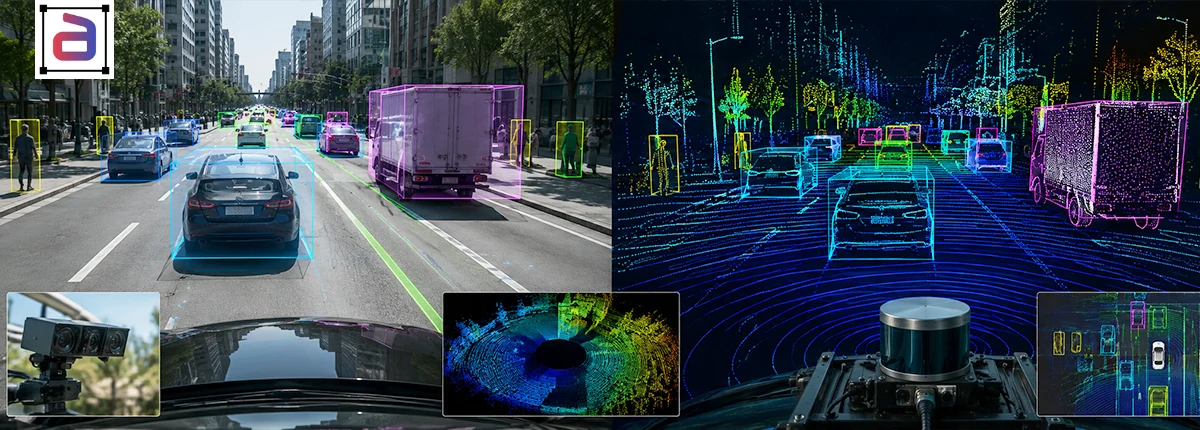
Autonomous systems do not simply need to recognize objects—they need to understand where those objects are, how large they are, how they are oriented, and how they move through the environment. That requires training data capable of representing the physical world in three dimensions. This is where 3D cuboid annotation and sensor fusion become critical. Cameras deliver rich visual information, while LiDAR provides precise depth and spatial measurements. When these modalities are synchronized and accurately annotated, they create a more complete representation of the environment for autonomous vehicles, ADAS platforms, robotics systems, and other intelligent machines. LiDAR Sensor Fusion combines LiDAR’s precise 3D spatial data with video’s rich visual information, enabling autonomous systems to understand objects, distances, movement, and surroundings more accurately. This multimodal approach creates reliable training data for advanced perception and decision-making.
As autonomous technology moves from controlled demonstrations toward complex real-world environments, the quality of this multimodal training data can become a decisive factor in model performance. For organizations developing these systems, the challenge is no longer simply collecting more data. It is creating high-quality, synchronized, and consistently labeled data at scale. For multi-sensor setups, this extends naturally into 3D cuboid annotation for LiDAR and sensor fusion.
Key Points
- 3D cuboids provide autonomous systems with precise information about an object’s position, dimensions, orientation, and movement in three-dimensional space.
- Combining video’s visual and temporal context with LiDAR’s depth and spatial information helps AI models build a more comprehensive understanding of complex environments.
- Accurate camera-LiDAR alignment and consistent annotation support critical applications such as object detection, multi-object tracking, motion prediction, collision avoidance, and navigation.
- Data annotation outsourcing and specialized video annotation companies like Annotera help organizations scale 3D, LiDAR, and multimodal annotation while maintaining quality and consistency.
What Is 3D Cuboid Annotation?
A 3D cuboid is a three-dimensional bounding box used to represent an object’s location, dimensions, and orientation in physical space. Unlike a conventional 2D bounding box, which identifies an object within an image, a 3D cuboid captures attributes such as:
- Length, width, and height
- X, Y, and Z position
- Object orientation and heading
- Visibility and occlusion
- Object category
- Tracking identity across frames
For example, a 2D annotation might tell an autonomous vehicle that a car is visible ahead. A 3D cuboid can provide the additional spatial information needed to determine how far away that car is, its approximate dimensions, and its orientation relative to the ego vehicle. This depth-aware representation is fundamental to perception tasks such as object detection, localization, tracking, trajectory prediction, and collision-risk assessment. Annotera’s 3D cuboid annotation workflows support LiDAR, camera, stereo vision, and multimodal perception systems, helping AI teams build structured spatial training datasets.
“Autonomy depends on perception that is both visually rich and spatially precise.”
Why Sensor Fusion Matters for Autonomous Systems
No single sensor provides a perfect representation of the physical environment. Cameras excel at capturing color, texture, road markings, traffic signs, lane information, and contextual visual cues. LiDAR, by contrast, generates three-dimensional point clouds that provide valuable information about distance, shape, and spatial structure. The combination is powerful. A camera might identify an object as a pedestrian based on its visual appearance, while LiDAR can help determine its distance and three-dimensional position. When the two streams are accurately synchronized, an AI model can learn the relationship between visual characteristics and spatial geometry. This is the foundation of camera-LiDAR sensor fusion. Annotera’s multimodal workflows support cross-sensor correspondence, including alignment between LiDAR 3D cuboids and camera imagery.
“The goal of sensor fusion is not simply to combine sensors. It is to create a coherent understanding from different views of the same world.”
How Video and LiDAR Work Together
Video adds an important temporal dimension to 3D perception. A single LiDAR frame can show where an object is at one moment. A sequence of synchronized video and LiDAR data can show how that object moves over time. Consider a cyclist approaching an intersection. Across consecutive frames, the annotation system can maintain the cyclist’s identity while updating the cuboid’s position and orientation. The resulting dataset can help models learn movement patterns rather than treating every frame as an isolated observation. This supports applications including:
- Multi-object tracking
- Motion prediction
- Pedestrian behavior analysis
- Collision avoidance
- Path planning
- Autonomous navigation
- Traffic-scene understanding
Annotera’s 3D cuboid video annotation workflows are designed to maintain spatial and temporal consistency across frames, including handling occlusion, truncation, perspective changes, and moving objects.
The Role of 3D Cuboids in Sensor-Fusion Training
The real value of 3D cuboid annotation emerges when labels create explicit correspondence between modalities. An object identified in a camera frame should correspond to the appropriate cluster of LiDAR points. Its 3D cuboid should represent the same physical object, with consistent dimensions and orientation. This provides models with structured ground truth for learning relationships between: Pixels → Point Clouds → Objects → Spatial Position → Movement Accurate correspondence is especially important in complex environments where objects overlap or are partially hidden. For instance, when a vehicle is partially occluded by a truck, camera imagery may provide clues about its visible appearance, while LiDAR can contribute spatial information about its position and geometry. A carefully defined cuboid allows both signals to contribute to the training process.
Key Challenges in 3D Cuboid Annotation
1. Sparse Point Clouds
LiDAR point clouds become increasingly sparse as objects move farther from the sensor. Small or distant objects may therefore be difficult to define precisely.
2. Occlusion and Truncation
Vehicles, pedestrians, and cyclists can disappear behind other objects. Annotation guidelines must specify how partially visible objects should be represented.
3. Sensor Calibration
Camera-LiDAR alignment depends on accurate calibration. Even relatively small alignment errors can affect cross-modal correspondence.
4. Temporal Synchronization
Video and LiDAR streams must correspond to the same moments in time. Poor synchronization can create apparent positional errors, particularly when objects are moving quickly.
5. Orientation Accuracy
A cuboid’s dimensions alone are insufficient. Heading and rotation must also be represented consistently to support reliable spatial reasoning. These challenges make multimodal annotation substantially more demanding than standard image labeling.
Why Video Annotation Outsourcing Can Help
Building an internal team capable of handling large volumes of complex video, LiDAR, and sensor-fusion data can require significant investment in recruitment, training, infrastructure, annotation platforms, and quality assurance. Video annotation outsourcing allows organizations to access specialized annotation capacity without building every capability internally. A qualified video annotation company can provide trained teams, standardized labeling guidelines, temporal consistency checks, and multi-stage quality control for complex video datasets. For autonomous systems developers, outsourcing can also make it easier to scale projects as data requirements grow—from pilot datasets to production-scale training programs.
Choosing the Right Data Annotation Company
Not every annotation provider has the expertise required for 3D and multimodal AI. When evaluating a data annotation company, autonomous technology teams should consider:
- Experience with LiDAR and point-cloud annotation
- 3D cuboid and object-tracking capabilities
- Camera-LiDAR correspondence workflows
- Temporal video annotation expertise
- Quality assurance and reviewer processes
- Support for custom schemas and formats
- Data security and governance
- Ability to scale without compromising consistency
Annotera combines 3D annotation, LiDAR labeling, video annotation, and multi-sensor fusion capabilities within integrated workflows. Its services support autonomous vehicles, robotics, and other AI applications requiring spatially precise training data.
How Annotera Supports Production-Ready Sensor-Fusion Data
Annotera approaches multimodal annotation as a connected data problem rather than a collection of isolated labeling tasks. Its workflows can synchronize and annotate RGB, depth, LiDAR, and other sensor streams while maintaining cross-modal consistency. For autonomous systems, this can include:
- 3D cuboid annotation
- LiDAR point-cloud labeling
- Camera-LiDAR correspondence
- Multi-object tracking
- Temporal annotation
- Occlusion and truncation handling
- Spatial and temporal quality validation
The objective is straightforward: transform complex sensor streams into structured, reliable ground truth that AI models can learn from.
The Future of Autonomous Perception Is Multimodal
Autonomous systems will increasingly operate in environments that are unpredictable, dynamic, and sensor-rich. A single modality may provide valuable information, but combining complementary sensors can give perception models a more complete understanding of their surroundings. 3D cuboid annotation provides the spatial structure. Video provides temporal and visual context. LiDAR supplies depth and geometry. Sensor fusion connects these signals into a coherent training representation. That combination can help AI systems move beyond simply asking “What is there?” toward answering the more important questions: “Where is it? How is it moving? What is around it? And what could happen next?” For companies building the next generation of autonomous vehicles and intelligent machines, investing in high-quality multimodal training data is therefore not just an annotation decision—it is a model-performance decision.
Build Better Sensor-Fusion AI With Annotera
Whether you are developing autonomous vehicles, ADAS, robotics, or advanced perception systems, Annotera can help you scale complex annotation programs with specialized 3D, LiDAR, video, and sensor-fusion workflows. Ready to build more accurate perception models with high-quality multimodal training data? Partner with Annotera today to discuss your 3D cuboid annotation and sensor-fusion requirements.
A closely related read: Best Practices for Annotating LiDAR and Sensor Fusion Data in Autonomous Vehicles.