Autonomous vehicles are expected to make split-second decisions in environments where every object can move, stop, accelerate, or change direction without warning. To navigate safely, an autonomous vehicle must do more than detect a pedestrian or identify a nearby car. The annotation training that stack is covered in how meticulously annotated data powers autonomous driving systems. It must understand where that object is, how it is moving, and how its position changes over time. This is precisely where multi-object tracking (MOT) annotation becomes indispensable. For autonomous vehicle developers, high-quality tracking data can become the foundation for stronger perception, trajectory prediction, collision avoidance, and path-planning systems.
“A perception system is only as dependable as the data it learns from.”
For companies building the next generation of autonomous mobility, that makes accurate annotation not merely a data-preparation task, but a strategic component of AI development.
Key Points
- Enables Real-Time Object Understanding – Multi-object tracking annotation helps autonomous vehicles identify and continuously track cars, pedestrians, cyclists, and other road users across video frames.
- Improves Autonomous Vehicle Perception – Accurate tracking data provides temporal context that supports better trajectory prediction, collision avoidance, path planning, and decision-making.
- Handles Complex Real-World Scenarios – High-quality annotation addresses challenges such as occlusion, identity switching, dense traffic, nighttime conditions, adverse weather, and camera movement.
- Supports Scalable AI Development – Data annotation outsourcing and specialized video annotation companies like Annotera help autonomous vehicle developers scale high-quality tracking datasets while maintaining consistency and rigorous quality control.
What Is Multi-Object Tracking Annotation?
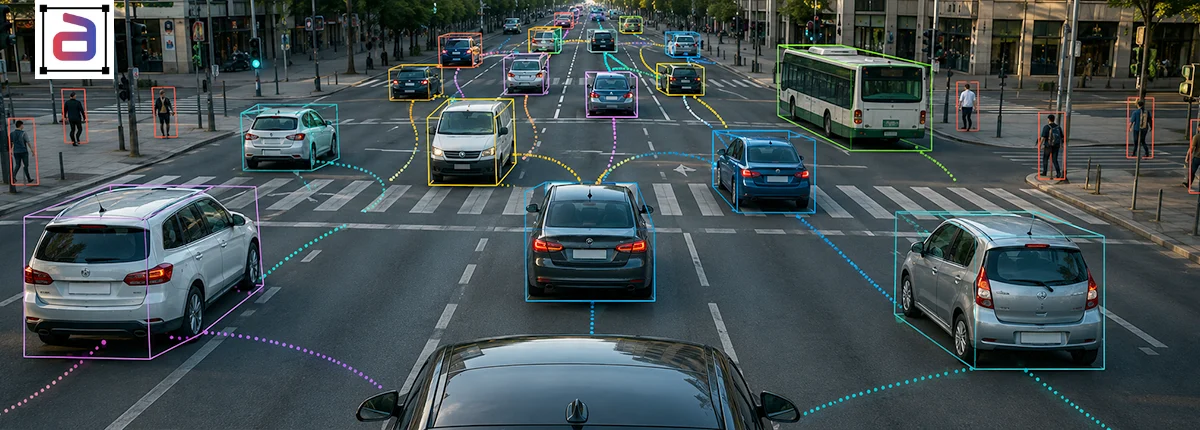
Multi-object tracking annotation involves identifying multiple objects in video sequences and maintaining their identities as they move from one frame to another. Consider a busy urban intersection. A single video sequence could contain cars, buses, motorcycles, cyclists, pedestrians, and traffic signs. An annotator must identify these objects, assign appropriate tracking IDs, and ensure that each object’s identity remains consistent throughout the sequence. Depending on the project, tracking annotations can include:
- Object class and category
- Bounding boxes or object contours
- Unique tracking IDs
- Frame-by-frame object positions
- Object movement and trajectories
- Occlusion status
- Visibility attributes
- Entry and exit points
- Object interactions
This temporal continuity is what differentiates MOT annotation from conventional image annotation. By linking objects across consecutive video frames, MOT annotation gives computer vision models the temporal context required to understand dynamic road scenes. Because tracking builds on frame-level boxes, precise and well-audited labels matter, and our guide to bounding box accuracy and quality control covers how to keep them consistent at scale.
Why Multi-Object Tracking Matters for Autonomous Vehicles
Imagine a pedestrian appearing at the edge of a road. Detecting the pedestrian in one frame tells the vehicle that a person exists. Tracking that pedestrian across multiple frames provides considerably more information. The system can learn whether the pedestrian is:
- Standing still
- Walking toward the road
- Crossing the road
- Moving away
- Temporarily hidden by another object
The same principle applies to vehicles. Tracking can help perception models understand whether another car is approaching, changing lanes, slowing down, or moving through an intersection.
“Detection tells an autonomous vehicle what is present. Tracking helps it understand what is happening.”
This distinction is fundamental to autonomous driving because safe navigation depends on interpreting motion and intent, not simply recognizing objects.
Multi-Object Tracking vs. Object Detection
Object detection and multi-object tracking work together, but they solve different problems. Object detection asks: “What objects are visible in this frame?” Multi-object tracking asks: “Which objects are these, and where have they moved?” A detection model may identify three vehicles in a frame. A tracking model must determine whether those same vehicles are still present in subsequent frames and maintain their identities. This temporal relationship is particularly important for autonomous vehicles because their surroundings are continuously changing.
The Biggest Challenges in Tracking Annotation
Creating high-quality MOT datasets is considerably more complex than labeling isolated images. Video object identity labels assign persistent IDs to objects across frames, helping AI systems recognize the same entity throughout a sequence. Maintaining identity becomes challenging during occlusion, crowded scenes, appearance changes, camera movement, and object re-entry.
Occlusion and Partial Visibility
Objects frequently disappear behind other vehicles, pedestrians, road infrastructure, or environmental obstacles. Annotators must determine whether an object that reappears later is the same tracked instance.
Identity Switching
One of the most damaging annotation errors is assigning an incorrect tracking ID. If two similar vehicles accidentally exchange identities, the resulting dataset can teach the model incorrect movement patterns.
Crowded Road Environments
Urban environments can contain dozens of objects within a relatively small area. Maintaining consistent identities becomes increasingly challenging as objects overlap and move in different directions.
Nighttime and Adverse Weather
Rain, fog, glare, shadows, snow, and low-light conditions can significantly reduce visibility. Annotation workflows must account for these difficult scenarios rather than focusing exclusively on clear daytime footage.
Camera Motion
Autonomous vehicles use cameras mounted on moving platforms. As the vehicle moves, the entire visual scene changes. Annotators therefore need to distinguish genuine object movement from changes caused by camera motion.
Why Video Annotation Outsourcing Is Becoming Strategic
Autonomous vehicle companies often need enormous volumes of labeled video to train and improve perception models. Managing this workload internally can require significant investments in hiring, training, annotation platforms, quality assurance, project management, and infrastructure. This is where video annotation outsourcing can provide a strategic advantage. Partnering with an experienced video annotation company allows organizations to scale annotation capacity according to project requirements while maintaining defined quality standards. A capable outsourcing partner can support:
- Frame-by-frame object tracking
- Vehicle and pedestrian annotation
- Trajectory labeling
- Occlusion handling
- Multi-class tracking
- Edge-case annotation
- Quality assurance
- Large-scale video processing
For AI teams, this can free internal resources to concentrate on model development, perception architecture, sensor fusion, simulation, and validation.
How Data Annotation Outsourcing Supports Autonomous Driving
Data annotation outsourcing is particularly valuable when autonomous vehicle projects move from prototype development toward production-scale datasets. An experienced data annotation company should be capable of creating structured datasets while maintaining consistency across large annotation teams. Key capabilities to evaluate include:
- Annotation expertise – Teams should understand computer vision concepts and autonomous driving scenarios.
- Scalability – The provider should be able to increase annotation capacity as datasets expand.
- Quality assurance – Multi-stage review processes should identify missed objects, incorrect IDs, inaccurate boundaries, and tracking inconsistencies.
- Security – Sensitive automotive and proprietary datasets require appropriate data protection practices.
- Edge-case expertise – The provider should understand difficult scenarios such as occlusion, nighttime driving, adverse weather, and dense traffic.
- Workflow flexibility – Different perception models may require different annotation formats, taxonomies, and labeling protocols.
The objective is not simply to produce more annotations. It is to produce more reliable training data.
Quality Control: The Difference Between Data Volume and Data Value
Large datasets are not automatically high-quality datasets. A tracking dataset containing millions of frames can still create problems if objects are inconsistently labeled or identities change between frames. For MOT projects, quality assurance should examine:
- Tracking ID consistency
- Frame-to-frame continuity
- Missed detections
- Duplicate object IDs
- Bounding-box accuracy
- Occlusion handling
- Class consistency
- Object entry and exit events
Human review combined with systematic QA processes can significantly reduce annotation noise. At Annotera, quality is treated as a core part of the annotation lifecycle—not an afterthought. Our annotation workflows are designed to help organizations transform complex visual data into structured, AI-ready datasets for demanding computer vision applications.
Annotera: Helping Build the Data Behind Autonomous Mobility
Developing autonomous vehicle technology requires more than sophisticated algorithms. It requires dependable training data that accurately represents the complexity of real-world driving. Annotera supports organizations with scalable image annotation and video annotation solutions designed for computer vision applications. From object detection and tracking to complex road-scene labeling, our teams can help transform raw visual data into structured datasets that support AI development. Our approach combines trained human annotation teams, defined labeling guidelines, quality-control workflows, and scalable production capabilities.
“Better AI starts with better data—and better data starts with disciplined annotation.”
For autonomous vehicle companies, this principle is especially important. Every incorrectly tracked pedestrian, inconsistent vehicle ID, or missed object can introduce noise into a model that ultimately needs to operate in dynamic real-world conditions.
The Future of Autonomous Vehicle Perception Depends on Temporal Data
As autonomous vehicles become more capable, perception systems will need to understand increasingly complex interactions between road users. Static object recognition will remain important, but it is only one part of the equation. AI systems must increasingly understand movement, continuity, interaction, and context. Multi-object tracking annotation provides the temporal foundation for this evolution. By investing in accurately labeled video sequences, autonomous vehicle developers can create training datasets that better represent how real-world environments evolve over time.
Conclusion
Multi-object tracking annotation is a critical building block for autonomous vehicle perception. It connects individual observations across video frames, allowing AI systems to learn not only what objects look like but also how they move and interact. As autonomous driving projects scale, partnering with a specialized video annotation company can help organizations handle growing annotation requirements without compromising quality. Similarly, the right data annotation company can provide the expertise, scalability, and quality controls required for complex perception datasets. Ready to build better training data for your autonomous vehicle AI? Partner with Annotera to scale high-quality multi-object tracking and video annotation for your computer vision projects. Contact Annotera today to discuss your dataset requirements and discover how our expert annotation teams can support your AI development journey.
A closely related read: Best Practices for Annotating LiDAR and Sensor Fusion Data in Autonomous Vehicles.