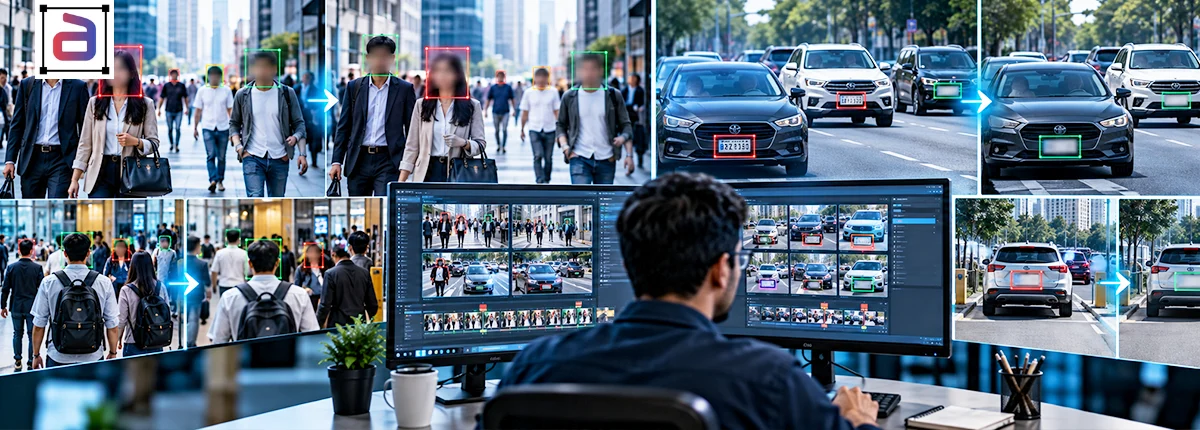
Computer vision models learn from labeled examples. In video AI, however, labeling is more demanding than annotating static images because objects move, overlap, change perspective, and may disappear and reappear across frames. Choosing the right annotation technique can therefore have a direct impact on dataset quality, project cost, and development speed. In computer vision, choosing between bounding box and polygon annotation can significantly influence dataset quality and model performance. While bounding boxes offer speed and scalability, polygons provide greater precision for complex object shapes and crowded scenes. When bounding boxes are the right choice For cases where precise polygon annotation of video content is the right choice for e-commerce, see polygon video annotation for e-commerce. When bounding boxes are the right choice — particularly for product detection at scale — see 2D bounding box services for product detection. In retail, that precision difference is the deciding factor for shelf auditing AI — see the full breakdown in polygon annotation for retail shelf auditing and product recognition.ect boundaries. Understanding these differences helps businesses select the right annotation method for their video AI applications. Two of the most widely used approaches are bounding box annotation vs. polygon annotation. While both identify objects in video, they provide different levels of spatial information.
Key Points
- Bounding Boxes for Speed & Scalability – Ideal for object detection, tracking, surveillance, and large video datasets where fast, cost-effective annotation is essential.
- Polygons for Precision – Polygon annotation delivers accurate object boundaries and is better suited for autonomous driving, robotics, medical AI, and complex scenes.
- Choose Based on Model Requirements – The right annotation method depends on accuracy needs, object complexity, dataset size, model architecture, and project budget.
- Annotera for Scalable Video Annotation – Annotera provides professional video annotation outsourcing with trained teams, quality-control workflows, and scalable solutions for computer vision projects.
What Is Bounding Box Annotation?
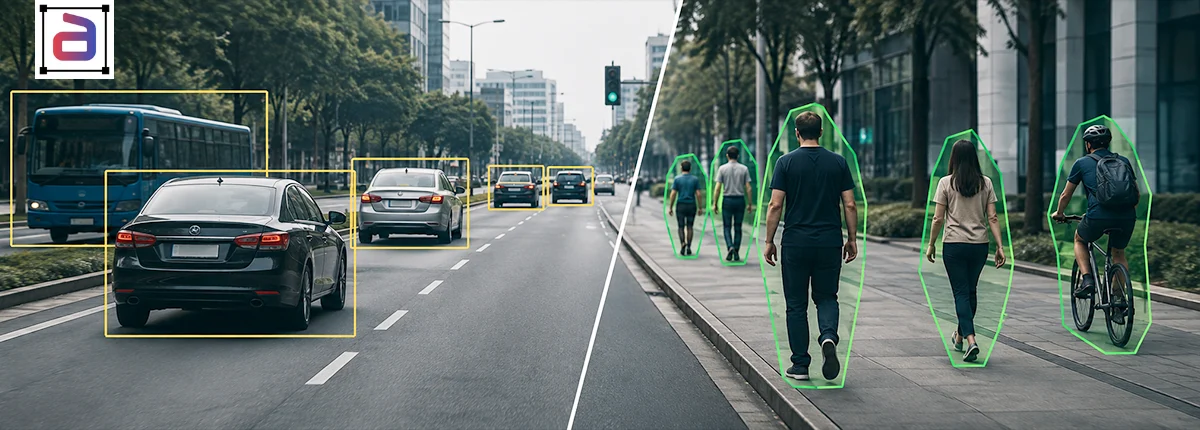
Bounding box annotation uses a rectangular box to identify an object within a video frame. The technique is particularly effective for object detection and tracking, where the model primarily needs to understand what an object is and where it is located.
For example, a traffic-monitoring model can use bounding boxes to identify cars, buses, cyclists, and pedestrians.
Retail systems can use them to locate products, while surveillance models can detect and track people or vehicles.
To go deeper on this topic, powering autonomous shopping with annotation at scale.
Why Choose Bounding Boxes?
Bounding boxes offer several practical advantages:
-
Faster annotation: Rectangles can be created quickly across large numbers of frames.
-
Lower labeling effort: They generally require less time than detailed shape annotation.
-
High scalability: Suitable for large video datasets.
-
Effective detection: Provides sufficient spatial information for many detection and tracking models.
-
Consistent workflows: Guidelines are relatively straightforward to standardize.
For projects where precise object contours are not essential, bounding boxes can deliver an excellent balance between accuracy, speed, and cost. When those boxes are labeled at scale, consistency becomes the real challenge, which is exactly what our guide to quality control for high-volume bounding box projects addresses.
“The right annotation strategy is not the one with the most detail—it is the one that captures the detail your model actually needs.”
What Is Polygon Annotation?
Polygon annotation provides a more detailed representation by tracing an object’s visible boundary using multiple points. Unlike a rectangle, a polygon can follow irregular shapes and exclude much of the surrounding background.
This additional precision can be valuable when the model needs to understand an object’s exact shape or distinguish closely positioned objects.
For instance, autonomous driving systems may benefit from precise outlines around pedestrians, cyclists, and obstacles. Similarly, industrial inspection applications may require detailed boundaries around defects or components.
Why Choose Polygons?
Polygon annotation is advantageous when:
-
Exact object boundaries matter.
-
Objects have irregular shapes.
-
Multiple objects overlap or appear close together.
-
The model requires segmentation-level information.
-
Spatial precision is more important than annotation speed.
The trade-off is clear: polygons generally require more annotation time and skilled labor than bounding boxes.
Bounding Box vs. Polygon: A Practical Comparison
The choice should begin with the model’s objective rather than the annotation technique itself.
| Factor | Bounding Box | Polygon |
|---|---|---|
| Annotation speed | High | Moderate to low |
| Complexity | Low | High |
| Cost efficiency | High | Lower |
| Boundary precision | Moderate | High |
| Large-scale datasets | Excellent | More demanding |
| Object detection | Excellent | Suitable |
| Segmentation | Limited | Excellent |
| Irregular objects | Less suitable | Highly suitable |
As Annotera’s own guidance explains, bounding boxes prioritize “speed and scalability,” while polygons emphasize “precision and edge-level detail.”
The important point is that more detailed annotation is not automatically better. If a detection model only needs approximate object locations, investing heavily in polygon labels can increase costs without providing meaningful downstream benefits.
When Should You Use Bounding Boxes?
Bounding boxes are often the better option when the project focuses on detection, counting, or tracking.
Consider bounding boxes when your application involves:
-
Vehicle and pedestrian detection
-
Security and surveillance
-
Retail video analytics
-
Traffic monitoring
-
Sports object tracking
-
Large-scale object detection
They are especially useful when annotation throughput is a major consideration. For high-volume datasets, faster annotation can significantly shorten the time between raw data collection and model training.
When Should You Use Polygon Annotation?
Polygon annotation becomes more valuable when object boundaries influence model performance.
It is well suited to:
-
Autonomous vehicle perception
-
Robotics and manipulation
-
Medical video analysis
-
Industrial inspection
-
Complex scene understanding
-
Instance segmentation
Polygon annotation can capture contours that a rectangle cannot. This makes it particularly useful for irregular objects or scenes where background pixels could confuse the model.
“Precision matters when the boundary itself is part of what the model needs to understand.”
Is a Hybrid Approach Better?
In many real-world projects, the answer is yes.
Instead of applying polygons to every object and every frame, teams can use bounding boxes for common objects and reserve polygon annotation for objects or scenes where precise boundaries are critical.
For example, an autonomous driving dataset could use bounding boxes for general vehicle detection while applying polygons to vulnerable road users or safety-critical obstacles.
This hybrid strategy can help organizations balance dataset precision, annotation throughput, and project economics.
What About Video-Specific Challenges?
Video annotation introduces another layer of complexity: temporal consistency.
An object should not suddenly shift position, change shape dramatically, or receive a different identity simply because the video moves to another frame. Consistent object tracking, handling of occlusion, motion, camera movement, and changing visibility are therefore essential.
High-quality annotation requires more than drawing shapes. It requires clear guidelines, trained annotators, systematic reviews, and frame-to-frame consistency.
Why Data Annotation Outsourcing Can Help
Building an internal annotation operation can become challenging as datasets grow. Organizations must recruit annotators, develop guidelines, establish quality assurance, manage productivity, and maintain consistent output.
With data annotation outsourcing, businesses can access trained teams and established workflows without creating an entire labeling operation internally.
A specialized data annotation company can also help determine whether bounding boxes, polygons, or a hybrid methodology is appropriate for a specific computer vision pipeline.
Why Choose Annotera?
Annotera provides scalable annotation solutions designed around the technical and operational requirements of AI teams.
Through video annotation outsourcing, Annotera supports projects involving object detection, tracking, classification, and detailed visual labeling. Our workflows are designed to maintain consistency across frames while incorporating structured quality-control processes.
As an experienced video annotation company, Annotera combines human expertise, scalable operations, and project-specific annotation guidelines to help organizations transform raw video into reliable training data.
Whether you need high-volume bounding box labeling, precise polygon annotation, or a hybrid workflow, Annotera can help align your annotation strategy with your model’s actual requirements.
Make the Right Annotation Choice with Annotera
Bounding boxes are ideal when speed, scalability, and detection are the priorities. Polygons are the stronger choice when precision, contours, and segmentation matter. In complex projects, combining both can deliver the best balance.
The goal should never be to annotate more—it should be to annotate smarter.
Ready to build high-quality video training data? Partner with Annotera for scalable, accurate, and professionally managed annotation solutions. Contact Annotera today to discuss your project and find the right annotation strategy for your computer vision model.
A closely related read: Bounding Boxes: The Foundation of Object Recognition.