
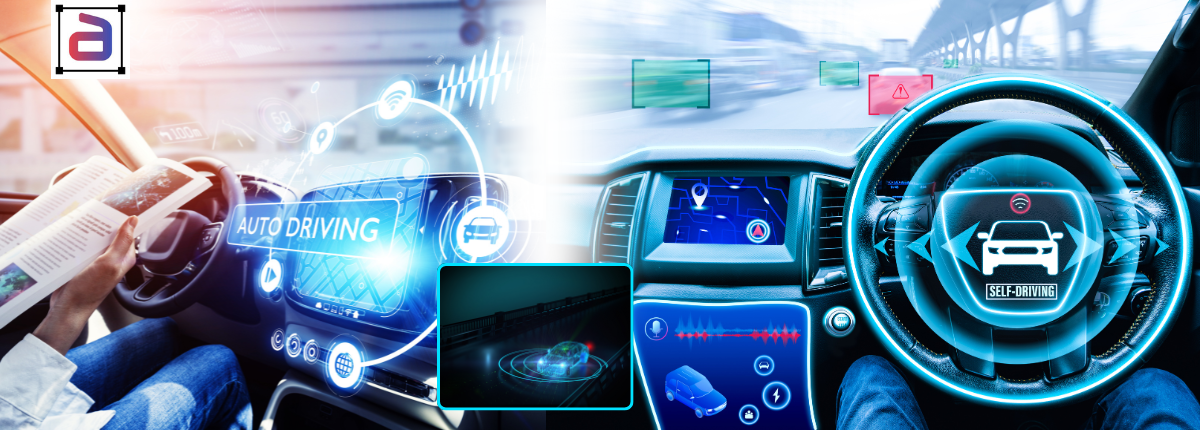
The development of autonomous vehicles (AVs) depends heavily on massive amounts of high-quality training data. From Level 2 driver assistance to full Level 5 autonomy, self-driving systems rely on expertly annotated sensor data to perceive the world, predict movement, and make safe decisions.
Key Points
- Autonomous driving annotation quality requirements scale with AV autonomy level: Level 2 systems tolerate more annotation error than Level 5 systems because human drivers provide a safety backstop at lower autonomy levels that is absent at full autonomy.
- AV annotation must cover the full range of road user types, not just the common categories: unusual vehicles, mobility devices, animals, and debris are precisely the objects that sensor fusion and object detection models most frequently misclassify in production.
- Meticulously annotated sensor data is what enables AV systems to build accurate world models: the precision of the annotation determines how well the AI can predict where objects will be in the next second, which is the core input to safe trajectory planning.
- AV annotation programs must include synthetic data coverage for rare safety-critical scenarios that cannot be safely collected in the real world: annotation standards for synthetic data must match real-world standards to prevent the model from learning synthetic-only visual patterns.
Table of Contents
The Foundation of Autonomous Driving: Perception, Prediction, and Planning
Autonomous vehicles use a three-stage system often called the AV Stack:
- Perception — Identifying and locating objects (vehicles, pedestrians, traffic signs, etc.) using cameras, LiDAR, and radar.
- Prediction — Anticipating how those objects will behave in the next few seconds.
- Planning — Calculating safe and efficient paths through the environment.
High-quality annotated data is essential for the first two stages. Without accurate labels, even the most sophisticated AI models cannot perform reliably in real-world conditions.
Essential Annotation Techniques for Autonomous Vehicles
AVs use multimodal sensor fusion, so annotation must handle multiple data types simultaneously:
| Sensor Modality | Common Annotation Methods | Primary Use Cases |
|---|---|---|
| Camera (2D / Video) | 2D Bounding Boxes, Semantic Segmentation, Polygons | Object detection, lane marking, traffic sign recognition |
| LiDAR (3D Point Cloud) | 3D Cuboids, Point Cloud Segmentation | Precise depth measurement, object tracking in 3D space |
| Sensor Fusion (Multi-Modal) | Fused Annotation | Creating consistent ground truth across all sensors |
Key Annotation Methods Explained
- 3D Cuboid Annotation — Used on LiDAR point clouds to define the exact position, size, and orientation of objects. Critical for understanding depth and avoiding collisions.
- Semantic Segmentation — Labels every pixel or point (e.g., road, sidewalk, vehicle, sky). Helps the vehicle understand drivable areas.
- Instance Segmentation — Distinguishes between individual objects of the same class (e.g., Car A vs. Car B).
- Keypoint & Tracking Annotation — Tracks movement over time in video sequences for better motion prediction.
Why Data Quality & Scale Matter
Developing safe autonomous systems requires both massive volume and exceptional quality. A single vehicle can generate 5–20 terabytes of sensor data per day. Training models to handle rare edge cases (construction zones, unusual weather, complex intersections) demands carefully curated and accurately labeled datasets.
Poor annotation leads to unreliable models, while high-quality labels accelerate development and improve safety outcomes.
Best Practices for AV Data Annotation
- Use hybrid workflows (AI pre-labeling + human validation)
- Implement strict multi-stage quality control and consensus scoring
- Maintain consistency across large annotation teams
- Focus heavily on edge cases and rare scenarios
- Ensure sensor fusion alignment for multimodal accuracy
Conclusion
High-quality data annotation is the hidden foundation behind safe and reliable autonomous vehicles. As the industry moves toward wider deployment, the difference between success and failure will largely come down to the precision and consistency of training data.
Read the full story of how we did exactly this for a global autonomous vehicle in our annotation case study.
If you’re developing autonomous driving technology and need expert support with image, video, LiDAR, or multimodal annotation, feel free to reach out to Annotera.
The Annotation Stack Behind an Autonomous Driving System
A production autonomous driving system relies on multiple annotation types working together — not a single label type in isolation. The full annotation stack includes:
- Camera-based perception: 2D bounding boxes, instance segmentation masks, lane marking polylines, traffic sign classification, drivable area segmentation across 8–12 cameras per vehicle.
- LiDAR perception: 3D cuboid annotation with heading and velocity attributes, ground segmentation, free-space boundary annotation in the point cloud.
- Sensor fusion: Cross-modal annotation that aligns camera labels with LiDAR cuboids at the same timestamp, ensuring the 2D detection and 3D object estimate refer to the same physical object.
- HD map annotation: Road topology, lane connectivity, speed limit zones, intersection geometry — the static world model that the perception system queries at runtime.
- Behaviour and scenario annotation: Scene-level labels for training edge-case handling: cut-in scenarios, pedestrian jaywalking, adverse weather conditions, construction zone geometry.
Each layer of this annotation stack has its own quality requirements, tooling needs, and annotator expertise. Annotera operates cross-modal AV annotation programs that cover the full stack with consistent quality standards across modalities.
Data Volume Requirements for AV Model Training
Autonomous driving models require annotation at a scale that makes quality management non-negotiable. A typical Level 4 AV system requires 10–50 million labeled frames across camera, LiDAR, and radar modalities before initial deployment — and continuous annotation of edge-case scenarios throughout the operational life of the fleet. At that volume, a 1% annotation error rate means 100,000–500,000 mislabeled samples in the training set. Quality monitoring is not optional overhead at AV scale — it is the core engineering discipline.
A closely related read: The 4D Challenge: Best Practices for Annotating LiDAR and Sensor Fusion Data in Autonomous Vehicles.
A closely related read: The Role of High-Quality Data Annotation in Autonomous Driving Systems.
A closely related read: Data Annotation for Autonomous Vehicles: How High-Precision Image Labeling Enables Safer Self-Driving Systems.