Artificial Intelligence is reshaping how people interact with technology, but one of its most meaningful applications lies in making communication more accessible. Sign Language Recognition (SLR) AI is helping bridge the gap between deaf and hearing communities by translating sign language into text, speech, or digital commands in real time. Yet behind every successful sign language AI model lies something far less visible but equally important: high-quality video annotation. From capturing intricate hand gestures to interpreting facial expressions and body movements, annotated video data provides the foundation that enables AI systems to understand the complexity of human communication. Without accurate annotation, even the most advanced machine learning algorithms struggle to recognize the nuances that make sign language a complete linguistic system. At Annotera, we help organizations transform raw video footage into precise, AI-ready datasets that power next-generation accessibility solutions.
Key Points
- Sign language recognition AI requires simultaneous annotation of hand shape, movement, facial expression, and body posture at the frame level.
- Sign languages are not universal — each regional variant has distinct grammar and gesture systems requiring separate annotated datasets.
- Temporal precision matters: sign language meaning changes with the speed and direction of hand movements across frames.
- Quality-annotated sign language datasets are foundational to accessible AI communication tools for deaf and hard-of-hearing communities.
Table of Contents
The Growing Need for Sign Language Recognition AI
Accessibility has become a major focus for governments, enterprises, and technology innovators worldwide. According to the World Health Organization (WHO), more than 1.5 billion people globally live with some degree of hearing loss, while over 430 million people require rehabilitation services related to hearing conditions. As digital accessibility becomes a global priority, the demand for Sign Language Recognition AI continues to grow. Consequently, organizations are investing in advanced AI systems that can interpret sign language accurately, thereby improving communication, inclusivity, and access to essential services. As digital services become increasingly integrated into daily life, there is growing demand for technologies that can facilitate seamless communication for deaf and hard-of-hearing individuals. Sign Language Recognition AI is being deployed across numerous applications, including:
- Real-time communication assistance
- Customer service automation
- Smart devices and wearables
- Educational technology platforms
- Healthcare accessibility solutions
- Public service communication systems
However, building accurate recognition systems requires much more than collecting video footage. It requires carefully annotated datasets that teach AI models how to interpret visual language.
Why Video Annotation Is the Foundation of Sign Language AI
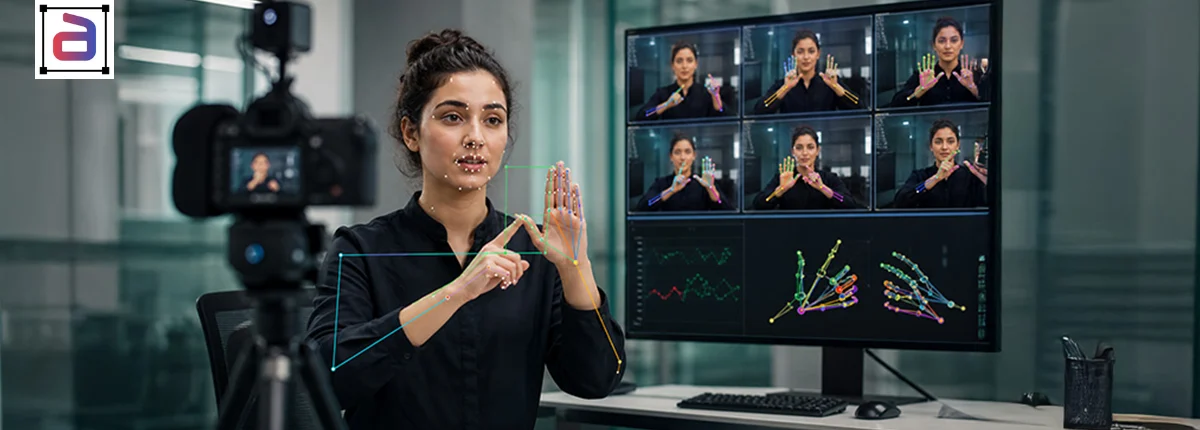
Unlike spoken language, sign language relies on multiple visual signals occurring simultaneously. Sign language relies on dynamic gestures, facial expressions, and body movements; therefore, AI models require accurately annotated video data to learn these visual cues. Consequently, video annotation provides the contextual information necessary for precise sign recognition and interpretation. Frame-by-frame video annotation is the foundation of sign language AI because it captures every hand movement, facial expression, and body posture with precision. As a result, AI models learn complex signing patterns more accurately, improving recognition and communication outcomes. These signals include:
- Hand shapes and positions
- Finger movements
- Gesture trajectories
- Facial expressions
- Eye movements
- Head orientation
- Body posture
Each element contributes meaning to a sign.
“Artificial intelligence is the new electricity.” – Andrew Ng
However, electricity requires infrastructure to deliver value. In AI, that infrastructure is high-quality training data. Video annotation provides the structured information machine learning models need to recognize, classify, and interpret sign language accurately. Without comprehensive annotation, AI systems cannot learn the subtle differences between gestures that may appear similar but convey entirely different meanings.
Key Types of Video Annotation Used in Sign Language Recognition
Effective Sign Language Recognition AI depends on multiple annotation techniques. For example, hand tracking captures gesture movements, while facial expression and body pose annotation provide context. Additionally, temporal segmentation helps AI models understand sign sequences and communication flow more accurately.
Hand and Finger Tracking
Hand movements are central to sign language communication. Annotators label:
- Hand locations
- Finger positions
- Palm orientation
- Motion direction
- Gesture transitions
This allows AI models to understand how specific hand configurations correspond to words, phrases, and concepts. Even small differences in finger placement can completely change a sign’s meaning, making precision essential.
Facial Expression Annotation
One of the most overlooked aspects of sign language recognition is facial expression analysis. Facial cues often communicate:
- Questions
- Emotions
- Emphasis
- Grammatical context
For example, raised eyebrows may indicate a question, while changes in mouth shape can alter the interpretation of a sign. Video annotation teams carefully label these non-manual markers to ensure AI systems understand the full context of communication.
Body Pose Annotation
Many signs involve coordinated movement across the upper body. Annotators identify:
- Shoulder positioning
- Arm movement
- Head orientation
- Torso posture
These labels provide additional contextual information that improves recognition accuracy, particularly in conversational settings.
Temporal Segmentation
Sign language is continuous rather than isolated. AI models must learn where one sign begins and another ends. Temporal annotation helps identify:
- Gesture start points
- Gesture end points
- Transitional movements
- Sequential relationships
This frame-by-frame context is critical for training models capable of interpreting complete sentences rather than individual signs.
Why Human Expertise Remains Essential
Despite advances in automation, sign language annotation remains a highly specialized task. AI-assisted labeling tools can accelerate workflows, but they cannot fully understand linguistic context, cultural nuances, or subtle visual variations.
“The quality of AI systems depends on the quality of the data that trains them.” – Fei-Fei Li
This principle is especially relevant in sign language recognition. Human annotators bring:
- Contextual understanding
- Linguistic expertise
- Cultural awareness
- Quality validation capabilities
At Annotera, our human-in-the-loop approach ensures every annotation undergoes rigorous review, helping organizations build datasets that support real-world AI performance. Human expertise remains critical in first-person video annotation because egocentric footage often contains occlusions, rapid movements, and context-dependent interactions. Skilled annotators can accurately interpret user intent, subtle gestures, and complex object manipulations, ensuring high-quality datasets for reliable AR/VR model training.
Challenges in Sign Language Video Annotation
Developing high-quality training datasets for sign language AI presents several unique challenges.
Gesture Variability
Different individuals often perform the same sign differently due to:
- Regional dialects
- Signing styles
- Age-related variations
- Physical characteristics
Annotation teams must maintain consistency while accounting for these natural differences.
Motion Blur and Occlusion
Fast-moving hands frequently overlap or move outside the camera’s field of view. Accurately tracking these movements requires experienced annotators and robust quality assurance processes.
Multi-Layer Annotation Requirements
Sign language datasets often require simultaneous annotation of:
- Hands
- Face
- Eyes
- Body posture
- Gesture timing
This complexity makes annotation significantly more demanding than traditional object detection projects.
Why Organizations Choose Video Annotation Outsourcing
Building large-scale sign language datasets internally often requires significant investments in workforce management, training, quality control, and annotation infrastructure. As a result, organizations increasingly turn to video annotation outsourcing to accelerate development while maintaining quality standards. Partnering with a specialized video annotation company provides access to:
- Experienced annotation professionals
- Scalable production capacity
- Faster project timelines
- Advanced annotation tools
- Comprehensive quality assurance workflows
Similarly, data annotation outsourcing enables AI teams to focus on model development and deployment while trusted partners manage data preparation.
How Annotera Supports Accessibility-Focused AI Development
At Annotera, we understand that accessibility technologies require exceptional data quality. As a trusted data annotation company, we deliver high-precision annotation services designed to support advanced computer vision and machine learning applications. Our capabilities include:
- Sign language video annotation
- Gesture recognition datasets
- Human pose estimation
- Facial landmark annotation
- Motion tracking and segmentation
- Multi-level quality assurance
Whether organizations need large-scale specialized video annotation outsourcing, Annotera combines domain expertise, scalable delivery models, and rigorous validation processes to ensure every dataset meets production-grade standards. We don’t simply annotate videos—we create the training foundation that enables AI systems to communicate, understand, and serve diverse communities more effectively.
The Future of Inclusive AI Starts with Better Data
Sign Language Recognition AI has the potential to transform accessibility across education, healthcare, public services, and digital communication. However, its success depends on the quality of the data used to train it. Every accurately labeled gesture, facial expression, and movement contributes to building AI systems that better understand human communication. As accessibility becomes a strategic priority for organizations worldwide, investing in high-quality video annotation is no longer optional—it is essential.
Partner with Annotera to Build More Accurate Sign Language AI
Looking to develop accessibility-focused AI solutions powered by high-quality annotated video data? Annotera provides scalable, human-in-the-loop video annotation services tailored to complex computer vision projects, including sign language recognition, gesture analysis, and human pose estimation. Contact Annotera today to discover how our expert annotation teams can help accelerate your AI development while ensuring the accuracy, consistency, and quality your models need to succeed.