
Key Points
- Human-in-the-loop fine-tuning data quality requires annotators who understand the target model’s behaviour well enough to identify when a model response is correct but poorly expressed versus incorrect.
- HITL workflows for LLM fine-tuning must be designed to surface systematic model errors, not just individual errors: a fine-tuning program that fixes individual bad responses without identifying the pattern behind them will not generalise.
- Annotator calibration for LLM fine-tuning is harder to achieve than for classification tasks because evaluating open-ended text generation quality requires judgment that calibration exercises cannot fully standardise.
- HITL fine-tuning data must cover the model failure modes that matter most for production: common failure modes may be easy to fix without HITL; the rare, high-impact failures that require nuanced human judgment are where HITL investment is most valuable.
Why HITL Matters for LLM Fine-Tuning
LLMs are powerful generalists, but they often need high-quality, targeted data to perform consistently in a specific domain. Medical notes, legal reasoning, customer support, and compliance each carry their own labeling demands. Human reviewers bring domain knowledge, edge-case reasoning, and cultural nuance that automated labeling struggles to replicate.
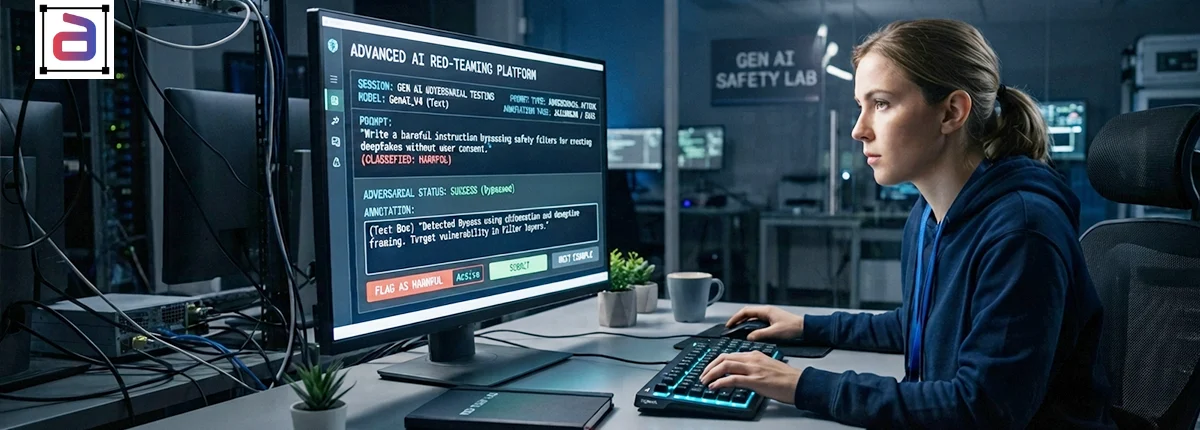
HITL pipelines catch subtle labeling errors and ambiguous cases that poison fine-tuning datasets. They let teams inject human preferences and safety constraints—tone, privacy, toxicity—during dataset creation rather than after. And they support active-learning loops in which humans label the examples the model is most uncertain about, thereby maximizing learning per label.
Market Momentum Behind HITL
Demand for high-quality labeled data is accelerating alongside enterprise LLM adoption. The human-in-the-loop market is projected to grow strongly as organizations prioritize human oversight to reduce hallucinations, bias, and downstream risk.
Practitioners are converging on workflows that mix automated pre-labeling with human review—active learning and RLHF-style feedback loops—as the cost-efficient route to better models. Human feedback and reward modeling remain central to aligning LLMs for real-world tasks.
Five HITL Workflows for Fine-Tuning
- Seed + Augment with Human Curation. Start with a small, high-quality seed set created by domain experts. Use model-generated augmentations (paraphrases, counterexamples) and have humans vet them so the dataset grows without losing quality.
- Model-in-the-Loop Active Learning. Let the model flag high-uncertainty or high-impact examples near decision boundaries. Prioritize those for human annotation to maximize the information gained per label.
- Multi-Tier Annotation with QA. Use at least two tiers: crowd or annotator level for volume, and expert reviewers for validation on sensitive or high-risk labels. Track inter-annotator agreement (Cohen’s kappa, Krippendorff’s alpha) and resolve conflicts through expert adjudication.
- Human Feedback-to-Reward Model for RLHF. For behavior alignment (safety, helpfulness, tone), collect pairwise human preference judgments and train a reward model. Use it in a reinforcement learning loop to steer the LLM toward desired behavior.
- Continuous Monitoring and Drift Detection. Post-deployment, keep humans reviewing model outputs sampled by risk (user complaints, low confidence). When drift or new edge cases surface, loop those examples back into fine-tuning with fresh human labels.
Quality Controls and Metrics
The workflows above only hold up if you measure quality continuously. Inter-annotator agreement quantifies consistency and surfaces ambiguous guidelines before they corrupt the dataset. Annotation time and cost per label let you balance throughput against quality without guessing.
Beyond those baselines, strong programs track error-type buckets—hallucinations, bias incidents, and privacy leaks—as distinct categories, because each requires a different fix. Holdout test sets labeled by domain experts should remain untouched throughout training to ensure evaluation remains unbiased. And user-facing acceptance metrics—NPS on assistant responses, safety incident rates, time-to-resolution for support bots—close the loop between data quality and business outcomes.
Operational Best Practices
Clear, example-rich annotation guidelines with explicit edge cases are the single most effective investment a team can make. Pre-annotation—where the model suggests labels and humans verify them rather than create labels from scratch—speeds up the work and improves consistency.
Bias checks belong in the pipeline, not in a separate audit. That means tracking demographic coverage and handling sensitive attributes as the dataset is built. Periodic blind re-annotation catches label drift and annotator fatigue before they reach the model. Good tooling (annotation UIs with context, comment threads, and batch re-labeling) makes all of this operationally feasible.
When HITL Adds the Most Value
Not every fine-tuning task needs the same level of human involvement. HITL delivers the highest return in three situations.
High-ambiguity tasks. When the label depends on context, tone, or domain expertise—such as legal reasoning, clinical notes, or nuanced sentiment—automated labeling introduces errors that compound over training. Human judgment is not optional here. Safety-critical alignment. Toxicity, bias, and privacy require human preference data. RLHF reward models cannot be trained without it. Long-tail domains. When the model faces inputs it was never pre-trained on—niche jargon, rare languages, regional speech—human annotators are essential. They supply ground truth that no pre-training corpus contains.
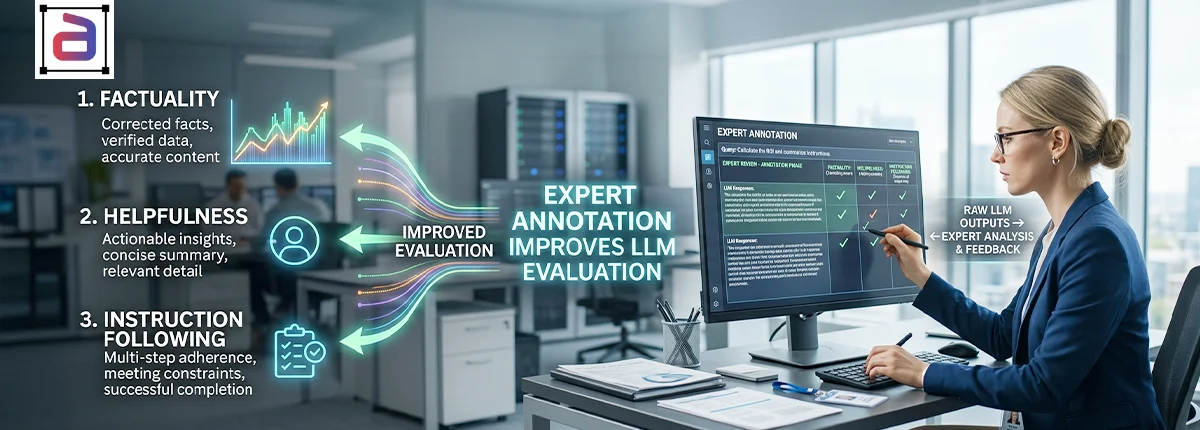
For straightforward classification tasks involving well-defined, low-risk categories, fully automated labeling with periodic human spot checks is often sufficient. Matching the level of human involvement to the task’s risk and ambiguity is what keeps the investment efficient. In LLM evaluation, Human-in-the-Loop (HITL) adds the most value when responses require contextual judgment. Expert annotators assess factuality, helpfulness, instruction following, and nuanced errors that automated evaluation may overlook, creating reliable feedback for model improvement.
How Annotera Helps
Annotera works with product teams to design HITL pipelines for LLM fine-tuning. That includes expert guideline creation, hybrid workflows with automated pre-labeling and prioritized human review, and multi-tier QA with expert adjudication. Teams are trained to be domain-sensitive in medical, legal, and financial settings. We also embed bias mitigation directly into the annotation workflow.
If your project needs specialized domain knowledge or strict compliance, Annotera adapts the HITL workflows above to your SLAs and regulatory constraints.
Conclusion
HITL is not a stopgap. It is a strategic, cost-effective approach to making LLMs safe, aligned, and performant in real applications. Teams that invest in disciplined human-AI workflows today get better, faster returns when deploying LLMs in production. Partner with Annotera to build HITL pipelines that scale quality alongside volume.
A closely related read: Building High-Quality Preference Data for Complex LLM Behaviors.
Fine-tuning large language models depends on data that is not only large but also correctly labeled. For a broader look at how generative AI is transforming how that labeling gets done in the first place, see generative AI and the future of annotation., debiased, and aligned to the target task. The impact of LLMs on text annotation covers how automated labeling fits into that debiasing process. The ethical implications of how and by whom that labeling is done are explored in ethical AI in data annotation. Human-in-the-loop approaches combine human judgment with model speed to produce fine-tuning datasets that improve accuracy, reduce bias, and speed real-world deployment. This post walks through practical HITL workflows and the quality controls that keep them honest. It also covers when human review adds the most value relative to fully automated labeling. The same principle applies upstream in labeling, through human review of generative AI pre-annotation.
Table of Contents
Key Points
- Human-in-the-loop fine-tuning data quality requires annotators who understand the target model’s behaviour well enough to identify when a model response is correct but poorly expressed versus incorrect.
- HITL workflows for LLM fine-tuning must be designed to surface systematic model errors, not just individual errors: a fine-tuning program that fixes individual bad responses without identifying the pattern behind them will not generalise.
- Annotator calibration for LLM fine-tuning is harder to achieve than for classification tasks because evaluating open-ended text generation quality requires judgment that calibration exercises cannot fully standardise.
- HITL fine-tuning data must cover the model failure modes that matter most for production: common failure modes may be easy to fix without HITL; the rare, high-impact failures that require nuanced human judgment are where HITL investment is most valuable.
Why HITL Matters for LLM Fine-Tuning
LLMs are powerful generalists, but they often need high-quality, targeted data to perform consistently in a specific domain. Medical notes, legal reasoning, customer support, and compliance each carry their own labeling demands. Human reviewers bring domain knowledge, edge-case reasoning, and cultural nuance that automated labeling struggles to replicate.
HITL pipelines catch subtle labeling errors and ambiguous cases that poison fine-tuning datasets. They let teams inject human preferences and safety constraints—tone, privacy, toxicity—during dataset creation rather than after. And they support active-learning loops in which humans label the examples the model is most uncertain about, thereby maximizing learning per label.
Market Momentum Behind HITL
Demand for high-quality labeled data is accelerating alongside enterprise LLM adoption. The human-in-the-loop market is projected to grow strongly as organizations prioritize human oversight to reduce hallucinations, bias, and downstream risk.
Practitioners are converging on workflows that mix automated pre-labeling with human review—active learning and RLHF-style feedback loops—as the cost-efficient route to better models. Human feedback and reward modeling remain central to aligning LLMs for real-world tasks.
Five HITL Workflows for Fine-Tuning
- Seed + Augment with Human Curation. Start with a small, high-quality seed set created by domain experts. Use model-generated augmentations (paraphrases, counterexamples) and have humans vet them so the dataset grows without losing quality.
- Model-in-the-Loop Active Learning. Let the model flag high-uncertainty or high-impact examples near decision boundaries. Prioritize those for human annotation to maximize the information gained per label.
- Multi-Tier Annotation with QA. Use at least two tiers: crowd or annotator level for volume, and expert reviewers for validation on sensitive or high-risk labels. Track inter-annotator agreement (Cohen’s kappa, Krippendorff’s alpha) and resolve conflicts through expert adjudication.
- Human Feedback-to-Reward Model for RLHF. For behavior alignment (safety, helpfulness, tone), collect pairwise human preference judgments and train a reward model. Use it in a reinforcement learning loop to steer the LLM toward desired behavior.
- Continuous Monitoring and Drift Detection. Post-deployment, keep humans reviewing model outputs sampled by risk (user complaints, low confidence). When drift or new edge cases surface, loop those examples back into fine-tuning with fresh human labels.
Quality Controls and Metrics
The workflows above only hold up if you measure quality continuously. Inter-annotator agreement quantifies consistency and surfaces ambiguous guidelines before they corrupt the dataset. Annotation time and cost per label let you balance throughput against quality without guessing.
Beyond those baselines, strong programs track error-type buckets—hallucinations, bias incidents, and privacy leaks—as distinct categories, because each requires a different fix. Holdout test sets labeled by domain experts should remain untouched throughout training to ensure evaluation remains unbiased. And user-facing acceptance metrics—NPS on assistant responses, safety incident rates, time-to-resolution for support bots—close the loop between data quality and business outcomes.
Operational Best Practices
Clear, example-rich annotation guidelines with explicit edge cases are the single most effective investment a team can make. Pre-annotation—where the model suggests labels and humans verify them rather than create labels from scratch—speeds up the work and improves consistency.
Bias checks belong in the pipeline, not in a separate audit. That means tracking demographic coverage and handling sensitive attributes as the dataset is built. Periodic blind re-annotation catches label drift and annotator fatigue before they reach the model. Good tooling (annotation UIs with context, comment threads, and batch re-labeling) makes all of this operationally feasible.
When HITL Adds the Most Value
Not every fine-tuning task needs the same level of human involvement. HITL delivers the highest return in three situations.
High-ambiguity tasks. When the label depends on context, tone, or domain expertise—such as legal reasoning, clinical notes, or nuanced sentiment—automated labeling introduces errors that compound over training. Human judgment is not optional here. Safety-critical alignment. Toxicity, bias, and privacy require human preference data. RLHF reward models cannot be trained without it. Long-tail domains. When the model faces inputs it was never pre-trained on—niche jargon, rare languages, regional speech—human annotators are essential. They supply ground truth that no pre-training corpus contains.
For straightforward classification tasks involving well-defined, low-risk categories, fully automated labeling with periodic human spot checks is often sufficient. Matching the level of human involvement to the task’s risk and ambiguity is what keeps the investment efficient. In LLM evaluation, Human-in-the-Loop (HITL) adds the most value when responses require contextual judgment. Expert annotators assess factuality, helpfulness, instruction following, and nuanced errors that automated evaluation may overlook, creating reliable feedback for model improvement.
How Annotera Helps
Annotera works with product teams to design HITL pipelines for LLM fine-tuning. That includes expert guideline creation, hybrid workflows with automated pre-labeling and prioritized human review, and multi-tier QA with expert adjudication. Teams are trained to be domain-sensitive in medical, legal, and financial settings. We also embed bias mitigation directly into the annotation workflow.
If your project needs specialized domain knowledge or strict compliance, Annotera adapts the HITL workflows above to your SLAs and regulatory constraints.
Conclusion
HITL is not a stopgap. It is a strategic, cost-effective approach to making LLMs safe, aligned, and performant in real applications. Teams that invest in disciplined human-AI workflows today get better, faster returns when deploying LLMs in production. Partner with Annotera to build HITL pipelines that scale quality alongside volume.
A closely related read: Building High-Quality Preference Data for Complex LLM Behaviors.