The conversation around autonomous vehicles has long been dominated by roads, highways, and urban mobility. Yet some of the most challenging—and transformative—applications of autonomy are unfolding far from city streets. Deep within open-pit mines, underground tunnels, and remote extraction sites, autonomous mining equipment is redefining operational efficiency, worker safety, and productivity. From autonomous haul trucks and drilling rigs to intelligent excavators and loaders, mining companies are increasingly relying on AI-powered systems to navigate environments that are far more unpredictable than public roads. However, these systems can only be as intelligent as the data used to train them. This is where multi-sensor video annotation becomes mission-critical. At Annotera, we believe that the future of mining autonomy depends on high-quality, precisely annotated sensor data that enables AI systems to perceive, interpret, and respond to complex real-world mining conditions with confidence. Learn more about annotation challenges in underwater and non-road environments.
Key Points
- Mining environments present annotation challenges — dust, darkness, irregular terrain, non-standard obstacles — that road AV datasets do not prepare models for.
- Autonomous mining equipment fuses LiDAR, radar, and camera data requiring synchronized multi-sensor annotation.
- Specialized annotation taxonomies and edge-case coverage are essential for unmapped underground and open-pit environments.
- Safety-critical mining AI demands higher annotation precision thresholds than commercial autonomous driving applications.
Table of Contents
Why Mining Autonomy Is a Different Challenge Altogether
Unlike autonomous vehicles operating on structured road networks, mining equipment must function in environments where conditions change constantly. There are no traffic lights. No lane markings. No predictable pedestrian behavior. Instead, AI systems must contend with:
- Rugged and evolving terrain
- Dust clouds and low-visibility conditions
- Underground environments with limited GPS availability
- Heavy machinery operating in close proximity
- Dynamic work zones and temporary haul roads
- Extreme weather and lighting variations
As researchers studying autonomous mining transportation have noted, one of the biggest barriers to deploying autonomous mining vehicles is ensuring robustness in complex and dynamic conditions unique to mining environments. For this reason, mining companies increasingly depend on sensor fusion systems that combine information from multiple sources rather than relying on a single camera feed.
The Rise of Multi-Sensor Intelligence in Mining
Modern autonomous mining equipment leverages a sophisticated combination of:
- RGB Cameras
- LiDAR Sensors
- Radar Systems
- Thermal Cameras
- GPS and GNSS Data
- Inertial Measurement Units (IMUs)
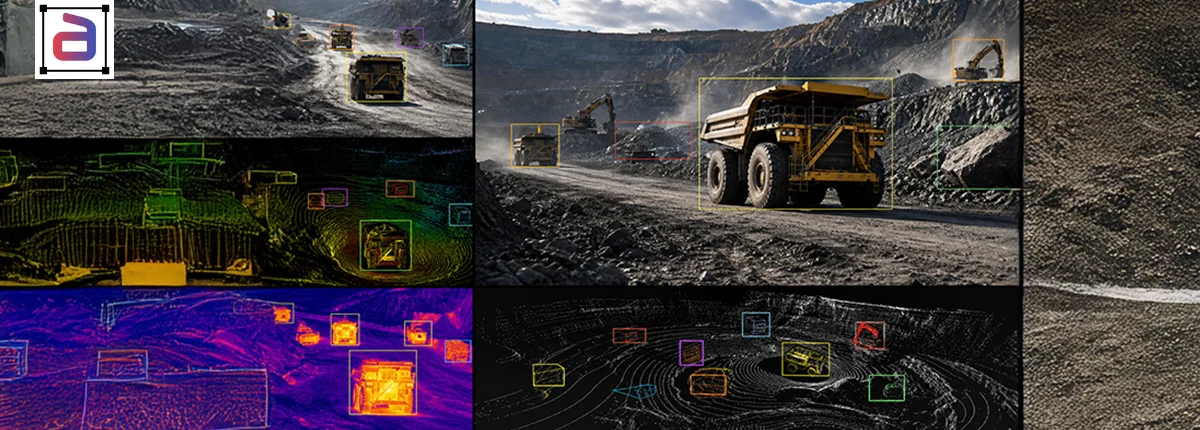
Each sensor contributes unique information. A camera may identify a worker’s safety vest. LiDAR can determine precise distance and spatial geometry. Radar can continue detecting objects through dust or fog. Thermal cameras can identify heat signatures in low-light conditions. Together, these sensors create a comprehensive understanding of the environment. But raw sensor data alone is not enough. AI models require accurately labeled training datasets that align information across every sensor stream. This process is known as multi-sensor video annotation, and it serves as the foundation of autonomous perception systems.
Why Annotation Quality Matters More Than Ever
The mining industry is accelerating its investment in automation technologies. According to industry forecasts, the global autonomous mining equipment market is expected to grow from approximately $4.7 billion in 2026 to more than $11 billion by 2034, reflecting the industry’s growing commitment to AI-driven operations. At the same time, mining automation continues to demonstrate measurable operational benefits. Studies indicate that autonomous haulage systems can improve productivity by 15–30% while significantly reducing workplace accidents.
“It’s driving efficiencies, more automated processes, and less man-hours.” — Mining Industry Expert
These gains are only possible when perception models are trained on highly accurate datasets. An incorrectly labeled obstacle, missed worker, or poorly annotated hazard zone can compromise the performance of an autonomous system operating in a safety-critical environment. In mining, annotation accuracy is not merely a quality metric—it is a safety requirement.
The Complexity of Multi-Sensor Video Annotation
Traditional video annotation focuses primarily on visual data. Mining autonomy requires something far more advanced. A single object must often be labeled simultaneously across:
- Camera imagery
- LiDAR point clouds
- Radar detections
- Thermal sensor outputs
- Spatial positioning data
For example, a haul truck visible in a camera frame must correspond precisely with its representation in LiDAR and radar datasets. Every annotation must remain synchronized across multiple modalities and thousands of video frames. This level of precision requires specialized expertise, scalable workflows, and robust quality control mechanisms. It also explains why mining organizations increasingly seek support from a trusted data annotation company capable of managing large-scale multimodal datasets.
Why Mining Companies Are Turning to Annotation Partners
As autonomous fleets expand, so does the volume of sensor data generated every day. A single mining operation can produce terabytes of video and sensor data daily. Managing annotation internally often becomes expensive, resource-intensive, and difficult to scale. As a result, many organizations are embracing data annotation outsourcing strategies to accelerate AI development while maintaining quality standards. Working with a specialized video annotation company offers several advantages:
- Faster project turnaround times
- Access to trained annotation experts
- Scalable workforce capacity
- Consistent quality assurance
- Reduced operational overhead
- Support for complex sensor-fusion workflows
More importantly, outsourcing allows mining companies to focus on innovation while ensuring that their AI systems are trained on accurate, reliable, and production-ready datasets. This growing demand has made video annotation outsourcing an essential component of modern autonomous mining programs.
How Annotera Powers the Next Generation of Mining AI
At Annotera, we understand that mining environments are fundamentally different from road-based autonomous systems. Our teams specialize in creating high-quality datasets for advanced AI applications, including:
- Multi-sensor video annotation
- LiDAR point cloud annotation
- 3D cuboid labeling
- Object tracking
- Semantic segmentation
- Sensor fusion validation
- Autonomous equipment perception training
By combining domain expertise, rigorous quality control, and scalable annotation operations, Annotera helps organizations build AI models that perform reliably in some of the world’s most demanding environments. Whether the objective is improving collision avoidance, enhancing fleet management, or enabling fully autonomous operations, accurate annotation remains the foundation of success.
Beyond the Road, Toward the Future
The future of autonomy extends far beyond highways and urban transportation. Mining represents one of the most complex testing grounds for artificial intelligence, where machines must operate safely amid uncertainty, changing terrain, and harsh environmental conditions. As automation continues to reshape the industry, multi-sensor video annotation will play an increasingly critical role in enabling intelligent, reliable, and safe autonomous systems. The organizations that invest in high-quality training data today will be the ones leading the mines of tomorrow.
Partner with Annotera
Building autonomous mining solutions requires more than data—it requires expertly annotated data that reflects the realities of challenging operational environments. Annotera delivers scalable, high-precision annotation services tailored to the needs of autonomous mining, industrial automation, and AI-driven perception systems. Looking for a trusted data annotation company to support your autonomous mining initiatives? Connect with Annotera today and discover how our annotation experts can help accelerate your AI development journey with accuracy, speed, and confidence.A closely related read: India’s Role in Training Data for Global Autonomous Vehicle Programs.