The race toward autonomous mobility is no longer driven by algorithms alone. Behind every perception model, prediction engine, and autonomous driving system is an enormous volume of training data—and the quality of that data can determine how reliably an autonomous vehicle performs in the real world. See how meticulously annotated data powers autonomous driving systems for the full annotation picture. As global autonomous vehicle programs expand across increasingly diverse environments, India is emerging as an important contributor to the training-data ecosystem. Its technology talent, established outsourcing infrastructure, growing AI capabilities, and experience handling large-scale data operations make the country strategically positioned to support global autonomous driving initiatives. For companies developing next-generation mobility systems, India is becoming more than a cost-effective delivery location. It is evolving into a valuable component of the global AI data pipeline.
Key Points
- India is emerging as a strategic training-data hub for global autonomous vehicle programs, supported by its AI talent, technology infrastructure, and mature outsourcing ecosystem.
- Diverse Indian road environments provide valuable training data, helping autonomous vehicle systems learn to handle complex traffic, pedestrians, two-wheelers, varied infrastructure, and challenging scenarios.
- Specialized data annotation is essential for AV development, including image and video labeling, LiDAR and 3D annotation, object tracking, sensor-fusion annotation, and edge-case data preparation.
- Data annotation outsourcing enables scalable AI development, allowing global autonomous vehicle companies to access skilled teams and quality-controlled datasets while focusing internal resources on AI models, testing, and deployment.
Autonomous Vehicles Need More Than Algorithms
An autonomous vehicle must continuously interpret a complex physical environment. Cameras, LiDAR, radar, GPS, and other sensors generate massive quantities of raw data that AI models must learn to understand. But raw data alone does not teach an AI system what it is seeing. Images and video need to be labeled with vehicles, pedestrians, cyclists, traffic signals, road signs, lanes, road boundaries, and other objects. LiDAR point clouds require 3D bounding boxes and semantic classifications. Video sequences need object tracking, while sensor-fusion projects require consistent labels across multiple modalities. This makes high-quality training data a foundational component of autonomous driving.
NASSCOM has described training data as the “Achilles’ Heel of AI,” emphasizing its ability to influence whether an AI model succeeds or fails. Its research estimated that India’s data annotation market was worth approximately $250 million in FY2020, with around 60% of revenues coming from U.S. clients. Managed services accounted for approximately 65–70% of India’s annotation market at the time. The lesson for autonomous vehicle developers is straightforward: sophisticated AI requires sophisticated data operations.
Why India Is Becoming a Strategic Training-Data Hub
India already has decades of experience delivering technology and business-process services to global enterprises. That foundation provides several advantages for data-intensive autonomous vehicle programs. First is scalability. Autonomous driving projects can involve millions of images, video frames, point clouds, and sensor records. A capable data annotation company can build specialized teams and processes around rapidly changing project volumes. Second is technical talent. Modern annotation increasingly involves more than drawing boxes around objects. Teams may need to understand 3D geometry, sensor data, object tracking, segmentation, temporal relationships, and complex quality-control requirements. Third is operational maturity. India’s established outsourcing ecosystem has experience working with international clients, standardized workflows, quality assurance, security protocols, and large distributed teams.
India’s Road Environments Offer Valuable Diversity
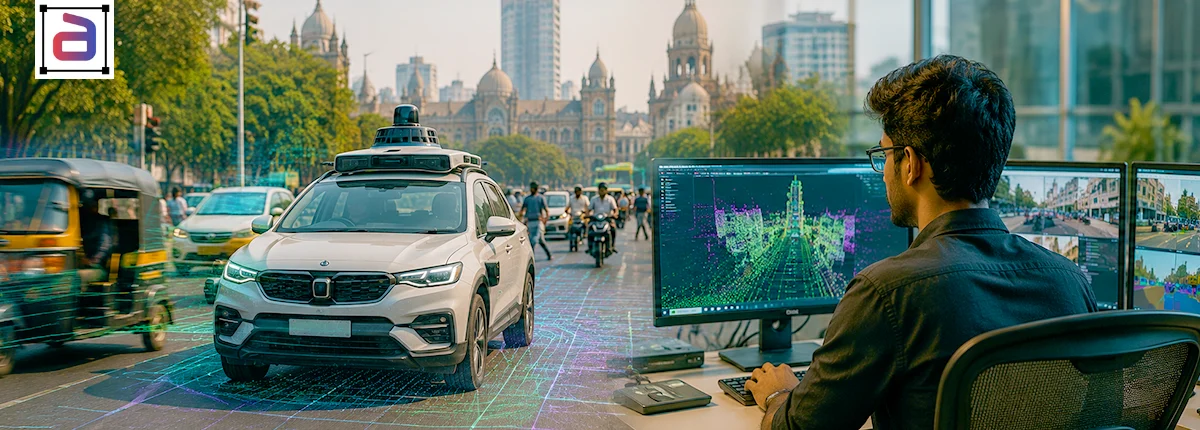
India also brings something that cannot be replicated through technology infrastructure alone: complex real-world driving environments. Indian roads can include dense traffic, motorcycles, pedestrians, varied vehicle types, informal road behavior, complex intersections, inconsistent lane markings, and rapidly changing road conditions. This diversity can be valuable for AI developers seeking to improve perception systems and prepare models for scenarios outside highly structured road environments. Research behind the Indian Driving Dataset (IDD-3D) highlights this challenge. The dataset was created specifically to address complex and unstructured Indian road scenarios and contains 12,000 annotated LiDAR frames collected across multiple traffic situations. Additionally, researchers noted that many existing autonomous-driving datasets are geographically biased toward developed cities. Consequently, this may not adequately represent the diversity found in countries such as India. For global autonomous vehicle programs, geographically diverse training data can help expose models to different object densities, road layouts, traffic behaviors, and environmental conditions.
From Image Annotation to 3D Sensor Data
The role of an Indian data annotation company can extend across the complete autonomous vehicle data lifecycle.
Computer Vision Annotation
Teams can identify and classify vehicles, pedestrians, cyclists, traffic signs, traffic lights, road markings, and other objects in images and video.
LiDAR and 3D Annotation
3D bounding boxes, point-cloud segmentation, object classification, and spatial relationships are increasingly important for autonomous perception systems.
Video and Object Tracking
Autonomous systems need to understand not only what an object is but also how it moves. Temporal annotation helps models learn trajectories and interactions across consecutive frames.
Sensor-Fusion Annotation
Modern autonomous vehicle platforms combine cameras, radar, LiDAR, and other sensors. Consistent labeling across these data sources is essential for building reliable multimodal perception systems.
Edge-Case Annotation
Rare events can create disproportionate challenges for autonomous systems. Construction zones, emergency vehicles, unusual pedestrian behavior, poor visibility, road obstructions, and unexpected maneuvers can all become valuable training scenarios.
The Scale of Autonomous Driving Makes Data Outsourcing Critical
The scale of leading autonomous vehicle programs illustrates why specialized data operations are increasingly important. In February 2026, Waymo said its sixth-generation Driver had accumulated nearly 200 million fully autonomous miles across more than 10 major cities. By June 2026, the company reported that its safety analysis covered more than 220 million fully autonomous miles through March 2026. Waymo’s experience demonstrates a fundamental principle of autonomous driving development. Real-world exposure creates enormous quantities of data that can be used to improve, validate, and expand autonomous systems. As autonomous programs scale into additional cities and operating environments, the demand for structured, accurately labeled training data will scale with them.
Why Data Annotation Outsourcing Makes Sense
Building an internal annotation operation can create significant challenges around recruitment, training, infrastructure, quality control, and fluctuating project volumes. Data annotation outsourcing allows autonomous vehicle companies to access specialized teams without building every operational capability internally. The right partner can provide trained annotators, standardized annotation guidelines, multi-level quality assurance, project management, and scalable delivery. More importantly, outsourcing allows internal AI engineers to concentrate on model development, simulation, testing, and deployment while a specialized team manages the data layer. Further, for autonomous vehicle programs, however, outsourcing should never mean compromising quality. Inaccurate labels can introduce noise into training datasets and potentially undermine model performance.
Annotera: Turning Complex AV Data Into AI-Ready Training Data
This is where Annotera brings strategic value. Annotera provides scalable data annotation solutions designed to support demanding AI and machine learning applications. Its India operations combine a technically skilled workforce with high-throughput delivery capabilities, supporting workflows. This includes image segmentation for autonomous vehicles, video labeling, and other specialized AI training-data requirements. For global autonomous vehicle developers, Annotera can serve as an extension of the data operations team. We help in transform raw visual and sensor information into structured datasets that AI systems can learn from. India’s opportunity in autonomous mobility is therefore not limited to building vehicles or developing algorithms. Also, it can also play a critical role behind the scenes: creating the high-quality training data. We enable autonomous systems to perceive, interpret, and respond to increasingly complex environments.
The Road Ahead Is Data-Driven
Autonomous driving will ultimately depend on the convergence of sensors, compute, algorithms, simulation, testing, and high-quality training data. India’s combination of technology talent, outsourcing expertise, operational scale, and diverse driving environments gives it a strong position within this ecosystem. For companies developing autonomous vehicle technology, partnering with the right data annotation company can transform annotation from a bottleneck into a competitive advantage. Ready to build better training data for your autonomous vehicle program? Partner with Annotera for scalable, quality-focused data annotation and data annotation outsourcing solutions tailored to complex AI workflows. Get in touch with Annotera today and turn your raw data into AI-ready intelligence.
A closely related read: Video Annotation for Robotics: Teaching Autonomous Systems to Understand Motion.