
As large language models move from experimental pilots to enterprise-grade applications, organizations face a growing challenge: ensuring AI systems behave reliably across languages, cultures, and geographies. A model that delivers safe, nuanced, and contextually accurate responses in English may struggle when interacting in Hindi, Spanish, Arabic, Japanese, or other languages. Multilingual RLHF enables large language models to learn from human feedback across diverse languages and cultures, improving response consistency, safety, and contextual relevance. It helps organizations build globally aligned AI systems using high-quality LLM training Ddata and native-speaker evaluations. This inconsistency has become one of the most significant barriers to global AI adoption.
At Annotera, we believe the future of trustworthy AI depends on high-quality human feedback collected from native speakers who understand linguistic subtleties, cultural expectations, and regional contexts. This is precisely where Multilingual Reinforcement Learning from Human Feedback (RLHF) emerges as a strategic advantage. Organizations building next-generation generative AI applications increasingly recognize that multilingual alignment is not simply a translation exercise—it is a data-centric challenge that requires expertly curated LLM training data, scalable human evaluation pipelines, and domain-specific feedback mechanisms.
Key Points
- LLMs trained primarily on English RLHF data produce inconsistent and unsafe outputs in other languages.
- Multilingual RLHF requires native-speaker annotators for each target language — translated preference data is not a substitute.
- Cultural context, idiomatic expressions, and local norms vary across languages and cannot be captured through translation alone.
- Performance parity across languages is a safety requirement for enterprise LLMs deployed in global markets.
Table of Contents
Leading AI Researchers Are Highlighting the Challenge
Researchers behind Google’s massively multilingual language model research noted:
“Language technologies should serve speakers of all languages, not just those with abundant digital resources.”
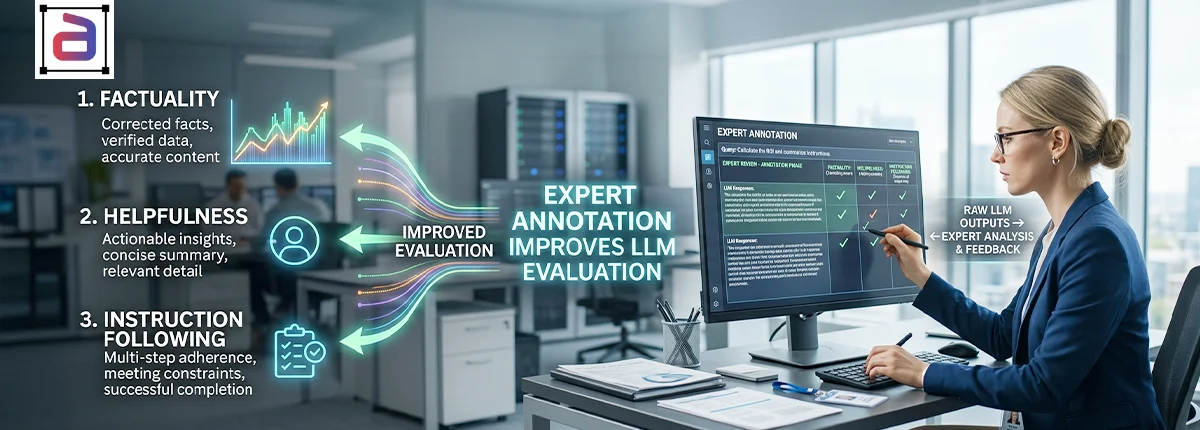
Similarly, researchers working on multilingual preference optimization have shown that models aligned using multilingual human feedback consistently outperform English-only aligned models in instruction following, helpfulness, and cultural appropriateness. These findings reinforce an important reality: global AI systems require global human intelligence. Researchers increasingly emphasize that language models trained predominantly on English data struggle to generalize globally. Consequently, multilingual preference optimization and native-speaker feedback have become essential for improving cultural relevance, instruction adherence, and response consistency across diverse languages.
How Annotera Helps Enterprises Build Globally Aligned LLMs
At Annotera, we understand that multilingual RLHF is more than an annotation task—it is an alignment strategy that determines how effectively AI products engage users across markets. As a trusted data annotation company, Annotera supports AI teams with scalable, human-in-the-loop workflows designed specifically for multilingual model alignment. Our capabilities include:
- Native-speaker preference ranking across multiple languages
- Multilingual prompt-response evaluation
- Safety and toxicity assessments for region-specific use cases
- Reward model dataset creation
- Domain-specific feedback collection for healthcare, finance, legal, retail, and enterprise AI applications
- Consensus-driven quality assurance frameworks
- Flexible data annotation outsourcing models that accelerate development timelines while maintaining rigorous quality standards
Whether organizations are fine-tuning customer support copilots, enterprise knowledge assistants, multilingual chatbots, or foundation models, Annotera enables teams to build AI systems that are not only intelligent but also culturally aware, safe, and globally scalable. Annotera empowers enterprises to develop globally aligned LLMs through multilingual preference annotation, native-speaker evaluations, and scalable human feedback workflows. Moreover, our expert-led processes help improve model safety, cultural relevance, and performance consistency across diverse languages and markets.
The Future of AI Speaks Every Language
The race to build larger models is giving way to a more important challenge: building models that understand people. Tomorrow’s most successful AI systems will not merely translate words. They will recognize cultural nuances, adapt communication styles, uphold regional safety expectations, and provide equitable experiences regardless of the user’s language.
Multilingual RLHF is rapidly becoming the cornerstone of this transformation. Organizations investing today in high-quality LLM training data, multilingual preference datasets. This expert human evaluation frameworks will be better positioned to deploy AI products that earn trust across borders and industries. At Annotera, we are committed to helping enterprises bridge the gap between language capability and language understanding—ensuring that AI performs consistently, responsibly, and effectively for users everywhere. As AI adoption accelerates worldwide, future-ready models must understand linguistic nuances and cultural contexts. Therefore, multilingual RLHF will play a pivotal role in enabling AI systems to deliver trustworthy experiences for users across every language and region. The future of intelligent robotics depends on understanding human preferences. Robot preference annotation captures choices, behaviors, and feedback, helping AI systems learn what people prefer and enabling robots to deliver safer, more personalized, and context-aware interactions.
Ready to Build Multilingual AI That Users Trust?
Training globally capable language models requires more than scale—it requires high-quality human insight. Partner with Annotera to accelerate multilingual RLHF initiatives through expert preference annotation, native-speaker evaluations, and enterprise-grade human feedback pipelines designed for production-ready LLMs. Talk to our AI data specialists today and discover how Annotera can help you create multilingual AI experiences.
A closely related read: RAG vs. Fine-Tuning: Which One Should You Choose?.
A closely related read: How Multi-Agent Collaboration Enhances Reasoning in LLMs.