When we think about machines understanding audio, speech usually comes first. Voice assistants, automated customer support, conversational AI, and speech transcription have made spoken-language processing a major component of modern artificial intelligence.
But the acoustic world contains far more information than words.
A smoke alarm, breaking glass, approaching footsteps, a vehicle horn, barking dog, malfunctioning machine, or object hitting the floor can communicate critical information without anyone speaking.
Teaching AI to recognize these signals is the purpose of sound event detection (SED). And behind reliable sound-aware AI lies something equally important: accurately annotated audio data. Capturing these events consistently is the same discipline behind noise labeling for voice AI.
At Annotera, we help organizations turn complex audio into structured, AI-ready datasets through scalable audio annotation services designed around real-world model requirements.
Key Points
- Sound Expands Robotic Perception: Sound event detection enables robots to recognize alarms, machinery, footsteps, impacts, and other environmental events that visual sensors may miss.
- Precise Annotation Builds Reliable AI: Accurate classification, timestamps, multi-label annotation, and acoustic metadata create high-quality robot training data for sound-aware AI systems.
- Multimodal Data Creates Better Context: Combining annotated audio with camera, LiDAR, depth, and other sensor data helps robots understand real-world events more comprehensively.
- Human Expertise Strengthens Data Quality: Professional robotics data annotation services help maintain consistent labels, capture complex edge cases, and prepare scalable datasets for real-world robotic applications.
What Is Sound Event Detection?
Sound event detection is a machine learning task that identifies specific acoustic events and determines when they occur within an audio stream.
It differs fundamentally from speech transcription.
Transcription answers:
“What was said?”
Sound event detection answers:
“What happened, and when?”
An SED system could recognize events such as:
-
Sirens and alarms
-
Footsteps
-
Glass breaking
-
Vehicle horns
-
Doors opening or closing
-
Machinery operating
-
Animals barking or calling
-
Objects falling
-
Engine noises
-
Household appliances
-
Construction sounds
-
Environmental events
The model may also need to determine when an event starts and ends, whether multiple sounds overlap, and—in more sophisticated systems—where the sound originated.
This creates complex annotation requirements that extend far beyond assigning one label to an audio file.
“For intelligent systems to make best use of the audio modality, it is important that they can recognize not just speech and music… but also general sounds in everyday environments.” — DCASE research
The Scale of Machine Listening Is Already Significant
Large public datasets illustrate just how diverse the acoustic world can be.
Google’s AudioSet contains more than 2.08 million human-labeled 10-second audio clips and an expanding ontology containing 632 audio event classes. Its categories span human and animal sounds, musical instruments, and everyday environmental events.
The scale of AudioSet demonstrates an important principle: machines require extensive, diverse, human-labeled examples to learn the enormous variety of sounds encountered outside controlled environments.
Commercial interest in audio intelligence is also expanding. Grand View Research valued the global voice and speech recognition market at approximately $20.2 billion in 2023 and projects it to reach $53.7 billion by 2030, representing a 14.6% CAGR from 2024 to 2030.
While speech recognition and SED solve different problems, both belong to the broader evolution toward machines capable of extracting meaningful information from audio.
For organizations building these systems, partnering with an experienced data annotation company can provide the human expertise required to transform raw recordings into dependable training datasets.
How Audio Annotation Makes Sound Detection Possible
A raw audio recording is essentially an unstructured signal. Annotation adds semantic meaning.
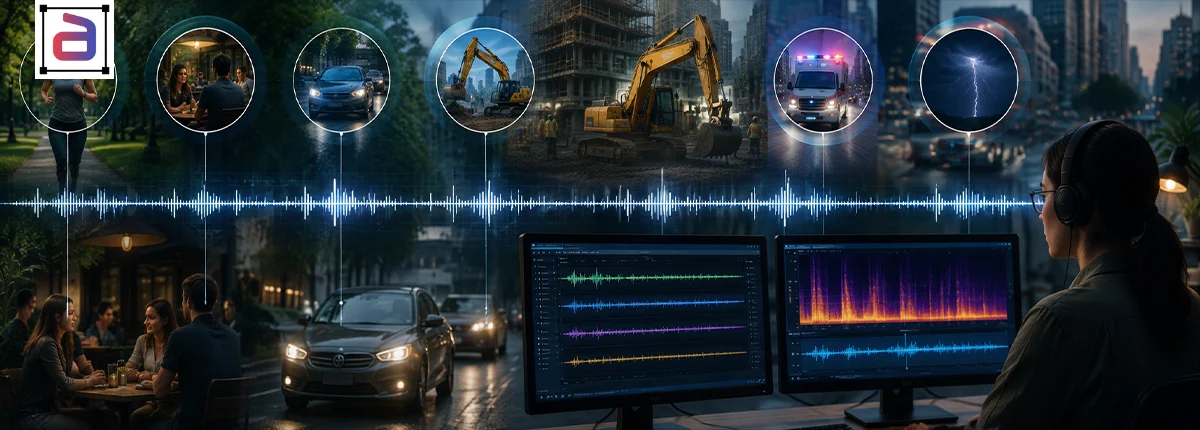
Consider a 15-second recording containing:
00:02.1–00:04.3 — Footsteps
00:05.8–00:06.7 — Door slam
00:09.4–00:12.2 — Dog barking
These temporal labels teach models both what an event sounds like and when it occurs.
Depending on the application, Annotera’s audio annotation services can support different annotation structures.
Audio Classification
Audio clips are categorized according to the sounds they contain. This approach is useful when recordings contain relatively distinct events.
Timestamp Annotation
Annotators mark the beginning and end of each event. Timestamp-level ground truth is critical for models that must continuously detect events within longer recordings.
Multi-Label Annotation
Real environments often contain several simultaneous sounds. Multi-label workflows capture overlapping events rather than forcing each recording into a single category.
Acoustic Attribute Annotation
Projects may require additional labels for background noise, intensity, environmental context, source characteristics, or other attributes relevant to model objectives.
Real-World Audio Is Complicated
The greatest annotation challenges emerge when AI moves from laboratory datasets into real environments.
Imagine audio recorded at a busy intersection.
Cars are moving. People are talking. A truck engine is idling. Someone sounds a horn. Construction equipment is operating nearby. Then an ambulance siren appears in the distance.
Humans can often separate these signals almost instinctively. AI models must learn the distinction from data.
Research challenges such as DCASE specifically evaluate systems in multisource conditions because everyday sounds are rarely encountered in isolation. DCASE sound event detection tasks have also incorporated weakly labeled, unlabeled, and strongly timestamped data, demonstrating the range of annotation structures involved in training SED models.
“Real-world sound understanding is fundamentally a context problem: models must learn individual events while handling everything happening around them.”
This makes annotation consistency essential.
Poor timestamps, ambiguous class definitions, missed events, or inconsistent labeling can introduce noise directly into the model-training pipeline.
Beyond Speech Transcription: Understanding the Entire Acoustic Scene
Speech transcription remains indispensable for voice assistants, contact-center analytics, conversational AI, meeting intelligence, and automatic speech recognition.
But imagine what becomes possible when AI understands both speech and its surrounding acoustic context.
A smart-home system could understand a spoken command while simultaneously detecting a smoke alarm.
A vehicle could process passenger speech while recognizing an emergency siren outside.
An industrial monitoring system could capture technician conversations while identifying unusual machinery sounds.
A robot could understand verbal instructions while recognizing an object falling nearby.
Combining speech, environmental sound, video, and sensor information creates richer multimodal datasets—and ultimately more context-aware AI.
Why Data Annotation Outsourcing Matters for Audio AI
Building large-scale audio datasets internally requires more than annotators.
Teams must create taxonomies, define annotation rules, train workforces, calibrate reviewers, monitor agreement, handle ambiguous recordings, manage quality assurance, and scale capacity as dataset requirements change.
This is where data annotation outsourcing can become strategically valuable.
An experienced annotation partner can provide the operational infrastructure and specialized workforce required to process large volumes of audio while maintaining defined quality standards.
More importantly, the right data annotation company should understand that different AI applications require different ground-truth structures.
A speech recognition project may prioritize verbatim transcription and speaker attribution. A sound detection system may prioritize temporal boundaries and event taxonomies. Multimodal AI may require audio events synchronized with video or other sensor streams.
Annotation workflows must therefore be designed around the model—not the other way around.
Annotera: Human Expertise Behind Smarter Audio AI
At Annotera, we help AI teams transform complex audio into structured datasets built around their machine learning objectives.
Our audio annotation services can support:
-
Sound event classification
-
Audio segmentation
-
Timestamp annotation
-
Multi-label audio annotation
-
Speaker labeling
-
Speech transcription
-
Acoustic attribute labeling
-
Multimodal annotation
-
Project-specific taxonomies
-
Human quality review
Annotera combines trained human annotators, structured workflows, scalable delivery, and quality-control processes to help organizations develop reliable ground truth for sophisticated AI applications.
“Better machine listening starts with better human-labeled data.”
From Hearing Sound to Understanding Context
The next generation of AI will need to do more than recognize voices.
Machines operating in homes, factories, vehicles, hospitals, public spaces, and robotic environments must interpret the wider acoustic world around them.
Sound event detection makes that possible—but only when models have access to diverse, accurately labeled, context-rich training data.
Turn Real-World Audio into AI-Ready Data with Annotera
Building an audio AI model that needs to recognize more than words? Partner with Annotera for scalable audio annotation services, speech transcription, sound event labeling, and customized data annotation outsourcing.
From thousands of recordings to complex multimodal datasets, Annotera provides the human intelligence behind high-quality AI training data. Connect with Annotera today and build AI that doesn’t just hear the world—it understands it.
A closely related read: Audio Classification Annotation for Environmental Sound Recognition
To go deeper on this topic, Training AI for Smart Homes: Sound Event Detection