Robotics is no longer confined to factory floors and research laboratories. Today, intelligent robots are navigating warehouses, assisting surgeons, inspecting infrastructure, supporting agriculture, and even delivering products in urban environments. Behind these advancements lies a critical technology that often goes unnoticed: high-quality AI training data. For robots to understand the world around them, they need more than images—they need spatial intelligence. This is where video cuboid annotation becomes essential. By enabling AI systems to perceive objects in three-dimensional space across video frames, cuboid annotation powers accurate 3D scene understanding for modern robotics applications. As robotics systems grow more sophisticated, businesses increasingly depend on a trusted data annotation company and video annotation outsourcing solutions to accelerate AI development. At Annotera, we help organizations build smarter robotics AI through precision-driven annotation services tailored for real-world machine learning performance.
Key Points
- Robots operating in unstructured environments need 3D spatial understanding, not just object detection — cuboid annotation provides the depth and orientation data required.
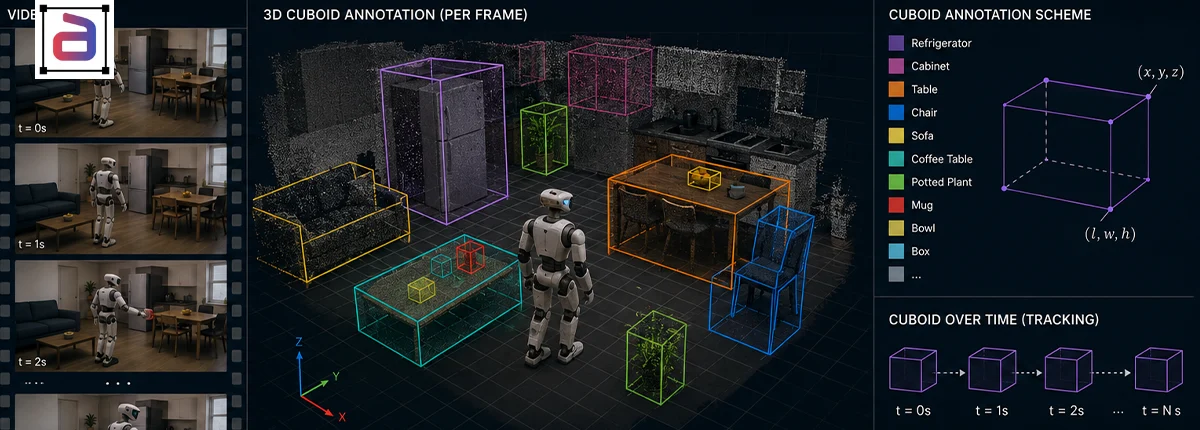
- Video cuboid annotation tracks object dimensions, position, and heading across frames, enabling robots to plan grasps and movements in dynamic scenes.
- Annotation accuracy in robotics is directly tied to physical safety: a mislabeled object size or position can cause a robot to apply incorrect force or trajectory.
- Production robotics annotation programs require annotators with spatial reasoning training, not just image labeling experience.
Table of Contents
What Is Video Cuboid Annotation?
Video cuboid annotation is a specialized 3D labeling technique used in computer vision and robotics. Unlike traditional 2D bounding boxes, cuboid annotations capture an object’s height, width, depth, and orientation across sequential video frames. This added spatial dimension allows robotics AI models to better understand:
- Object positioning
- Distance estimation
- Movement trajectories
- Spatial relationships
- Environmental depth
- Occlusion patterns
In robotics, this level of understanding is critical. Whether an autonomous robot is navigating a crowded warehouse or a drone is mapping uneven terrain, accurate 3D scene interpretation directly impacts safety, precision, and operational efficiency.
“AI is the new electricity.” — Andrew Ng
But without accurately annotated data, even the most advanced AI models cannot function effectively.
Why 3D Scene Understanding Matters in Robotics
Robotics systems operate in dynamic, unpredictable environments where machines must constantly interpret spatial information in real time. Unlike static image recognition tasks, robotics AI requires contextual awareness of movement, depth, and object interaction. For example: Reliable scene understanding rests on accurate 3D cuboid yaw ground truth.
- Autonomous warehouse robots must avoid collisions while optimizing routes.
- Delivery robots need to identify sidewalks, pedestrians, and obstacles.
- Agricultural robots must differentiate crops from terrain variations.
- Industrial robotic arms require precise object localization for manipulation tasks.
Traditional 2D annotations simply cannot provide the depth intelligence necessary for these applications. Video cuboid annotation fills this gap by giving AI models a more human-like understanding of physical environments.
How Video Cuboid Annotation Improves Robotics AI
Modern robotics systems require accurate spatial intelligence to operate efficiently, making advanced annotation techniques essential for improving AI-driven perception, navigation, and real-time environmental understanding. 3D cuboid video annotation services help robotics AI models understand object depth, motion, and spatial positioning across video sequences. This improves navigation accuracy, obstacle detection, and real-time decision-making in autonomous robotics and advanced computer vision applications.
Enhanced Object Localization
Cuboid annotations help robotics systems understand where objects exist within a 3D environment. This enables more accurate navigation, obstacle avoidance, and robotic movement planning.
Improved Motion Tracking
Robotics AI must continuously track moving objects across video sequences. Video cuboid annotation maintains object consistency frame-by-frame, helping models predict movement more accurately.
Better Depth Perception
Depth estimation is fundamental for robotics applications involving object interaction and spatial awareness. Cuboid annotations train AI models to interpret volumetric relationships within scenes more effectively than flat 2D labels.
Reliable Occlusion Handling
Real-world environments are messy. Objects frequently overlap, disappear temporarily, or move unpredictably. Cuboid annotation helps preserve object identity even during partial occlusion, improving model stability and tracking accuracy.
The Growing Demand for Annotation Expertise
As robotics and automation continue to scale globally, annotation quality has become a competitive differentiator for AI development. According to Grand View Research, the global data annotation tools market size was estimated at USD 1.02 billion in 2023 and is projected to reach USD 5.33 billion by 2030, growing at a CAGR of 26.5% from 2024 to 2030. . However, building in-house annotation operations for robotics AI presents several challenges:
- Large-scale video processing requirements
- Specialized annotation expertise
- Quality assurance complexities
- High operational costs
- Time-intensive workflows
Why Businesses Choose Data Annotation Outsourcing
Modern AI development demands scalability, consistency, and speed. Managing annotation internally can slow deployment cycles and increase operational strain.
Faster Project Scalability
Annotation needs can fluctuate dramatically during model training phases. Outsourcing enables businesses to scale quickly without recruiting and training large internal teams.
Access to Specialized Expertise
A professional data annotation company brings domain-specific knowledge, advanced tooling capabilities, and experienced annotators trained in complex labeling formats such as cuboid annotation and object tracking.
Higher Annotation Accuracy
Poor-quality data leads to poor-performing AI systems. Professional annotation providers implement structured QA workflows to maintain consistency and precision.
“Poor data quality costs organizations an average of $12.9 million every year.” — Gartner
Reduced Operational Burden
By leveraging video annotation outsourcing, organizations can focus on AI innovation while experienced annotation teams manage large-scale dataset preparation.
Why Annotera Is the Preferred Annotation Partner
At Annotera, we understand that robotics AI demands more than standard labeling workflows. It requires precision, scalability, and deep expertise in computer vision annotation. As a trusted video annotation company, Annotera delivers high-quality annotation solutions designed specifically for advanced AI and robotics applications.
- Video cuboid annotation
- 3D object tracking
- Semantic segmentation
- LiDAR and sensor fusion annotation
- Autonomous vehicle annotation
- Human-in-the-loop quality validation
Whether businesses require enterprise-scale data annotation outsourcing or specialized robotics annotation workflows, Annotera provides scalable solutions built for production-ready AI systems. Annotera delivers high-precision video semantic segmentation services that help enterprises train smarter AI models through pixel-level accuracy, scalable annotation workflows, multilingual expertise, and rigorous quality assurance designed for complex multimodal AI and computer vision applications.
The Future of Robotics Starts with Better Data
The next generation of robotics will depend heavily on AI systems capable of understanding complex physical environments with near-human accuracy. Video cuboid annotation is becoming a foundational component of 3D scene understanding, enabling robots to perceive depth, movement, and environmental context more intelligently than ever before. Businesses that invest in high-quality annotation today will be better positioned to build safer, smarter, and more scalable robotics solutions tomorrow.
Ready to Power Smarter Robotics AI?
Partner with Annotera to access scalable, high-precision annotation solutions tailored for robotics and computer vision applications. Contact Annotera today and discover how our industry-leading annotation services can support your next breakthrough in robotics innovation.