
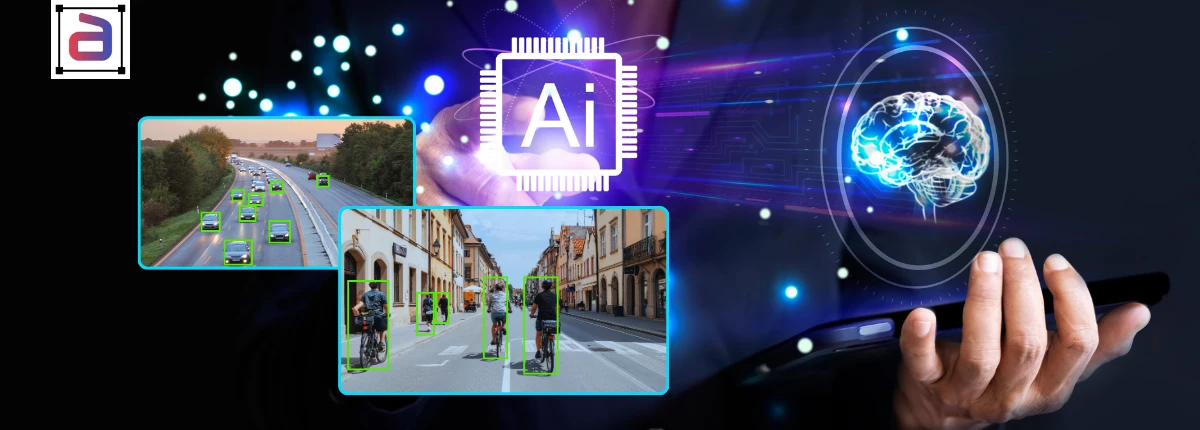
Every supervised AI model learns from examples that a person has explained to it. A defect detector learns from images where someone has outlined the defects. A support chatbot learns from conversations where someone has tagged the customer’s intent. A speech model learns from audio that someone has transcribed word by word. That explanation step is data annotation, and it decides more about how a model behaves in production than most teams expect. This guide covers what data annotation is, the main types, how the process works, how quality is measured, and how to decide who should do the work.
In This Article
Key Points
- Data annotation adds labels to raw images, video, text, audio or sensor data so a machine learning model can learn from it.
- The labels become the model’s ground truth: it learns whatever they encode, including their mistakes and inconsistencies.
- Good annotation is a process, not a task: written guidelines, a pilot, a gold set, layered QA and a feedback loop.
- Quality is measured with agreement between annotators, accuracy against a gold set and error severity, not with one overall score.
- Teams choose between in-house, crowdsourced and managed annotation based on volume, data sensitivity and how much expertise the labels need.
What Is Data Annotation?
Data annotation is the process of adding labels to raw data, such as images, video, text, audio or sensor readings, so that a machine learning model can learn from it. Each label records a human judgment: this region of the image is a pedestrian, this sentence is a cancellation request, this stretch of audio is the second speaker. The model studies thousands or millions of those judgments and learns to make them on its own.
Raw data on its own teaches a model very little. A folder of street images contains pedestrians, but nothing in the pixels tells a model which ones they are. Annotation supplies that missing structure. It is also where business rules enter the dataset: what counts as a defect, which complaints need escalation, how a partly hidden product on a shelf should be treated. Those decisions are made by people, written into guidelines and applied consistently, or the model learns something nobody intended.
Data Annotation vs Data Labeling
In everyday use, the two terms mean the same thing, and most teams use them interchangeably. Where a distinction is drawn, “labeling” usually means assigning a class to a whole item, such as tagging an image as “damaged”, while “annotation” covers richer work like drawing boundaries, marking relationships between entities or adding timestamps. Our guide to data annotation vs data labeling explains where the difference matters in practice.
Types of Data Annotation
Annotation types follow the kind of data a model learns from. Many production systems combine several, which is why multimodal data annotation that keeps labels aligned across formats is becoming common.
| Data type | Common annotation methods | Typical applications |
|---|---|---|
| Image | Bounding boxes, polygons, semantic segmentation, landmarks, classification | Retail shelf monitoring, medical imaging, quality inspection |
| Video | Object tracking, event and action tagging, keypoints across frames | Autonomous vehicles, security, sports and robotics |
| Text | Named entities, intent, sentiment, classification, relations | Chatbots, document processing, search, compliance |
| Audio | Transcription, speaker labels, sound events, emotion | Voice assistants, call analytics, speech recognition |
| LiDAR and 3D | 3D cuboids, point cloud segmentation, sensor fusion | Autonomous driving, robotics, mapping |
| LLM and generative AI | Prompt-response writing, preference ranking, evaluation, red teaming | Fine-tuning, RLHF, model evaluation and safety |
Image Annotation
Image work ranges from tagging a whole image to outlining every pixel that belongs to an object. Bounding boxes are fast and suit object detection; polygons and segmentation masks capture exact shapes where boundaries matter, as in medical scans or crowded retail shelves. See our image annotation services for the full range of methods.
Video Annotation
Video adds time. Objects have to keep the same identity from frame to frame, partly hidden objects need consistent rules, and actions have start and end points that must be marked precisely. Those temporal decisions are where most video datasets go wrong, and they are the core of video annotation work.
Text Annotation
Text annotation teaches language models what words mean in context: which phrases are names, dates or amounts, what a customer wants, how they feel, and how parts of a document relate to each other. Domain knowledge matters here, because a legal clause or a clinical note can only be labeled correctly by someone who understands it. Our text annotation services cover these NLP tasks.
Audio Annotation
Audio annotation turns speech and sound into training data: transcripts, speaker turns, timestamps, background events and tone. Accents, dialects and overlapping speech make it demanding, and native speakers are essential for anything beyond English. Our audio annotation work covers speech and non-speech audio.
LiDAR and 3D Annotation
Self-driving cars and robots see the world in three dimensions, through LiDAR point clouds and multiple sensors. Annotators place 3D cuboids around objects, segment points by class and keep labels consistent across sensors and time. The work is slower and more specialized than 2D labeling; our LiDAR annotation page explains how it is done.
LLM and Generative AI Annotation
Large language models need a different kind of human input. People write example prompts and ideal responses for fine-tuning, rank competing answers so the model learns preferences, grade outputs for accuracy and safety, and try to provoke harmful responses before users do. This is the newest and fastest-growing area of annotation, covered by our LLM and generative AI annotation services.
How the Data Annotation Process Works
Reliable annotation follows a repeatable process. Skipping the early steps is the most common reason a dataset has to be relabeled later.
- Define the task and the label set. Decide what the model needs to learn, which classes exist, and what each one means, with examples and counter-examples.
- Write the guidelines. Turn every decision into a written rule, including edge cases: partly hidden objects, ambiguous sentences, overlapping speech. Our guide to writing effective annotation guidelines covers what good ones contain.
- Run a pilot. Label a small sample, compare annotators, and fix the guidelines wherever people disagree. A pilot usually exposes more unclear rules than any review meeting.
- Build a gold set. Have experts label a reference sample that represents the real data, including hard cases. It becomes the yardstick for training and scoring annotators.
- Annotate at scale with layered QA. Production labeling runs with peer review, expert spot checks and adjudication of disagreements, rather than a single pass.
- Measure, feed back and version. Track quality metrics, update the guidelines when new edge cases appear, and version both the guidelines and the dataset so every label can be traced.
Ground Truth: What Annotation Produces
The output of annotation is ground truth: the set of answers a model is trained and tested against. The name suggests certainty, but ground truth is only as reliable as the guidelines and people that produced it. If annotators disagree on 10% of items, the model is learning from a reference that is wrong or arbitrary 10% of the time, and its measured accuracy will be misleading in the same proportion.
That is why mature teams treat ground truth as something to design and maintain. They keep separate training, validation and test sets, protect the test set from leaking into training, and refresh the reference data when the real world changes: new products, new slang, new types of fraud. Stale ground truth produces models that score well in testing and disappoint in production.
How Annotation Quality Is Measured
Quality has to be measured, because an annotated dataset looks equally convincing whether it is right or wrong. A single “98% accurate” figure hides more than it reveals; useful measurement breaks quality down.
- Agreement between annotators. How often independent people give the same label. Low agreement usually means unclear guidelines rather than careless people. Our guide to inter-annotator agreement explains how to measure it for subjective tasks.
- Accuracy against the gold set. Scores each annotator and each batch against the expert reference.
- Per-class results. Quality reported for each class, so rare or look-alike classes cannot hide behind a strong average.
- Boundary precision. For boxes, polygons and masks, how closely shapes match the reference, usually measured as overlap (IoU).
- Error severity. Not every error costs the same. A misspelled filler word in a transcript is cosmetic; a wrong drug dosage is critical. Weighting errors by impact keeps attention on the ones that matter.
Our best practices for quality assurance in data annotation cover how to build these checks into the workflow.
Human in the Loop and AI-Assisted Labeling
Modern annotation rarely starts from a blank screen. A model often pre-labels the data and people correct it, or the model selects the examples it is least sure about and people label those first. Both approaches cut cost and time, but only if the human review stays rigorous; a person who simply accepts a model’s suggestion adds nothing. NIST researchers studying machine-assisted annotation describe the aim as using machine learning to assist a human in domain-specific tasks, not to replace the person.
The same idea extends beyond training data into live AI systems, where people review uncertain predictions, verify alerts and feed corrections back into the next training round. Our guide to human-in-the-loop AI covers how that works and where it pays off, and our comparison of human-in-the-loop and fully automated annotation explains when each approach fits.
Why Annotation Quality Decides Model Performance
A model cannot tell a correct label from an incorrect one. It learns whatever patterns the labels contain, so annotation problems turn directly into model problems. Four failures account for most of them. Inconsistent labels, where two annotators read the same rule differently, teach the model contradictory patterns. Missing edge cases leave the model blind in exactly the rare situations that matter most, such as fraud attempts or unusual road scenes. Weak QA lets errors spread silently through the dataset until they surface in production. And label drift, where definitions loosen over months, fragments the dataset so that old and new labels no longer mean the same thing.
Regulators now treat this as a governance issue, not just an engineering one. Article 10 of the EU AI Act lists data-preparation operations “such as annotation, labelling, cleaning, updating, enrichment and aggregation” among the practices that must be governed for high-risk AI systems, and requires that training, validation and testing data sets be relevant, sufficiently representative, and to the best extent possible, free of errors and complete in view of their intended purpose. Documented guidelines, QA records and dataset versions are becoming part of the evidence buyers and regulators expect.
In-House, Crowdsourced or a Managed Team?
There are three common ways to get annotation done, and many organizations use more than one. The right choice depends on volume, how sensitive the data is, how much expertise each label needs and how quickly demand changes.
| Model | Works best when | Watch out for |
|---|---|---|
| In-house team | Volumes are small, data cannot leave the company, or labels need deep internal knowledge | Hiring, training and QA overhead; hard to scale up or down |
| Crowdsourcing | Tasks are simple, low-risk and very high volume | Inconsistent quality, limited security, little domain expertise |
| Managed annotation team | Volumes are large or variable, tasks need trained specialists, and security and QA must be documented | Needs clear guidelines and a pilot to set expectations |
Our guide on whether to outsource data annotation or keep it in-house walks through the decision, and the ROI of data annotation outsourcing covers the cost side. If a managed team is the right fit, our data annotation outsourcing page explains the delivery models.
What Data Annotation Looks Like in Practice
Cashierless retail. Since 2020, Annotera has supported a global cashierless-store technology company whose stores let shoppers pick what they want and walk out. The annotation pipelines cover items, realograms, shopper actions and fraud prevention, delivered from India, the Philippines and Albania for grocery stores in Europe and stadium and event venues in the U.S. Live events create sudden spikes in demand while legacy stores need round-the-clock coverage, so the team flexes for events while holding steady for always-on sites. The full story is in our autonomous retail case study.
Wildfire monitoring. An AI-powered wildfire detection platform needed people to verify alerts around the clock, because a missed or late response carries life-safety consequences. Annotera stood up a monitoring team of more than 100 people that went live on April 10, 2025, met every KPI by week four and reached 100% certification on real wildfire scenario simulations. As alert triage accuracy improved, false-positive escalations fell. The details are in our wildfire monitoring case study.
How Annotera Approaches Data Annotation
Annotera, part of Fusion CX, runs data annotation with dedicated teams rather than an anonymous crowd. Every program starts with written guidelines and a pilot on the client’s own data, then moves to production with three-layer QA scored against gold sets. Work spans image, video, text, audio, LiDAR and LLM data, with native speakers for multilingual programs. Delivery draws on Fusion CX’s 17,000 people across 40 delivery centers in 13 countries, inside operations certified to ISO/IEC 27001:2022, SOC 2 Type II, HITRUST CSF and PCI DSS 4.0.1, with HIPAA-compliant workflows. We work only with client-provided data and do not resell datasets. Explore our data annotation services for the full range.
Frequently Asked Questions
What is data annotation in machine learning?
It is the step that turns raw data into training examples. People add labels, such as boxes around objects, tags on sentences or transcripts of audio, and a supervised machine learning model learns to reproduce those labels on new data.
What are the main types of data annotation?
The main types follow the data: image, video, text, audio, LiDAR and 3D, and LLM or generative AI annotation. Each has its own methods, from bounding boxes and segmentation to entity tagging, transcription and preference ranking.
What is ground truth in machine learning?
Ground truth is the set of correct answers a model is trained and evaluated against. In supervised learning, it is produced by annotation, so its reliability depends on clear guidelines, trained annotators and quality checks.
Can AI annotate data by itself?
Models can pre-label data and speed up the work, but people are still needed to correct errors, handle edge cases and decide what the labels should mean. Fully automated labeling tends to repeat the model’s existing mistakes.
How long does a data annotation project take?
It depends on data volume, task complexity and quality targets. A pilot on a sample of real data is the fastest way to get a reliable estimate of throughput, accuracy and cost before committing to full production.
Getting Started
Data annotation decides what a model believes about the world. Clear guidelines, a pilot, a gold set and layered QA turn it from a hidden risk into a dependable input, whichever team does the labeling.
Planning a new dataset or fixing one that is not performing? Talk to Annotera about a pilot on your own data.
A closely related read: From Vision to Value: Data Annotation for AI Models That Deliver Results.