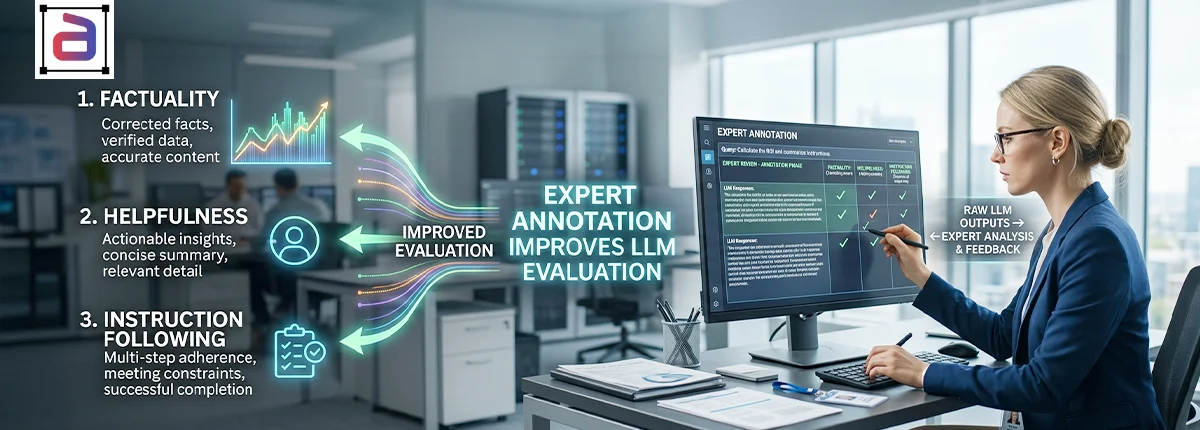
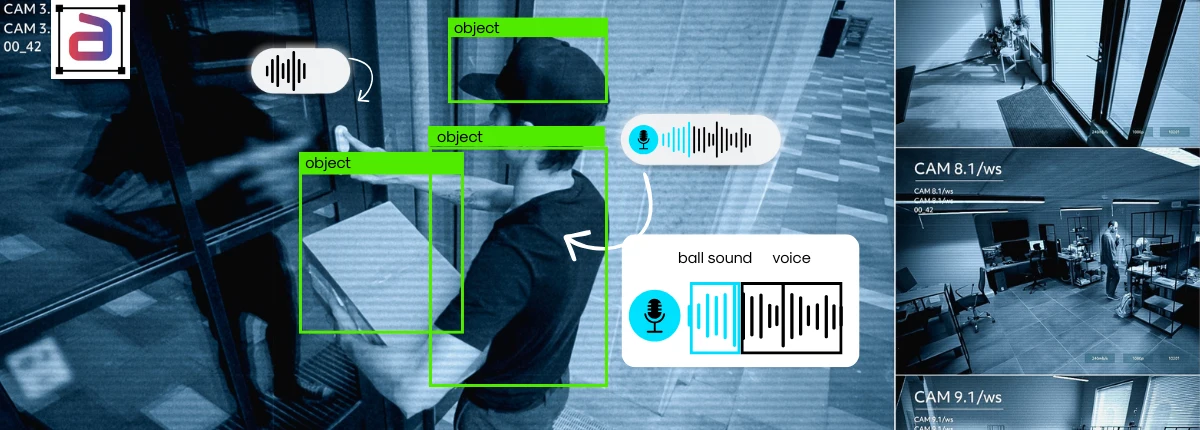
Artificial intelligence no longer learns from a single source of truth. The systems people now expect interpret the world the way humans do. Assistants that see and hear. Vehicles that read a whole scene. Clinical tools that weigh a scan against the notes beside it. They combine language, visuals, motion, and sound. From autonomous systems and voice assistants to retail analytics and healthcare AI, the next wave of models is multimodal by design. Learn more about multimodal alignment annotation for LLM training. Learn more about video transcription annotation for multimodal training.
That capability rests on one foundational requirement: high-quality, consistent annotation across text, image, video, and audio. Weak labels in any single modality drag down the entire model. Multimodal data annotation is the discipline that prevents this. Getting it right separates AI that demos well from AI that survives the real world.
Table of Contents
Key Points
- Multimodal annotation requires aligned labeling across modalities: the text label, image label, audio label, and video label for the same content event must be consistent and temporally synchronised.
- Annotation complexity scales faster than linearly with modality count: each new modality adds not just its own labeling requirements but cross-modal alignment requirements that compound the total annotation workload.
- Multimodal annotation programs must define primary modality conventions that other modalities align to, rather than annotating each modality independently, to prevent alignment drift between modalities in training data.
- The quality ceiling for multimodal AI is set by the weakest annotated modality: a system with excellent text annotation and poor audio annotation will not achieve performance commensurate with the text annotation investment.
What Multimodal Data Annotation Actually Is
Multimodal data annotation is the practice of labeling and aligning data from two or more modalities. The goal is a model that learns the relationships between them, not just the patterns within each one. A caption tied to the exact frame it describes. A transcript synced to the speaker who said it. An action label matched to the sound it produces. Alignment is the operative word.
This is what sets it apart from single-modal work. Labeling text, images, video, and audio separately produces four datasets. Annotating them as a connected whole produces something a model can reason across. The difference sounds subtle. In practice, it decides whether a multimodal system understands context or merely guesses at it.
Why Multimodal Annotation Matters Now
Enterprise AI adoption has moved from pilots to production. At that stage, the hardest problems rarely involve model selection. They involve data quality, labeling consistency, and governance—and multimodal environments amplify all three.
When text, image, video, and audio are annotated in silos, each with its own taxonomy and quality bar, models learn conflicting signals. The result is reduced accuracy, biased outputs, and brittle systems that fail under real-world conditions. Sentiment is a clear example. Sentiment analysis now reaches beyond text into voice, facial expression, and gesture, so a model trained on words alone misreads tone constantly. Aligned labeling across formats lets AI interpret emotion, intent, and context as a coherent whole.
Healthcare shows the same pattern at higher stakes. Medical audio transcription turns clinical speech into structured records, but its real value emerges when that text aligns with imaging and patient history. A diagnosis model learns far more from a scan, a report, and a dictated note read together than from any one in isolation.
The Four Core Modalities of Multimodal Annotation
Text Annotation: Capturing Meaning and Intent
Text remains foundational to most AI workflows, underpinning natural language processing, large language models, and decision-intelligence systems. The work spans named entity recognition, intent classification, sentiment and emotion analysis, and document classification with key-value extraction.
The hard part is ambiguity. The same phrase shifts meaning by domain, audience, and tone. That is why high-quality text annotation depends on domain expertise, explicit edge-case rules, and continuous calibration. In regulated fields such as finance and healthcare, a single misread term can carry compliance consequences.
- Image Annotation: Teaching Machines What to See: Image annotation teaches computer-vision models to detect, classify, and understand objects in visual data. Common applications include defect detection, medical imaging, identity verification, and retail analytics. Techniques range from bounding boxes and polygon annotation to semantic and instance segmentation and fine-grained attribute tagging. Here, precision and consistency are everything. When image labels feed safety-critical systems, a few pixels of error can change an outcome, so strong quality assurance is not optional. It is the difference between a model that generalizes and one that fails the first time conditions shift.
- Video Annotation: Understanding Actions Over Time: Video adds a temporal dimension, letting AI interpret motion, behavior, and sequence rather than frozen frames. The work includes object tracking across frames, action and activity recognition, timestamped event detection, and scene- or zone-based labeling. The challenge is persistence. An object must hold its identity through motion, occlusion, and lighting change, and event boundaries must stay consistent across thousands of frames. Given that scale, most enterprises lean on specialist annotation partners to maintain accuracy without slowing development cycles.
- Audio Annotation: Unlocking Voice and Sound Intelligence: Audio annotation powers speech recognition, voice assistants, call analytics, and sound-based anomaly detection. It covers speech transcription, speaker diarization, word- and phrase-level timestamping, emotion and compliance event tagging, and sound event detection. Sound is messy by nature. Accents vary, speakers overlap, and background noise obscures meaning, so accurate audio work demands linguistic expertise and disciplined handling of ambiguity. Diarization in particular—knowing who spoke when—becomes essential the moment a model must align speech with faces on screen.
The Real Challenge: Cross-Modal Alignment
Multimodal annotation is not four jobs running side by side. Its difficulty—and its value—lives in the connections between modalities. Consider a thirty-second retail clip. A shopper says “this is great” while frowning at a product on the shelf, as an on-screen promo praises that same item. Read alone, the audio suggests approval, the expression suggests doubt, and the text suggests nothing about the shopper at all. Aligned, the three reveal sarcasm—and the true sentiment a single-modal pipeline would have missed entirely.
Getting there depends on four disciplines that single-modal work never has to solve. Synchronized timestamps bind audio, video, and text to the same moment. A unified taxonomy ensures “vehicle” or “positive sentiment” means the same thing in every format. Conflict-resolution rules decide what happens when modalities disagree, as they often do. And label provenance records which modality produced which signal, so teams can trace and audit every decision later.
Skip any one of these, and the dataset fragments back into silos. That is why effective multimodal pipelines require integration by design, not coordination after the fact. It is also why many organizations consolidate the work with a single, accountable partner rather than stitching together separate vendors per modality.
Governance, Privacy, and Compliance Across Modalities
Sensitive information looks different in every modality, and a serious program accounts for all of them. Names and identifiers hide in text. Faces appear in images. Voiceprints live in audio. Video carries every one of these at once. Treating privacy as a text-only problem leaves the largest exposures untouched.
Mature multimodal annotation therefore builds consent tracking, modality-specific redaction, role-based access, and full audit trails into the workflow itself. For teams operating under HIPAA, GDPR, or PCI DSS, this governance layer is not overhead—it is the precondition for using real-world data at all. The annotation partner you choose should treat it as such.
A Quality Framework for Multimodal Annotation
Quality in a single modality is well understood: measure inter-annotator agreement, audit a sample, adjudicate disputes. Multimodal work keeps all of that and adds one more test—cross-modal consistency. Do the labels agree across modalities where they logically should? When the transcript marks a speaker, does the video track the same person at the same timestamp?
A robust framework runs per-modality agreement checks, layered audits, structured adjudication, and ongoing drift monitoring across the full pipeline. Together these catch the errors that matter most: not a single mislabeled frame, but a misalignment that teaches the model a relationship that does not exist.
Multimodal Annotation in Practice
- Autonomous Mobility: Self-driving and driver-assist systems fuse camera video, sensor data, and audio cues such as sirens. Annotation must align a detected emergency vehicle in the video with the siren in the audio at the same instant. That way, the model responds to the event itself, not to either signal alone.
- Healthcare AI: Diagnostic models pair medical imaging with clinical notes and dictated speech. Linking a finding in a scan to the phrase describing it gives the model real context. It draws on what a radiologist relies on, raising both accuracy and explainability.
- Retail and Customer Experience: Retail analytics combine shelf imagery, in-store video, and voice-of-customer audio. Aligning what shoppers say with what they do and what they look at turns scattered data into a genuine read on intent and satisfaction.
The Business Impact of Multimodal Annotation
Organizations that invest in high-quality multimodal annotation see it pay back in model accuracy, faster iteration, less rework, and far greater confidence deploying AI at scale. In a crowded AI market, annotation quality has stopped being a backend chore. It is now a durable strategic advantage, because the teams with the cleanest, best-aligned data simply ship better models.
How Annotera Delivers Enterprise-Grade Multimodal Annotation
Annotera is built specifically for complex, large-scale multimodal initiatives, pairing technical rigor with the operational flexibility enterprises need. The model combines several things that are hard to assemble in-house:
- Modality-specific expert annotators working under one unified framework
- Cross-modal alignment with synchronized timestamps and shared taxonomies
- Custom guidelines built for consistency and explicit edge-case handling
- Multi-layered QA, including audits and structured adjudication
- Secure, compliance-ready data handling across every modality
- Scalable delivery designed for long-term annotation outsourcing
Conclusion
Multimodal AI is redefining how machines understand the world, and it raises the bar for data readiness. The systems that win will be trained on data labeled and aligned with real discipline, not assembled from four disconnected pipelines. Enterprises that treat annotation as a core capability, rather than an afterthought, are the ones positioned to lead.
With deep expertise across text, image, video, and audio, Annotera helps organizations turn raw multimodal data into production-ready training assets. Ready to scale your multimodal AI? Partner with Annotera to build an annotation strategy that drives accuracy, speed, and long-term success.
A closely related read: egocentric video annotation