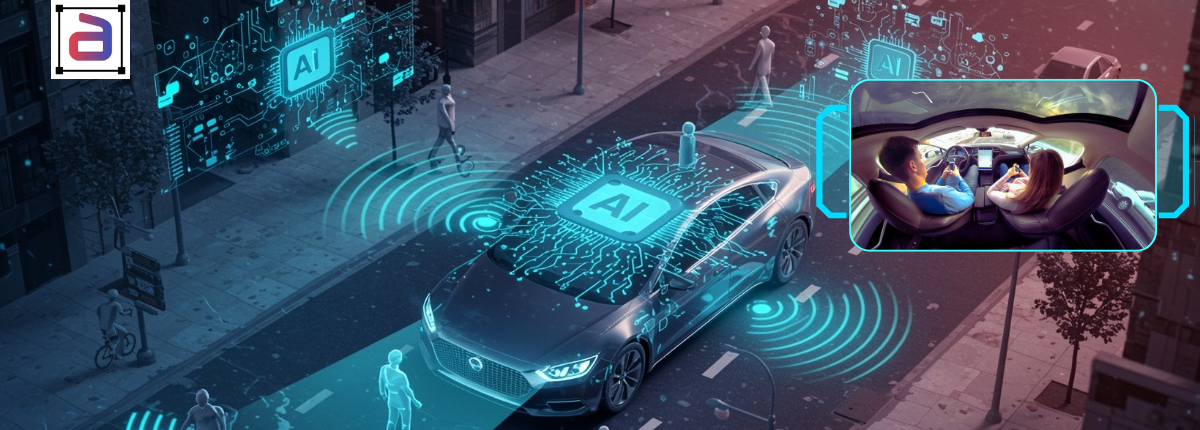
Autonomous vehicles rely on multiple sensors — cameras, LiDAR, radar, and sometimes audio or telemetry — to understand their surroundings. However, raw sensor data alone is not enough. Multi-modal annotation — the precise labeling and synchronization of data across different sensor types — is essential for building reliable perception systems that power safe autonomous driving. Learn more about multi-sensor video labeling for heavy equipment AI.
Table of Contents
Key Points
- Multi-modal AV annotation must synchronise labels across sensors that operate at different frequencies: a camera at 30 fps and a LiDAR at 10 Hz require interpolation conventions that maintain geometric consistency across modalities.
- The hardest multi-modal annotation challenge is sensor-edge cases where one modality captures an object clearly and another captures it poorly: annotation must reflect what each sensor actually sees, not the ground truth that another sensor reveals.
- Multi-modal annotation programs for autonomous vehicles must define a primary sensor for each object class and use secondary sensors to validate or enrich, not to override, the primary annotation.
- AV multi-modal annotation quality gates must be applied jointly across modalities, not independently per modality: a camera annotation that is correct but geometrically inconsistent with the corresponding LiDAR annotation produces a fusion model that cannot reconcile the two signals.
Why Single-Sensor Approaches Are Insufficient
Each sensor has strengths and weaknesses. Cameras provide rich visual detail but struggle in low light or bad weather. LiDAR delivers accurate 3D geometry but can miss fine textures. Radar excels at velocity and works in poor conditions but lacks shape resolution. Modern AV systems fuse these sensors to compensate for individual limitations. Training effective fusion models requires high-quality, temporally and spatially aligned annotations across all modalities.
What High-Quality Multi-Modal Annotation Includes
- 3D Bounding Boxes & Semantic Segmentation on LiDAR point clouds for precise spatial understanding.
- Instance Segmentation & Pixel-Level Masks on camera images for detailed object boundaries.
- Radar Object Association linking velocity data with LiDAR and camera detections.
- Temporal Tracking with consistent object IDs across frames and sensors.
- Calibration & Timestamp Alignment ensuring all sensor streams are perfectly synchronized.
How Multi-Modal Annotation Improves AV Performance
- Better Robustness — Models learn to rely on the most reliable sensor in different conditions (e.g., radar + LiDAR in fog).
- Improved Detection Range & Accuracy — Fusion helps detect distant or small objects earlier and more reliably.
- Fewer False Positives — Cross-sensor validation reduces erroneous detections that could cause unnecessary braking or disengagements.
- Stronger Scene Understanding — Rich annotations enable better intent prediction, trajectory planning, and behavior forecasting.
Best Practices for Multi-Modal AV Annotation
- Use detailed, version-controlled annotation guidelines
- Implement multi-stage QA with expert reviewers and consensus checks
- Prioritize edge cases and safety-critical scenarios
- Ensure strong temporal consistency and sensor synchronization
- Combine AI pre-labeling with human-in-the-loop validation
- Maintain privacy compliance and data provenance tracking
Conclusion
Multi-modal annotation is a critical foundation for safe and reliable autonomous driving. As AV systems incorporate more sensors and aim for higher levels of autonomy, the quality, consistency, and alignment of labeled data across modalities will determine real-world performance and safety outcomes.
We applied this at scale for a global automotive AV perception program — read the full case study.
If you’re developing autonomous vehicle technology and need expert support with multi-modal data annotation (LiDAR, camera, radar, video, or sensor fusion), feel free to reach out to Annotera.
A closely related read: Data Annotation for Autonomous Vehicles: How High-Precision Image Labeling Enables Safer Self-Driving Systems.