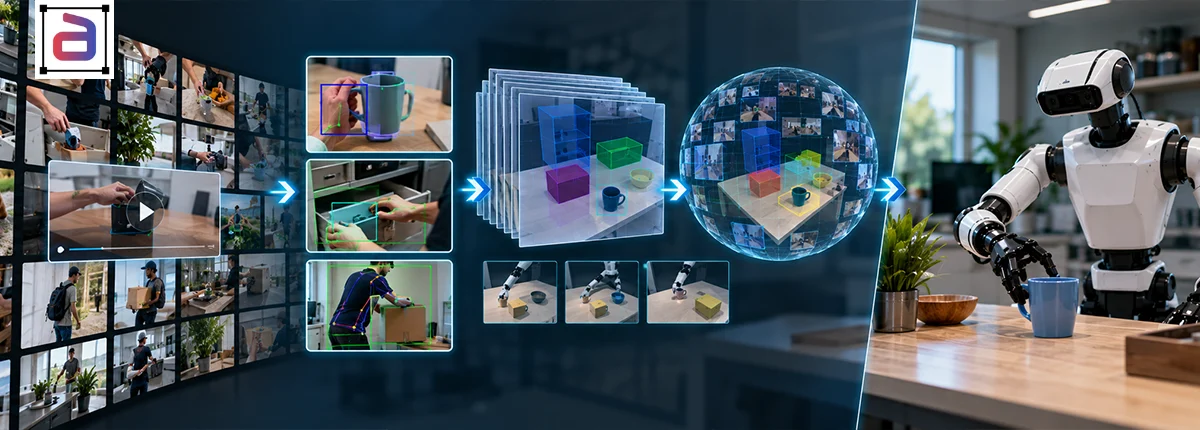
Artificial intelligence is entering a new era—one where machines are expected to see, hear, read, and reason much like humans do. From AI assistants capable of interpreting screenshots and spoken instructions to autonomous systems navigating dynamic environments, the next generation of intelligence will be inherently multimodal. Yet, while multimodal large language models (MLLMs) continue to capture headlines, one critical enabler often remains overlooked: high-quality aligned training data. “AI models are only as good as the data they learn from.” This adage has become increasingly relevant as organizations move beyond text-only systems and invest in models that simultaneously process images, videos, speech, and language. Learn more about world model training data for next-gen agents.
The challenge is no longer simply collecting data—it’s ensuring that these diverse modalities are accurately connected, contextualized, and validated for effective learning. At Annotera, we believe that multimodal intelligence begins with multimodal annotation. As organizations strive to build production-ready AI systems, the demand for specialized annotation workflows spanning text, image, audio, and video data is growing exponentially.
Key Points
- Multimodal LLMs require training data that aligns text, image, audio, and video simultaneously — not independently.
- Alignment annotation is the critical gap between collecting raw multimodal data and training reliable models.
- Cross-modal consistency errors in training data cause systematic misalignment in model reasoning across modalities.
- Annotation teams need modality-specific expertise combined with cross-modal quality controls to deliver aligned datasets.
Table of Contents
Why Multimodal LLMs Are Reshaping Enterprise AI
Traditional LLMs transformed natural language understanding, but they were designed primarily to process text. Human intelligence, however, relies on integrating multiple sensory inputs simultaneously. We don’t merely read instructions—we observe gestures, interpret facial expressions, recognize sounds, and understand temporal events. Multimodal LLMs seek to bridge this gap. Industry analysts are taking notice. Gartner predicts that 40% of generative AI solutions will be multimodal by 2027, up from just 1% in 2023, signaling a profound shift in how enterprises build and deploy AI applications. These advanced models can analyze visual scenes, comprehend spoken language, summarize lengthy videos, and reason across multiple information sources. Their capabilities are unlocking innovative applications across industries, including:
- Intelligent document processing
- Autonomous robotics
- Medical diagnostics
- Retail visual search
- AI-powered customer service
- Smart surveillance systems
- Accessibility technologies
- Embodied AI agents
“The world is multimodal, and intelligence should be too.”
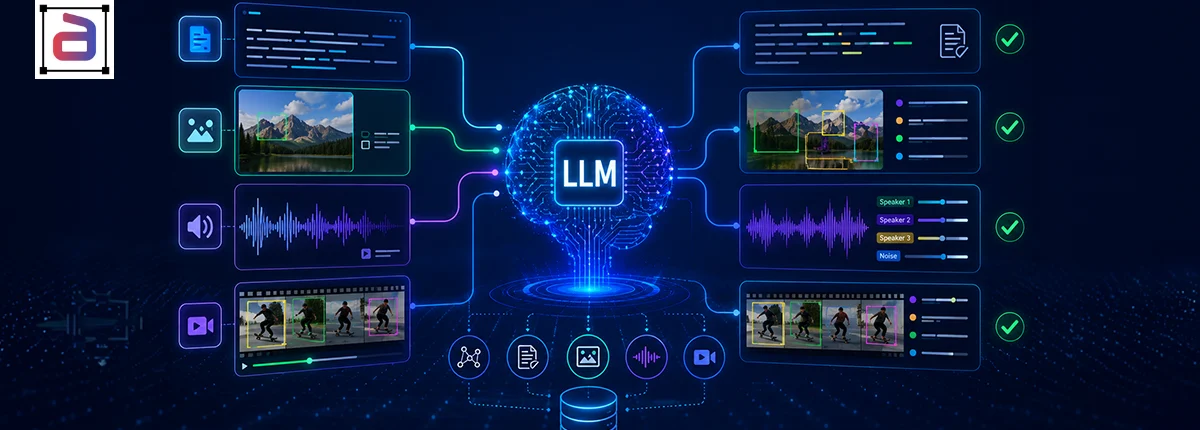
This perspective reflects a growing consensus within the AI community: future foundation models must understand information in the same interconnected way humans experience it. Multimodal LLMs are reshaping enterprise AI because they can understand and reason across text, images, audio, and video simultaneously. As a result, businesses can build more intuitive applications, improve decision-making, and deliver richer, context-aware user experiences.
The Hidden Bottleneck: Data Alignment
Building multimodal models isn’t simply about aggregating images, audio clips, videos, and documents. The real challenge lies in teaching models the relationships between them. Consider a training example where an image depicts a child riding a bicycle while laughing. The corresponding caption, audio narration, object labels, and temporal events must all align precisely. Any inconsistency introduces ambiguity that weakens model learning. Although organizations can collect massive volumes of multimodal data, aligning text, images, audio, and video remains a significant challenge. Without accurate synchronization and contextual connections, models may produce unreliable outputs, hallucinations, and poor reasoning capabilities. For multimodal systems, annotation involves establishing meaningful relationships such as:
| Modality | Alignment Tasks |
|---|---|
| Text | Entity linking, instruction tuning, preference ranking |
| Images | Visual grounding, scene descriptions, OCR labeling |
| Audio | Transcription, speaker diarization, emotion tagging |
| Video | Event segmentation, object tracking, action recognition |
| Sensor Data | Spatial and temporal synchronization |
Without high-quality alignment, even the most sophisticated architectures suffer from hallucinations, poor contextual reasoning, and unreliable outputs. McKinsey emphasizes that multimodal AI can significantly improve contextual understanding because models learn to correlate information across different data types, reducing uncertainty and enhancing decision-making capabilities.
Text Annotation: The Foundation of Multimodal Reasoning
Text remains the semantic backbone of multimodal systems. This serves as the foundation of multimodal reasoning because it provides semantic context for other data types. Moreover, accurately labeled prompts, responses, and entities enable models to better understand relationships, follow instructions, and generate contextually relevant outputs. However, modern annotation workflows extend far beyond traditional sentiment analysis or named entity recognition. For multimodal applications, organizations increasingly require:
Instruction Tuning
Human annotators develop high-quality prompts and responses that teach models how to follow instructions accurately.
Preference Annotation
Reviewers compare multiple outputs and rank responses based on helpfulness, factual accuracy, and safety.
Grounded Conversations
Textual descriptions are linked directly with visual evidence, spoken interactions, or video sequences to improve model reasoning. These datasets are becoming essential LLM training data assets for enterprises building domain-specific AI assistants.
Image Annotation: Moving Beyond Bounding Boxes
Images provide rich contextual signals, but extracting meaningful understanding requires precise supervision. Image annotation has evolved beyond simple image bounding box services. Today, multimodal LLMs require semantic segmentation, visual grounding, and scene understanding. Consequently, richer annotations help models interpret complex visual contexts and generate more accurate, context-aware responses. Today’s multimodal models depend on annotation tasks such as:
- Semantic segmentation
- Polygon labeling
- OCR extraction
- Scene graph generation
- Object relationship mapping
- Visual question answering datasets
- Human activity recognition
For example, a retail assistant that answers customer questions about a product image needs more than object detection—it requires contextual understanding of colors, materials, branding, and usage scenarios. This level of intelligence is only achievable through carefully curated datasets.
Audio Annotation: Teaching AI to Listen Like Humans
Voice-based interfaces are becoming increasingly central to enterprise experiences. Audio annotation enables AI systems to understand not only spoken words but also intent, emotion, and context. Moreover, accurately transcribed and labeled speech datasets help multimodal models deliver more natural, responsive, and human-like interactions across applications. Audio annotation helps models understand not just words, but also emotions, intent, speaker characteristics, and environmental context. Key annotation tasks include:
- Speech transcription
- Speaker identification
- Emotion labeling
- Accent tagging
- Intent classification
- Background sound categorization
High-quality speech datasets are especially valuable for healthcare applications, contact centers, automotive systems, and multilingual conversational AI.
Video Annotation: Understanding Motion and Temporal Context
Video is perhaps the most information-dense modality. This enables multimodal models to understand actions, object movements, and event sequences over time. Consequently, accurately labeled video datasets improve temporal reasoning, allowing AI systems to interpret dynamic environments and make more informed decisions. Unlike static images, videos capture sequences of events unfolding over time, making annotation significantly more complex. Organizations developing robotics systems, autonomous platforms, and intelligent surveillance solutions rely on:
- Frame-level object tracking
- Human behavior analysis
- Event segmentation
- Gesture recognition
- Activity classification
Industry analysts estimate that the multimodal AI market is expected to grow at a CAGR exceeding 30% over the next decade, driven largely by increased demand for video-centric AI applications.
Why Businesses Are Choosing Data Annotation Outsourcing
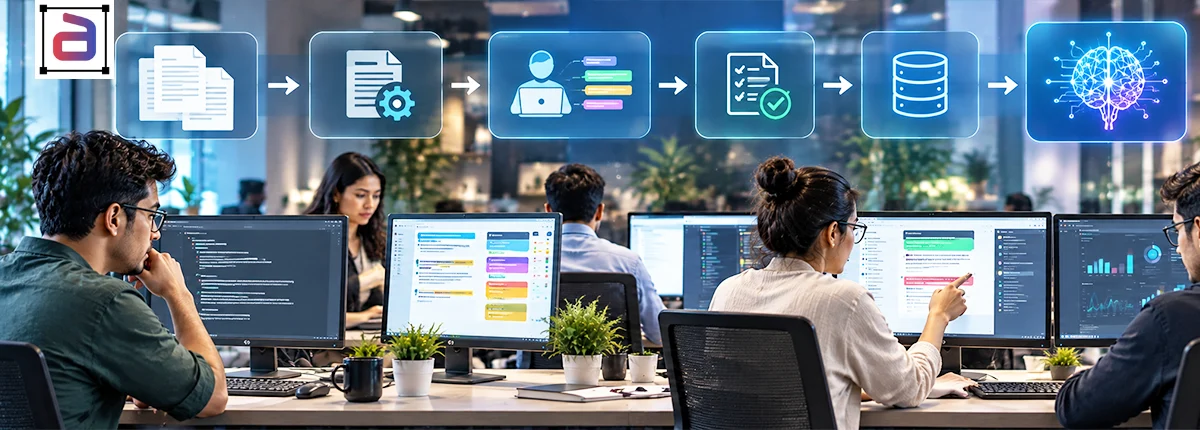
Building internal annotation teams for multimodal AI is expensive, resource-intensive, and difficult to scale. Organizations must recruit specialized talent, establish rigorous quality controls, and support multilingual workflows while meeting aggressive AI development timelines. This is why many enterprises are embracing data annotation outsourcing. Partnering with an experienced data annotation company offers several strategic advantages:
- Faster dataset turnaround times
- Access to trained domain experts
- Human-in-the-loop validation processes
- Flexible scaling capabilities
- Consistent quality assurance frameworks
- Reduced operational overhead
More importantly, outsourcing enables AI teams to focus on model innovation while trusted annotation partners manage the complexities of dataset preparation.
Why AI Innovators Choose Annotera
At Annotera, we understand that building trustworthy multimodal AI requires more than labeling data—it requires creating meaningful connections between modalities that help models learn, reason, and generalize effectively. Our teams support AI innovators through:
- Instruction tuning and preference ranking
- Image and visual grounding annotation
- Audio transcription and speaker labeling
- Video event segmentation
- Multimodal alignment validation
- Human-in-the-loop quality assurance
- Scalable managed annotation programs
Whether you’re fine-tuning foundation models, developing enterprise copilots, or building embodied AI systems, Annotera delivers high-quality LLM training data designed to accelerate model performance and reduce costly iterations.
The Future of AI Is Multimodal—and Annotation-Driven
As multimodal AI becomes mainstream, organizations can no longer treat annotation as a downstream operational task. It is rapidly emerging as a strategic capability that directly influences model accuracy, safety, and commercial success. The companies that invest today in robust multimodal data pipelines will be the ones defining tomorrow’s AI experiences.
Ready to Build Better Multimodal Models?
Annotera helps AI teams transform raw text, images, audio, and video into production-ready datasets tailored for multimodal LLM training. Connect with our experts today to discover how scalable, human-in-the-loop annotation can accelerate your next generation of AI systems.
This connects closely with challenges in aligning multimodal training data.
It is worth also looking at the fundamentals of multimodal alignment annotation.