Enterprise adoption of Generative AI has moved well beyond experimentation. Organizations are now racing to deploy intelligent assistants, internal copilots, semantic search platforms, and domain-specific knowledge agents capable of delivering accurate, contextual, and trustworthy responses. Knowledge base annotation is rapidly becoming a cornerstone of enterprise AI success. As organizations adopt Retrieval-Augmented Generation (RAG) architectures to power intelligent assistants and domain-specific copilots, simply storing documents in a vector database is no longer sufficient. Learn more about semantic text labeling for RAG pipelines.
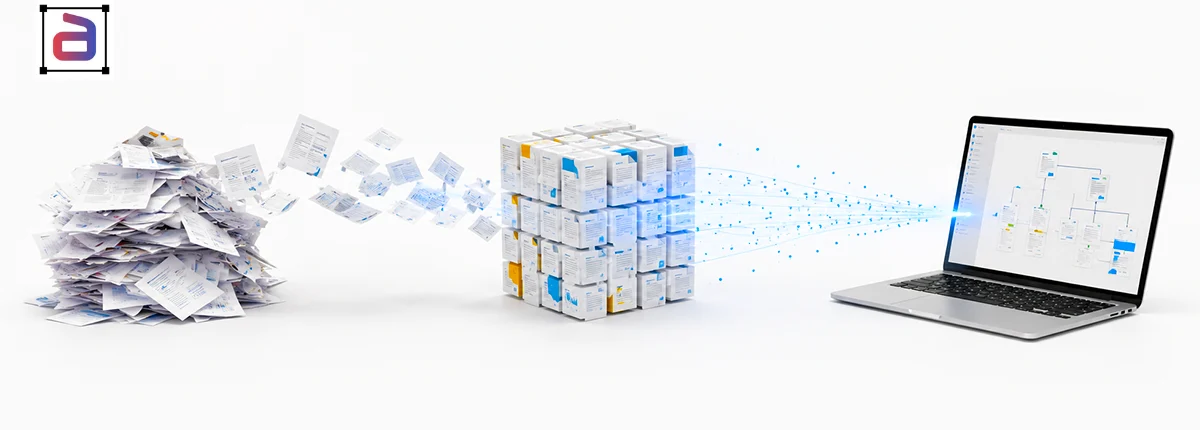
Enterprise content must be enriched with semantic labels, metadata, entity relationships, citations, and contextual signals that enable retrieval systems to identify and surface the most relevant information. By transforming unstructured repositories into retrieval-ready knowledge assets, knowledge base annotation improves search precision, reduces hallucinations, and ensures that large language models generate responses grounded in trusted enterprise data.
Why Most Enterprise RAG Systems Fail Before Retrieval Begins
At the center of this transformation lies Retrieval-Augmented Generation (RAG)—an architecture designed to ground Large Language Models (LLMs) in proprietary enterprise knowledge. Yet despite significant investments in vector databases, embedding models, and orchestration frameworks, many organizations discover an uncomfortable truth after deployment: Their RAG systems still retrieve the wrong information. The issue rarely stems from the language model itself. More often, it is rooted in poorly prepared enterprise knowledge repositories—documents that lack semantic structure, contextual labeling, metadata enrichment, and relationship mapping. In the era of enterprise AI, one might argue that where there is retrieval failure, there is almost always a data quality problem.
Knowledge base annotation has emerged as a critical but often overlooked discipline that directly influences retrieval precision, answer relevance, citation quality, and hallucination reduction. In other words, annotation is no longer simply about labeling datasets—it is about engineering knowledge assets that AI systems can understand, navigate, and trust. At Annotera, we believe that building high-performing RAG systems begins long before selecting an LLM. It starts with transforming unstructured enterprise content into retrieval-ready intelligence through expert annotation, human validation, and scalable knowledge curation workflows.
Key Points
- RAG systems retrieve relevant documents before generating answers to improve accuracy.
- Knowledge base annotation ensures retrieval indexes return the most relevant chunks.
- Poor annotation leads to low retrieval precision and degraded RAG output quality.
- Expert annotators label document relevance, entity mentions, and semantic relationships.
Table of Contents
Why Retrieval Accuracy Is Becoming the Defining KPI for Enterprise AI
Organizations deploying enterprise RAG applications face a growing expectation gap. End users expect AI systems to provide responses that are not only conversational but also explainable, auditable, and factually grounded. As enterprises increasingly integrate RAG-powered applications into critical workflows, retrieval accuracy has emerged as a key success metric. After all, even highly capable LLMs can generate misleading responses when supplied with irrelevant context. Therefore, improving retrieval quality is essential for building trustworthy, enterprise-grade AI systems.
“Data is the new oil, but unlike oil, data gains value the more it is refined.” — Andreas Weigend, Former Chief Scientist at Amazon
For enterprise RAG implementations, annotation is that refinement layer. As enterprises increasingly deploy RAG-based applications, retrieval accuracy has become a critical performance metric. After all, even the most advanced LLMs can produce unreliable outputs if they access irrelevant or outdated information, ultimately diminishing user trust and business value. Without structured annotations, even the most advanced embedding models struggle to distinguish between competing contexts, outdated policies, duplicated documents, or domain-specific terminology.
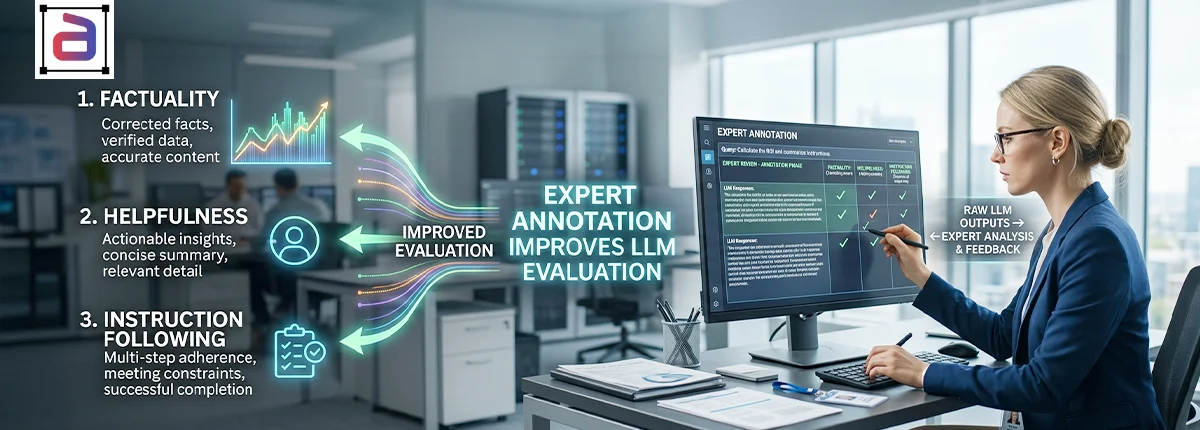
Retrieval accuracy increasingly depends on human feedback loops. RLHF annotation services enable enterprises to rank responses, validate retrieved passages, and capture preference signals, helping RAG systems generate more relevant, trustworthy, and contextually grounded outputs for enterprise AI applications. A legal assistant retrieving obsolete contract clauses, a healthcare chatbot surfacing superseded treatment guidelines, or an engineering copilot referencing deprecated technical specifications can significantly erode user trust and business confidence. Annotation addresses these challenges by introducing semantic clarity, metadata hierarchies, and human-validated relevance signals into enterprise knowledge repositories.
Annotera’s Approach to Retrieval-Ready Knowledge Engineering
As enterprises move toward production-scale AI deployments, annotation workflows must evolve beyond conventional document tagging. As enterprises seek more dependable AI outcomes, Annotera combines human expertise with scalable annotation workflows to enrich knowledge repositories. Consequently, organizations can improve retrieval precision, minimize hallucinations, and build RAG systems that deliver trustworthy, context-aware responses. Annotera combines domain expertise, human-in-the-loop review methodologies, and scalable annotation operations to help organizations build knowledge repositories optimized for modern RAG architectures. Our capabilities include:
- Semantic document classification
- Named entity and ontology annotation
- Preference ranking for retrieval evaluation
- Citation and attribution tagging
- Metadata enrichment
- Question-answer pair generation
- Knowledge graph support
- Multilingual corpus annotation
- Human validation for sensitive enterprise domains
By leveraging a hybrid model that combines automation with expert oversight, Annotera enables organizations to reduce hallucinations, and accelerate time-to-value for AI initiatives.
“Where there is data smoke, there is business fire.”— Jim Gray, Turing Award Recipient and Computer Scientist
The Future of Enterprise AI Will Be Won by Better Knowledge
The conversation around RAG frequently centers on foundation models, vector stores, and orchestration frameworks. Yet the most successful enterprise deployments increasingly recognize that retrieval performance is fundamentally a knowledge quality challenge. As enterprise AI adoption accelerates, organizations must prioritize high-quality knowledge assets. Ultimately, well-annotated and retrieval-ready datasets will differentiate industry leaders. This enables AI systems to deliver more accurate, explainable, and trustworthy outcomes at scale.
As enterprise AI adoption accelerates, organizations must recognize that models alone do not create competitive advantage. Instead, high-quality, well-annotated knowledge assets will increasingly determine success. Consequently, businesses that invest in retrieval-ready datasets will be better positioned to deliver trustworthy AI experiences at scale. Organizations that invest in retrieval-ready datasets will gain a measurable advantage in deploying trustworthy AI systems that users can confidently rely upon. As enterprise AI continues to mature, organizations must move beyond model selection and focus on knowledge quality. After all, well-annotated, retrieval-ready datasets not only improve response accuracy but also reduce hallucinations, and ultimately provide a sustainable competitive advantage.
Build Retrieval-Ready Knowledge Bases with Annotera
Whether you’re developing enterprise copilots, Annotera provides the expertise needed to transform fragmented enterprise content into high-quality, retrieval-optimized datasets. As organizations scale their generative AI initiatives, they need knowledge repositories that are accurate, structured, and retrieval-ready. Therefore, Annotera combines human expertise with advanced annotation workflows to enrich enterprise content. This helps businesses improve retrieval precision, reduce hallucinations, and deploy more trustworthy RAG applications. Ready to improve retrieval accuracy and reduce hallucinations in your RAG applications? Partner with Annotera to build knowledge bases that power trustworthy, explainable, and enterprise-grade AI experiences.
For more on this, a complete guide to RAG evaluation.