In the race to build smarter AI systems, organizations are collecting more video data than ever before. From autonomous vehicles and intelligent surveillance systems to sports analytics and retail intelligence, video has become one of the most valuable training assets in modern artificial intelligence. Yet the success of these AI models depends on a critical factor that often receives less attention than algorithms or computing power: annotation quality. As video datasets continue to expand into millions of frames, AI teams face an important question: should they rely on frame interpolation to accelerate annotation workflows, or invest in frame-by-frame annotation for maximum precision? The answer directly impacts model accuracy, project timelines, and overall AI performance.
At Annotera, we’ve supported organizations across industries in building high-quality video datasets that power production-grade AI systems. Through years of experience delivering video annotation services at scale, we’ve found that choosing the right annotation strategy can significantly influence model outcomes. In this article, we’ll explore the strengths and limitations of frame interpolation and frame-by-frame annotation, and determine which approach delivers the best results for modern AI applications.
Key Points
- Frame interpolation propagates labels between keyframes automatically, reducing cost but introducing tracking errors in complex or fast-moving scenes.
- Frame-by-frame annotation captures accurate object state at every moment but requires significantly more annotator time and budget.
- The right approach depends on object speed, scene complexity, and the accuracy threshold required by the target application.
- Safety-critical applications like autonomous driving require frame-by-frame annotation; interpolation is viable only for slow, simple motion scenarios.
Table of Contents
Why Video Annotation Accuracy Matters
Many AI initiatives focus heavily on model architecture and computational resources. However, industry experts consistently emphasize that data quality remains the most important determinant of model success. As Andrew Ng, Founder of Landing AI, famously stated:
“The data-centric approach to AI focuses on systematically engineering the data needed to build a successful AI system.”
This philosophy reflects a growing reality within the AI industry. Even the most sophisticated machine learning model cannot compensate for inaccurate or inconsistent training data. Poor annotation quality can lead to:
- Lower object detection accuracy
- Increased false positives and false negatives
- Reduced tracking performance
- Poor generalization across real-world scenarios
- Higher retraining costs
For organizations investing heavily in AI development, annotation is no longer a simple preprocessing task—it’s a strategic competitive advantage.
Understanding Frame-by-Frame Annotation
Frame-by-frame annotation is the traditional approach to video labeling. Every individual frame within a video sequence is manually reviewed and annotated by trained specialists. Objects are labeled using bounding boxes, polygons, segmentation masks, keypoints, or tracking identifiers, ensuring that every movement and visual variation is captured accurately. For example, a 30-second video recorded at 30 frames per second contains approximately 900 frames. With frame-by-frame annotation, each of those 900 frames receives human attention. This method is widely considered the gold standard for annotation accuracy because it allows annotators to capture:
- Rapid object movements
- Shape transformations
- Lighting changes
- Motion blur
- Occlusions and partial visibility
- Complex interactions between objects
Industries such as autonomous driving, medical imaging, robotics, and defense frequently rely on frame-by-frame annotation because even minor labeling errors can have significant consequences. The primary challenge, however, is scalability. Researchers from the University of California, Berkeley have noted that data labeling often represents one of the most time-consuming stages of computer vision development, creating significant bottlenecks in AI deployment.
Understanding Frame Interpolation
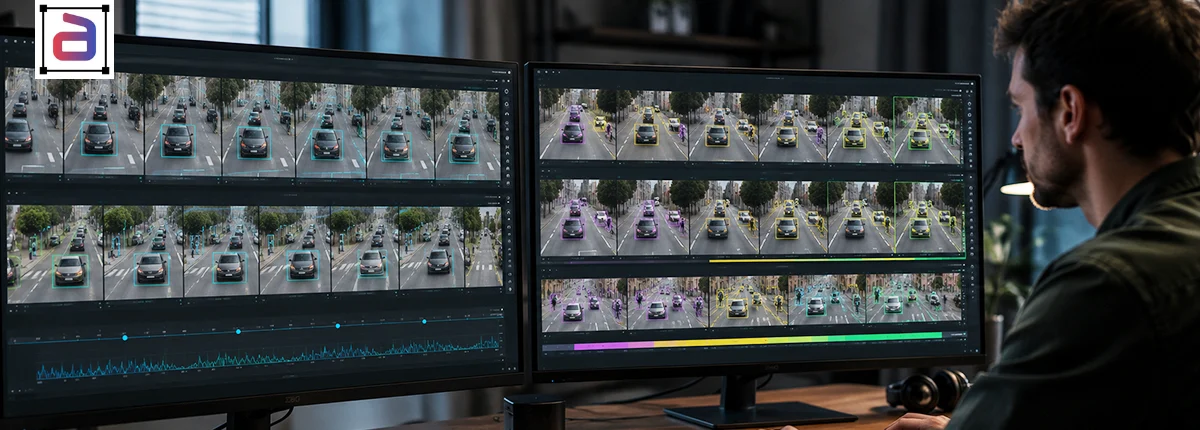
Frame interpolation was introduced to address the growing demand for faster and more cost-effective video annotation. Instead of labeling every frame manually, annotators label selected keyframes while annotation software predicts object locations across intermediate frames. The process typically works as follows:
- An object is labeled in a starting frame.
- The same object is labeled again in a later frame.
- The annotation platform automatically calculates object movement between those points.
- Intermediate annotations are generated automatically.
- Human reviewers validate and correct any inaccuracies.
Modern AI-powered interpolation tools leverage object tracking, optical flow algorithms, and machine learning models to automate much of the annotation process. For large-scale projects, interpolation can reduce annotation effort dramatically while maintaining acceptable quality levels. This efficiency has made interpolation increasingly popular among organizations pursuing video annotation outsourcing initiatives where speed and scalability are critical.
Comparing Accuracy: Which Approach Performs Better?
Frame-by-Frame Annotation: Maximum Precision
When model accuracy is the highest priority, frame-by-frame annotation remains unmatched. Every frame undergoes human review, ensuring that subtle object movements and scene changes are captured correctly. This approach performs exceptionally well when:
- Objects move unpredictably
- Multiple objects overlap
- Occlusions occur frequently
- Videos contain complex environments
- Safety-critical decisions depend on the model
Consider an autonomous vehicle identifying pedestrians in busy urban environments. Missing even a few frames of accurate labeling could negatively affect model learning and real-world performance. For these use cases, annotation precision directly translates into operational reliability. Frame-by-frame annotation delivers the highest level of accuracy by labeling every relevant object and event throughout a video annotation workflow. Consequently, it enables AI models to learn detailed motion patterns, object interactions, and complex driving scenarios with greater precision.
Frame Interpolation: Efficiency with Intelligent Automation
Frame interpolation delivers significant productivity gains and performs extremely well when object motion is relatively predictable. Examples include:
- Traffic monitoring systems
- Warehouse automation
- Manufacturing inspection
- Sports analytics
- Retail behavior tracking
In these environments, interpolation can dramatically reduce project costs while maintaining strong annotation consistency. However, interpolation can encounter challenges when:
- Objects suddenly change direction
- Visibility is interrupted
- Motion blur increases
- Multiple objects intersect
Without proper quality assurance, interpolation errors may introduce annotation noise that ultimately affects model accuracy. This is why experienced teams never rely solely on automation.
Why Leading AI Teams Choose Hybrid Annotation Workflows
The debate between interpolation and frame-by-frame annotation often creates the impression that organizations must choose one approach exclusively. In reality, the most successful AI teams combine both. At Annotera, we frequently implement hybrid workflows that leverage the strengths of each methodology:
- Strategic frame-by-frame annotation for critical sequences
- AI-assisted interpolation for repetitive motion patterns
- Multi-level quality assurance reviews
- Human validation of automated outputs
- Continuous accuracy monitoring
This approach delivers the scalability of automation without sacrificing the precision required for high-performing AI systems. As Fei-Fei Li, Co-Director of Stanford’s Human-Centered AI Institute, has observed:
“The strength of AI is not in the algorithm alone but in the quality of the data that teaches it.”
Hybrid workflows ensure that quality remains at the center of the annotation process.
Why Annotation Expertise Matters
Annotation tools continue to evolve, but technology alone cannot guarantee dataset quality. Choosing the correct annotation strategy requires a deep understanding of:
- Model objectives
- Industry requirements
- Object behavior patterns
- Data complexity
- Quality assurance methodologies
As a trusted video annotation company, Annotera helps organizations determine the optimal balance between speed, cost, and accuracy. Our specialists design annotation workflows tailored to each project’s unique requirements, whether that involves frame-by-frame labeling, AI-assisted interpolation, or a hybrid model. For businesses exploring data annotation outsourcing and video annotation outsourcing, this expertise can significantly improve both dataset quality and project efficiency.
Conclusion
Frame-by-frame annotation remains the benchmark for precision, making it the preferred choice for safety-critical and highly complex AI applications. Frame interpolation offers exceptional efficiency and scalability, helping organizations accelerate dataset creation while controlling costs. The highest-performing AI programs, however, rarely rely on one method alone. By combining intelligent automation with expert human oversight, organizations can achieve the speed of interpolation and the accuracy of manual annotation simultaneously. At Annotera, we help AI teams build reliable, scalable, and production-ready video datasets through expertly managed annotation workflows. Whether you’re developing autonomous systems, surveillance solutions, retail analytics platforms, or advanced computer vision applications, our annotation experts ensure your models learn from data you can trust.
Ready to Improve Your Video Annotation Accuracy?
Building high-performance AI starts with high-quality training data. Partner with Annotera to access scalable video annotation services, rigorous quality assurance processes, and industry-specific expertise designed to maximize model performance. Contact Annotera today to discuss your video annotation requirements and discover how our expert-led annotation workflows can accelerate your AI initiatives with confidence.
Related reading: when manual frame-by-frame work still wins.
A closely related read: Frame-by-Frame vs. Interpolated Video Annotation: How to Balance Accuracy and Turnaround Time.