
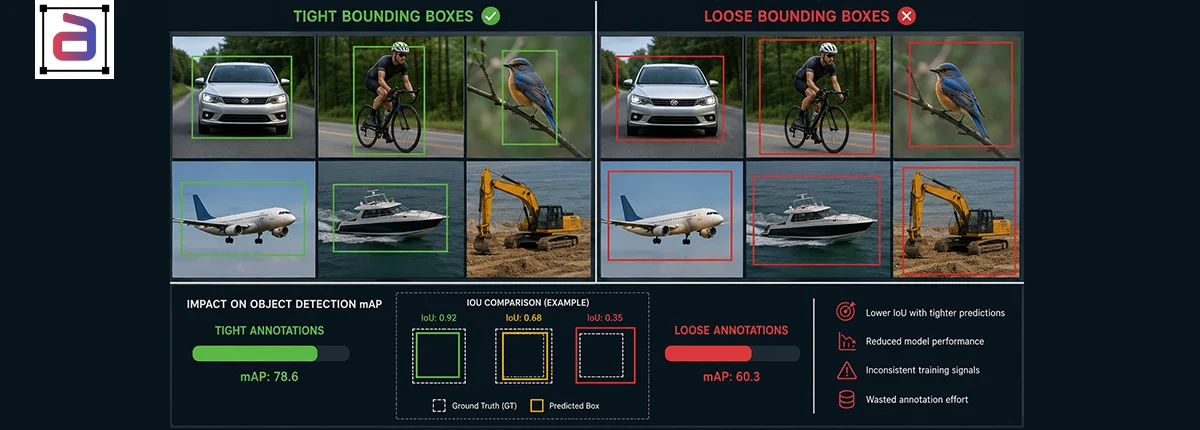
In the race to build more accurate object detection models, organizations often focus on larger datasets, more powerful GPUs, and increasingly sophisticated neural network architectures. Yet one critical factor continues to determine whether a computer vision model succeeds or fails in production: annotation quality. Bounding box annotation is the foundation of object detection, defining how AI models learn to recognize and locate objects within images. The precision of these annotations directly influences localization accuracy, IoU scores, and overall object detection mAP performance. Among the many variables that influence annotation quality, one of the most underestimated is bounding box tolerance—specifically, whether annotations are drawn tightly around an object or loosely with extra surrounding pixels.
At first glance, the difference may seem minor. After all, both annotations identify the same object. However, when measured against object detection metrics such as Intersection over Union (IoU) and mean Average Precision (mAP), annotation tolerance can dramatically influence model performance. At Annotera, we’ve seen firsthand how annotation consistency often contributes more to object detection accuracy than incremental changes in model architecture. In high-stakes applications such as autonomous driving, retail analytics, smart surveillance, and industrial inspection, a few misplaced pixels can translate into measurable performance degradation.
Key Points
- Bounding box tightness — the gap between box edge and object boundary — directly determines IoU scores during model evaluation.
- Loose bounding boxes introduce noise into training data, causing models to learn imprecise object boundaries that reduce mAP at standard thresholds.
- Annotation guidelines must specify acceptable pixel tolerance per object class to ensure consistency across large distributed annotation teams.
- The per-image cost of tight annotation is higher, but the downstream cost of retraining on imprecise labels is significantly greater.
Table of Contents
Why Bounding Box Precision Matters More Than Ever
The global computer vision market is projected to surpass $50 billion within the next few years, driven by growing demand for AI-powered automation across industries. Yet despite advancements in AI models, researchers consistently identify data quality as one of the biggest barriers to achieving reliable performance.
“Artificial intelligence is the new electricity. But data is the fuel that powers it.”— Andrew Ng, AI Researcher and Entrepreneur
In object detection, bounding boxes are among the most important forms of training data. Every box teaches a model where an object begins and ends. If those boundaries are inaccurate or inconsistent, the model learns inaccurate representations of reality. That’s why the debate between tight and loose bounding boxes is not simply an annotation preference—it’s a model performance issue.
Understanding Tight vs. Loose Bounding Boxes
A tight bounding box closely follows the visible edges of an object, minimizing unnecessary background pixels. A loose bounding box includes additional surrounding space beyond the object’s actual boundaries. Imagine annotating a delivery truck:
- A tight box captures only the truck.
- A loose box captures portions of the road, shadows, nearby vehicles, and background scenery.
While both annotations technically identify the truck, they create very different learning signals for machine learning models. The question is simple: Which annotation style helps models learn more effectively? The answer lies in how object detection systems are evaluated.
The Connection Between Bounding Boxes, IoU, and mAP
Modern object detection models are typically evaluated using Intersection over Union (IoU) and mean Average Precision (mAP). IoU measures how closely a model’s predicted bounding box matches the ground-truth annotation. The closer the overlap, the higher the IoU score. Today’s leading benchmarks—including COCO—evaluate models across multiple IoU thresholds ranging from 0.50 to 0.95. This means models are increasingly rewarded not just for detecting objects but for locating them precisely. This is where annotation tolerance becomes critical. If the ground truth itself is inconsistent, the model receives mixed signals regarding object boundaries, making it harder to achieve high-IoU detections.
How Loose Bounding Boxes Can Hurt Detection Performance
Many organizations assume that slightly larger boxes make annotation easier and faster. While that may reduce labeling time, it often comes at the expense of model accuracy. Loose annotations introduce several challenges:
Background Noise Becomes Part of the Object
When excessive background pixels are included, the model begins associating contextual elements with the object itself. For example:
- Cars become associated with road surfaces.
- Pedestrians become associated with sidewalks.
- Products become associated with store shelves.
Rather than learning the object, the model learns the environment.
Reduced Localization Accuracy
Models trained on loose annotations often produce oversized predictions. While these predictions may achieve acceptable IoU at lower thresholds, performance tends to decline significantly at higher IoU requirements.
Lower mAP Scores
Industry studies have shown that annotation inconsistencies can reduce object detection performance by 5–15%, particularly in datasets containing small or densely packed objects. This performance gap becomes especially noticeable in applications requiring precise localization, such as autonomous navigation, robotics, and medical imaging.
Poor Generalization
When models rely heavily on contextual cues, they struggle when deployed in new environments where backgrounds differ from training data. The result is lower real-world reliability despite strong validation results.
Why Tight Bounding Boxes Deliver Better Training Signals
Tight bounding boxes force the model to focus on the actual object rather than surrounding distractions. The advantages are substantial:
Improved Object Localization
Models learn precise object boundaries, leading to more accurate predictions.
Higher IoU Performance
Since ground-truth annotations are more precise, models are optimized for better overlap and stronger localization metrics.
Better Generalization Across Environments
Object-specific features become more important than contextual background information.
Stronger mAP Across Multiple Thresholds
Tight annotations help models perform consistently across both low and high IoU evaluation levels.
“The quality of data determines the quality of the AI.”— Fei-Fei Li, Computer Vision Pioneer
Few examples illustrate this principle more clearly than object detection annotation.
Precision Alone Isn’t Enough—Consistency Matters
Despite the advantages of tight bounding boxes, perfection is not always practical. Real-world datasets contain:
- Occluded objects
- Motion blur
- Reflections
- Transparent surfaces
- Ambiguous boundaries
Without clear annotation guidelines, two annotators may draw different boxes around the same object. This inconsistency creates label noise that can negatively impact model learning. The goal is not simply tighter annotations. The goal is consistent, repeatable annotation standards. This is where experienced annotation teams make the difference.
How Annotera Helps Organizations Maximize Object Detection Accuracy
At Annotera, we view annotation as a model optimization process—not just a data labeling task. As an experienced image annotation company, we build annotation workflows that are specifically designed to improve downstream AI performance. Our approach includes:
- Pixel-level annotation guidelines
- Multi-stage quality assurance reviews
- Inter-annotator agreement monitoring
- Domain-specific annotation protocols
- Continuous dataset audits
Whether clients require autonomous vehicle datasets, retail shelf analytics, aerial imagery labeling, or industrial inspection data, our focus remains the same: Create annotations that improve model outcomes—not just annotation throughput. For organizations pursuing image annotation outsourcing, this level of quality control can significantly reduce retraining cycles, improve mAP scores, and accelerate deployment timelines.
The Hidden Cost of Annotation Shortcuts
Many AI teams invest months optimizing model architectures while overlooking annotation quality. Yet a perfectly tuned model cannot overcome inconsistent ground-truth data. A loose bounding box drawn today can become a missed detection tomorrow.A few extra pixels around thousands of objects can eventually translate into lower localization accuracy, reduced mAP, and costly production failures. The most successful computer vision programs understand a fundamental truth: Better annotations create better models.
Conclusion
The difference between tight and loose bounding boxes may appear small, but its impact on object detection performance is substantial. Annotation tolerance directly influences IoU measurements, localization accuracy, model generalization, and ultimately mAP. Tight, consistent bounding boxes provide cleaner training signals, enabling models to learn object boundaries more effectively and perform reliably in real-world environments. As AI systems become increasingly dependent on high-quality training data, annotation precision is no longer optional—it’s a competitive advantage.
Ready to Improve Your Object Detection Performance?
If your computer vision models are limited by inconsistent training data, Annotera can help. Our expert annotation teams deliver high-quality bounding box annotations tailored to your model requirements, helping you achieve higher mAP scores, stronger localization accuracy, and faster AI deployment. High-quality bounding box annotation can significantly improve IoU and mAP performance. Partner with our teams to build precise, scalable, and production-ready computer vision datasets. Partner with Annotera today and transform annotation quality into measurable AI performance gains.
This connects closely with QC processes for large bounding box projects.
A closely related read: Bounding Box vs. Polygon Annotation for Video: Choosing the Right Method for Your Computer Vision Model