
Generative AI is rapidly transforming industries, enabling businesses to automate customer support, streamline operations, power intelligent search, and deliver highly personalized digital experiences. Yet despite the remarkable progress of Large Language Models (LLMs), one challenge continues to undermine trust in AI systems: hallucinations.When LLMs generate inaccurate, fabricated, or misleading responses with complete confidence, the consequences can be severe. From incorrect financial recommendations to misleading healthcare information and unreliable enterprise search results, hallucinations create operational, reputational, and compliance risks for businesses deploying AI at scale. This is precisely why Human-in-the-Loop (HITL) text annotation has become indispensable for modern AI development. Organizations seeking reliable and production-ready AI systems are increasingly partnering with Annotera to improve data quality, strengthen model alignment, and reduce hallucinated outputs. As a trusted data annotation company, Annotera helps enterprises build safer and more accurate AI systems through scalable, human-supervised annotation workflows tailored for LLM training and optimization.
Key Points
- Human-in-the-loop annotation for LLM hallucination reduction works by having experts identify incorrect outputs and label them with factual corrections for retraining.
- Hallucinations are most dangerous in high-stakes domains — medical, legal, financial — where confident but wrong outputs carry direct liability.
- HITL annotation creates a feedback loop: each hallucination identified and corrected makes the next model iteration more factually grounded.
- Effective HITL programs require domain experts, not general annotators, because hallucination identification requires knowing what the correct answer actually is.
Table of Contents
Why Hallucinations Are a Serious Enterprise AI Problem
LLMs are fundamentally predictive systems. They generate responses based on learned patterns in massive datasets rather than true understanding or factual reasoning. As a result, models may produce outputs that sound convincing but are entirely incorrect. According to a 2024 report by Vectara, hallucination rates among leading LLMs still range from 3% to over 25%, depending on the benchmark and use case. This issue becomes particularly dangerous in industries where factual precision matters most, including:
- Healthcare
- Legal services
- Financial technology
- Insurance
- Customer support
- Enterprise knowledge management
Even minor hallucinations can damage customer trust and expose organizations to legal or regulatory consequences.
“AI is the new electricity.” — Andrew Ng
However, electricity without proper control systems becomes dangerous. The same principle applies to generative AI. Without human oversight, even advanced LLMs can become unreliable. Structured review is central here, as we detail in a QA framework for human-in-the-loop pre-annotation.
What Is Human-in-the-Loop Text Annotation?
Human-in-the-Loop text annotation combines machine learning automation with human expertise to continuously improve AI training data and model outputs. Rather than relying solely on automated learning, HITL workflows introduce trained human annotators into critical stages of model development, including:
- Data labeling
- Response evaluation
- Fact verification
- Semantic annotation
- Intent classification
- Toxicity detection
- Reinforcement Learning from Human Feedback (RLHF)
This human supervision enables AI systems to better understand context, nuance, intent, tone, and factual accuracy. For organizations developing enterprise-grade LLMs, HITL annotation is no longer optional—it is foundational.
Why Human Oversight Is Critical for Reducing LLM Hallucinations
Human oversight is critical for reducing LLM hallucinations because human annotators can identify inaccuracies, validate context, and improve factual consistency. Moreover, Human-in-the-Loop workflows help businesses build safer, more reliable, and trustworthy generative AI systems.
1. Human Annotators Improve Contextual Accuracy
LLMs often struggle with ambiguity, domain-specific terminology, and multi-turn reasoning. Automated systems alone cannot consistently interpret nuanced human communication. For example, the phrase “cold storage” could refer to cloud infrastructure, logistics, or temperature-controlled warehousing depending on context. Human annotators help models understand these distinctions with greater precision. At Annotera, our linguistic specialists and domain-trained annotators create high-quality datasets that enable models to generate more contextually relevant responses across industries. This is one reason why businesses increasingly rely on text annotation outsourcing to accelerate reliable AI development.
2. HITL Workflows Strengthen Factual Reliability
One of the biggest causes of hallucinations is noisy or poorly structured training data. Human reviewers play a vital role in identifying fabricated claims, unsupported information, and inconsistent outputs before models are deployed. Researchers at Stanford University have consistently emphasized the importance of human feedback in improving alignment and factual grounding within generative AI systems. Human evaluators can:
- Validate references and citations
- Detect fabricated information
- Correct misleading outputs
- Flag low-confidence responses
- Improve domain-specific accuracy
Consequently, organizations using human-supervised annotation pipelines experience stronger AI reliability and lower operational risk.
3. Reinforcement Learning from Human Feedback (RLHF) Depends on Annotation Quality
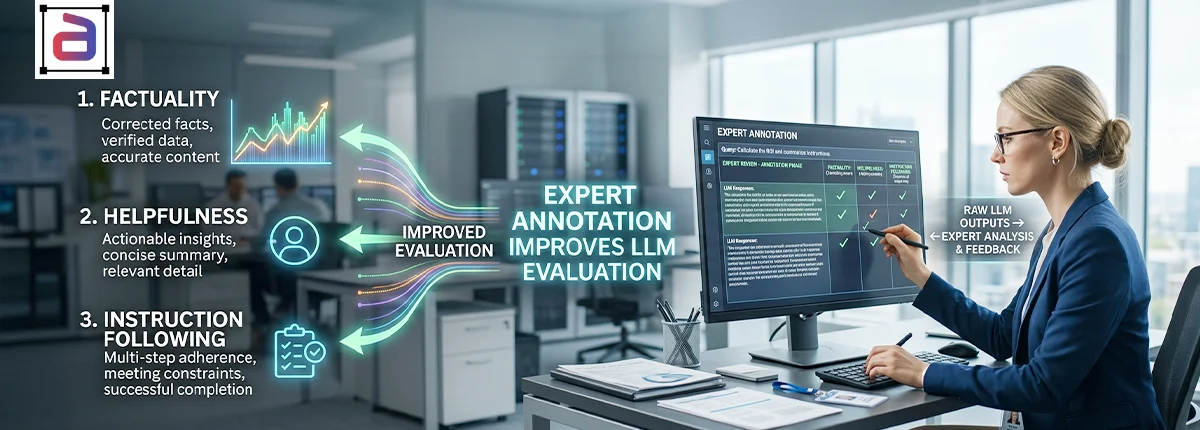
Modern LLMs rely heavily on RLHF to improve response quality and alignment. In these workflows, human evaluators rank model-generated responses based on accuracy, helpfulness, tone, and safety. Companies like OpenAI and Anthropic have demonstrated how human feedback dramatically improves conversational AI performance.
“The alignment problem is one of the most important technical problems of our time.” — Sam Altman
The quality of RLHF outcomes directly depends on the expertise and consistency of human annotators. This makes partnering with a specialized text annotation company essential for enterprises building advanced generative AI systems.
4. Human Annotation Helps Reduce Bias and Toxic Outputs
Hallucinations are not always factual errors. In many cases, LLMs produce biased, harmful, or unsafe responses learned from unfiltered internet-scale datasets. Human-in-the-loop annotation enables businesses to proactively identify and mitigate:
- Toxic language
- Hate speech
- Stereotypes
- Cultural bias
- Unsafe recommendations
- Harmful misinformation
At Annotera, ethical AI quality assurance is embedded into every annotation workflow. Our teams follow rigorous review protocols to help organizations develop AI systems that are not only intelligent but also responsible and trustworthy.
The Rising Demand for Annotation Expertise in the AI Era
The explosive growth of generative AI has created unprecedented demand for high-quality annotation services. According to Grand View Research, the global data annotation tools market is expected to surpass USD 8 billion by 2030, driven largely by enterprise AI adoption. Additionally, Gartner predicts that organizations implementing strong AI governance and human oversight frameworks will achieve significantly better AI reliability and customer trust outcomes. These trends clearly indicate that businesses can no longer treat annotation as a secondary operational task. Instead, annotation quality has become a competitive differentiator for AI success. The rapid growth of generative AI has significantly increased the demand for annotation expertise. Consequently, businesses are investing in high-quality Human-in-the-Loop workflows to improve AI accuracy, reduce hallucinations, and ensure reliable enterprise-grade model performance.
Why Businesses Choose Annotera for AI Annotation Excellence
As a leading data annotation company, Annotera helps enterprises overcome the challenges of LLM hallucinations through scalable and precision-driven annotation services. Businesses choose Annotera for AI annotation excellence because we combine skilled human annotators, scalable workflows, and rigorous quality assurance. Moreover, our Human-in-the-Loop approach helps enterprises improve AI accuracy, reduce hallucinations, and accelerate reliable generative AI deployment. Our Human-in-the-Loop workflows are specifically designed to support:
- Generative AI training
- RLHF optimization
- Conversational AI systems
- Semantic text annotation
- Intent and sentiment analysis
- Fact-checking workflows
- Multilingual AI datasets
- Domain-specific AI applications
What sets Annotera apart is our ability to combine human expertise, quality assurance, and scalable delivery models into a unified annotation ecosystem. Through our flexible data annotation outsourcing solutions, businesses can rapidly scale AI development while maintaining the accuracy and consistency required for enterprise deployment. Similarly, our text annotation outsourcing services help organizations reduce operational complexity while accelerating model refinement and time-to-market.
The Future of Trustworthy AI Is Human-Guided
Despite rapid advancements in generative AI, human intelligence remains central to building trustworthy LLMs. AI models alone cannot fully understand truth, ethics, context, or business-critical nuance without structured human guidance. The future of enterprise AI will belong to organizations that prioritize high-quality data, robust human oversight, and continuous model alignment. At Annotera, we empower businesses to build safer, smarter, and more reliable AI systems through industry-leading annotation expertise and scalable Human-in-the-Loop workflows.
Ready to Build More Reliable AI Systems?
If your organization is developing generative AI solutions, reducing hallucinations must become a strategic priority—not an afterthought. Partner with Annotera, a trusted text annotation company, to access scalable Human-in-the-Loop annotation services designed to improve model accuracy, strengthen AI alignment, and accelerate enterprise AI success. Contact Annotera today to explore customized data annotation outsourcing and text annotation outsourcing solutions tailored to your AI initiatives.
A closely related read: Beyond Keywords: Using Text Annotation To Build Smarter Chatbots And Legal AI.
A closely related read: Zero-Shot & Few-Shot Pre-Annotation: Using LLMs To Kick-Start Text Annotation Projects.