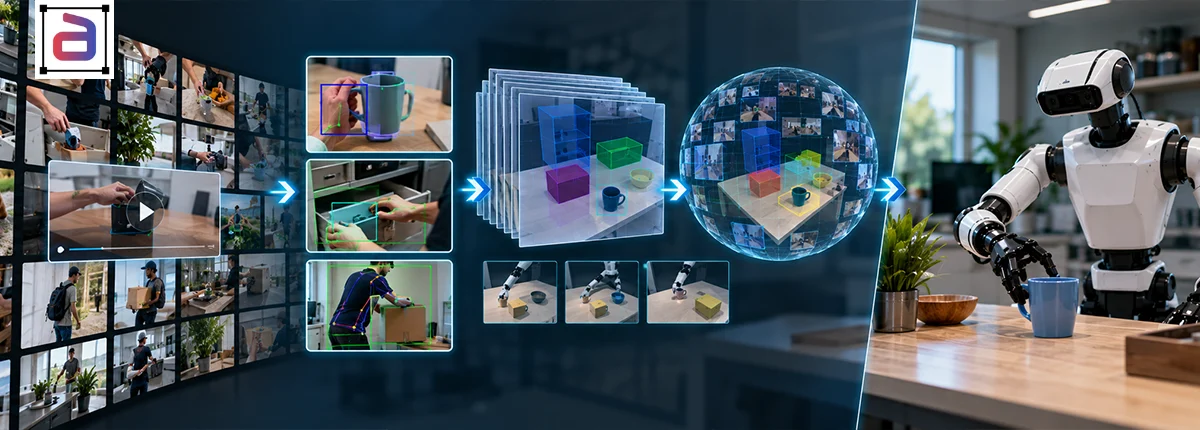
3D cuboids for AR are essential for creating augmented reality experiences that feel spatially accurate and visually convincing. As AR applications expand across retail, gaming, training, and industrial visualization, digital content must align precisely with the physical world. 3D cuboid annotation provides the depth, scale, and orientation data required to anchor virtual assets in real environments.
For digital content creators and AR developers, cuboid-based annotation is a critical step in delivering immersive, stable, and context-aware augmented reality experiences.
Table of Contents
Key Points
- AR object placement annotation must capture the three-dimensional geometry, scale, and surface orientation of digital assets relative to the physical environment they will be placed in.
- 3D cuboid annotation for AR must define object position relative to surface normals, not just floor-plane coordinates, because AR objects must sit correctly on walls, tables, and irregular surfaces.
- Scale accuracy in AR annotation has immediate perceptual impact: a virtual object annotated 20% too large or too small creates an uncanny effect that breaks immersion and undermines user trust.
- AR annotation programs must include multi-angle imaging of reference scenes so that digital assets are annotated with consistent geometry across the full range of user viewing angles.
Why Augmented Reality Requires 3D Cuboids
Augmented reality experiences demand spatial precision; therefore, 3D cuboids become essential for accurate object localization and depth estimation. Moreover, they capture real-world dimensions across axes, enabling stable overlays and occlusion handling. As a result, AR systems achieve realistic interactions, improved scene understanding, and consistent object tracking in dynamic environments. Augmented reality overlays digital objects onto real-world scenes. To appear realistic, these objects must respect physical constraints such as distance, perspective, and occlusion.
3D cuboids for AR enable systems to understand object volumes and spatial relationships, allowing virtual elements to interact correctly with real-world geometry.
How 3D Cuboid Annotation Supports AR Asset Placement
Cuboid annotations help AR engines estimate surface depth and object boundaries. This allows virtual assets to be placed at the correct scale and orientation relative to surrounding objects.
First, 3D cuboid annotation defines precise object boundaries within real-world coordinates. Moreover, it captures height, width, and depth, ensuring spatial accuracy. Consequently, AR systems can anchor digital assets with correct scale and orientation. Therefore, asset placement becomes stable, realistic, and context-aware across dynamic environments.Accurate cuboids also support occlusion handling, ensuring virtual elements appear behind or in front of real objects as expected.
AR Use Cases Powered by 3D Cuboids
Retail AR leverages 3D cuboids to visualize products at accurate scale within physical spaces. Additionally, industrial maintenance applications use them for equipment alignment and spatial guidance. Consequently, training simulations achieve realistic object interaction. Therefore, 3D cuboids enable precise, immersive, and context-aware AR deployments across industries.
- Virtual Try-Ons and Retail Visualization: 3D cuboids help align virtual products with physical spaces, improving realism in try-on and product preview experiences.
- Interactive Training and Simulation: AR training applications rely on cuboid annotations to accurately position instructional overlays in real-world environments.
- Gaming and Entertainment Experiences: Spatially aware cuboids allow game assets to respond dynamically to player movement and environmental changes.
- Industrial and Field Service AR: In industrial AR, cuboids support the accurate placement of instructions, diagnostics, and digital twins over physical equipment.
Challenges in Cuboid Annotation for AR Content
AR environments often include complex backgrounds, reflective surfaces, and varying lighting conditions. These factors complicate depth estimation and alignment of orientation. However, cuboid annotation for AR presents spatial alignment challenges, especially in dynamic or cluttered scenes. Moreover, annotators must ensure rotational accuracy and depth consistency. Consequently, minor misalignments can disrupt asset placement. Therefore, maintaining geometric precision and quality control becomes critical for reliable AR content performance.
Cuboid annotation for AR requires careful interpretation of spatial cues to ensure stable asset placement across different devices and viewing angles.
Precision and Orientation Requirements for AR Assets
Small inaccuracies in cuboid orientation or scale can break immersion and cause visual drift. High-quality 3D cuboids for AR must maintain consistent alignment across frames and sessions. First, AR assets demand millimeter-level precision to align seamlessly with physical environments. Moreover, accurate orientation across pitch, yaw, and roll ensures realistic interaction. Consequently, even slight rotational errors can distort perspective. Therefore, consistent spatial calibration and high-fidelity annotation are essential for immersive AR performance.
This level of precision is especially important for persistent AR experiences where content remains anchored over time.
Scaling AR Annotation Pipelines
As AR content libraries grow, annotation workflows must scale efficiently without compromising spatial accuracy. Managed 3D cuboid annotation services provide trained annotators, standardized spatial guidelines, and quality assurance processes suited to AR use cases.
This approach allows creators to focus on experience design while ensuring data integrity.
How Annotera Supports AR-Focused Teams
Annotera delivers 3D cuboids for AR through trained annotation teams experienced in spatial labeling and digital content. For a broader look at how annotation is reshaping AR pipelines, see our guide on augmented reality annotation workflows workflows. Annotation processes are governed by strict depth and orientation standards, supported by multi-layer quality checks.
This ensures AR-ready datasets that support immersive and reliable augmented reality experiences.
Conclusion
Augmented reality succeeds when digital and physical worlds align seamlessly. 3D cuboids for AR provide the spatial foundation required to achieve this alignment.
For digital content creators and AR developers, high-quality cuboid annotation is essential for building experiences that feel natural, stable, and immersive.
Creating or scaling augmented reality experiences? Partner with Annotera for expert-led 3D cuboid annotation designed specifically for AR assets and spatial accuracy.