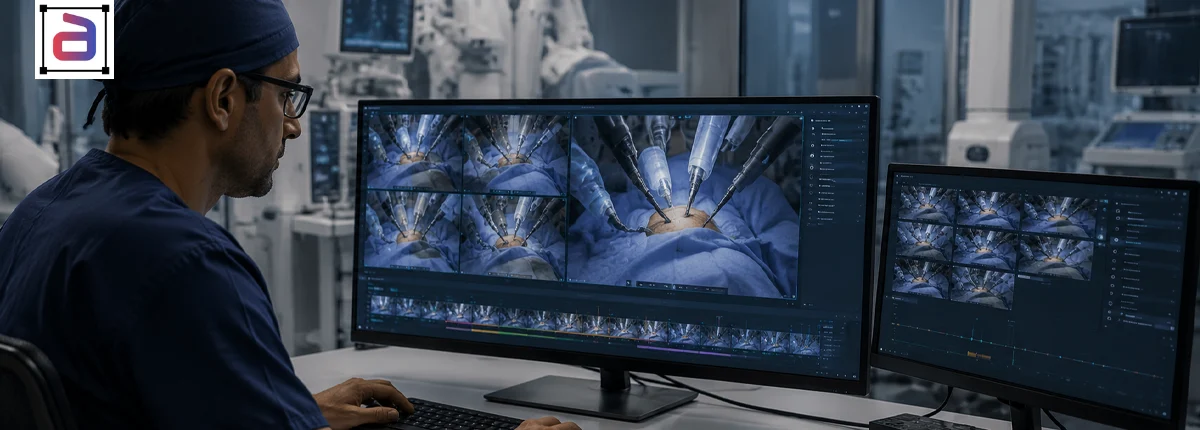
The operating room is rapidly becoming one of the most data-rich environments in healthcare. As robotic-assisted surgery gains widespread adoption, hospitals, medical device manufacturers, and AI developers are generating enormous volumes of surgical video data that can unlock new levels of precision, efficiency, and patient safety. Surgical video annotation plays a critical role in training AI systems for robotic-assisted procedures by accurately labeling surgical instruments, anatomical structures, and procedural events. High-quality annotations enable safer, more precise surgical intelligence, helping healthcare innovators advance next-generation robotic surgery technologies. However, raw surgical footage alone cannot train intelligent systems.
The true value lies in accurately annotated data that enables AI models to understand surgical instruments, anatomical structures, procedural phases, and critical events in real time. From instrument tracking and workflow analysis to autonomous surgical assistance, high-quality video annotation is the foundation upon which next-generation surgical AI is built. For organizations developing robotic-assisted surgical technologies, establishing rigorous annotation standards and protocols is no longer optional—it is mission-critical. At Annotera, we help healthcare innovators transform complex surgical video datasets into AI-ready training data through specialized medical annotation workflows, expert quality assurance, and scalable delivery models.
Key Points
- Surgical video annotation labels instruments, tissue types, and procedural steps.
- Robotic-assisted surgery AI requires frame-level annotation at high precision.
- Domain expertise is essential for accurate instrument segmentation in OR footage.
- High annotation quality directly supports surgeon assistance system safety.
Table of Contents
The Rise of AI-Powered Robotic Surgery
Robotic-assisted surgery has evolved from a niche technology into a transformative force across healthcare. According to industry reports, the global surgical robotics market is projected to exceed $25 billion by the end of the decade, driven by increasing demand for minimally invasive procedures, improved surgical precision, and AI-assisted clinical decision-making. As healthcare embraces digital transformation, robotic-assisted surgery is rapidly gaining momentum. Moreover, the integration of AI-powered computer vision enables greater precision, real-time decision support, and improved surgical outcomes, making advanced surgical technologies increasingly effective and accessible. Today’s robotic systems are no longer limited to mechanical assistance. They increasingly incorporate computer vision and machine learning algorithms capable of recognizing surgical instruments, identifying anatomical landmarks, monitoring procedural progress, and assisting surgeons during complex operations.
“The quality of data is more important than the quantity of data.” — Fei-Fei Li, AI Researcher and Computer Vision Expert
In surgical AI, this principle becomes even more critical. A model trained on poorly annotated data can introduce errors in clinical environments where accuracy directly impacts patient outcomes.
Why Surgical Video Annotation Matters
Modern robotic-assisted procedures generate thousands of video frames every minute. For AI systems to interpret this information correctly, every relevant object, action, and event must be accurately labeled. As surgical AI systems become more sophisticated, accurate training data becomes increasingly essential. Therefore, surgical video annotation helps AI models recognize instruments, anatomy, and procedural events, ultimately improving robotic precision, clinical decision-making, and patient safety during complex procedures. Surgical video annotation enables machine learning systems to:
- Detect and track surgical instruments
- Identify anatomical structures
- Recognize procedural phases
- Monitor surgeon actions
- Detect complications and anomalies
- Support robotic navigation systems
- Improve intraoperative decision-making
These capabilities are increasingly becoming essential components of intelligent surgical platforms. Without properly annotated datasets, even the most sophisticated AI algorithms struggle to achieve reliable performance in clinical settings.
Key Annotation Types Used in Robotic-Assisted Procedures
To train robust surgical AI models, multiple annotation techniques are required. For example, instrument tracking, anatomical segmentation, surgical phase recognition, and event detection collectively provide the contextual intelligence needed for accurate analysis and real-time robotic-assisted decision support.
Instrument Detection and Tracking
One of the most important annotation tasks involves identifying and tracking surgical instruments throughout an operation. Accurate instrument detection and tracking are fundamental to surgical AI. By continuously labeling surgical tools across video frames, AI systems can better understand tool movements, improve procedural analysis, and consequently enhance precision during robotic-assisted surgical interventions. Robotic arms, graspers, forceps, scalpels, suturing tools, and electrosurgical devices must be labeled frame by frame to help AI models understand tool movement, positioning, and interaction with tissue. Precise tracking enables systems to analyze surgical techniques and improve procedural guidance.
Anatomical Structure Segmentation
Human anatomy is highly complex and rarely conforms to simple geometric shapes. Anatomical structure segmentation enables AI models to precisely identify organs, tissues, blood vessels, and other critical structures. As a result, robotic-assisted systems gain improved spatial awareness, thereby supporting safer navigation, enhanced accuracy, and better surgical outcomes. Polygon annotation and segmentation techniques are used to outline:
- Organs
- Blood vessels
- Nerves
- Tumors
- Tissue boundaries
- Surgical targets
These annotations enable AI systems to distinguish critical structures and support safer surgical navigation.
Surgical Phase Recognition
Every surgical procedure follows a sequence of stages. Surgical phase recognition helps AI systems understand the sequence of procedural steps throughout an operation. Consequently, models can provide context-aware insights, monitor workflow progression, and support surgeons with more accurate real-time guidance during robotic-assisted procedures. Annotators label procedural phases such as:
- Initial access
- Tissue dissection
- Resection
- Suturing
- Closure
Phase recognition allows AI systems to understand procedural context and deliver relevant insights during surgery.
Event Annotation
Critical surgical events must also be accurately identified. Event annotation captures critical surgical actions and occurrences, such as instrument exchanges, tissue manipulation, or bleeding events. Consequently, AI models gain deeper procedural understanding, thereby improving workflow analysis, predictive insights, and decision support in robotic-assisted surgeries. Examples include:
- Instrument exchanges
- Tissue manipulation
- Bleeding incidents
- Vessel clipping
- Tumor removal
- Surgical complications
Event-level annotations create richer datasets that improve predictive analytics and workflow optimization.
Precision Standards for Medical Video Annotation
Healthcare AI datasets demand significantly higher accuracy than traditional computer vision applications. Because medical AI applications directly impact patient care, annotation accuracy is paramount. Therefore, precision standards such as clinical validation, frame-level consistency, standardized taxonomies, and rigorous quality assurance protocols are essential for building reliable and trustworthy surgical AI systems. At Annotera, we implement stringent quality protocols designed specifically for medical and surgical environments.
Clinical Expertise Integration
General annotation approaches are insufficient for surgical datasets. Clinical expertise plays a vital role in medical video annotation. By involving healthcare professionals in the review process, organizations can ensure greater labeling accuracy, while also improving dataset reliability and supporting the development of clinically relevant AI models. Medical annotation projects require oversight from trained healthcare professionals who understand anatomy, procedural workflows, and surgical terminology. Clinical validation helps eliminate labeling inconsistencies that could negatively affect model performance.
Frame-Level Precision
A single annotation error can propagate through thousands of training iterations. Frame-level precision ensures that every movement, interaction, and surgical event is accurately captured across video sequences. As a result, AI models can learn temporal patterns more effectively, thereby improving tracking accuracy and real-time performance during robotic-assisted procedures. This is why surgical video annotation requires frame-level accuracy and continuous quality monitoring across lengthy procedures. Maintaining temporal consistency is especially important when annotating instrument trajectories and procedural events.
Standardized Annotation Taxonomies
Consistency is essential when multiple annotators work on large-scale datasets. Standardized annotation taxonomies establish clear labeling rules across datasets. Consequently, annotators can maintain consistency and accuracy, while AI models benefit from uniform training data, ultimately improving performance, scalability, and reliability in surgical applications. Successful projects establish detailed guidelines covering:
- Instrument classifications
- Anatomical categories
- Event definitions
- Phase labels
- Escalation procedures
- Quality benchmarks
Standardized taxonomies improve inter-annotator agreement and reduce dataset variability.
Multi-Layer Quality Assurance
Medical AI development demands rigorous QA frameworks. Multi-layer quality assurance combines multiple review stages to validate annotation accuracy and consistency. As a result, errors are identified early, while continuous audits and expert checks help ensure reliable, high-quality datasets for medical AI development. Annotera employs structured review processes that include:
- Primary annotation review
- Secondary quality validation
- Clinical expert audits
- Random sampling checks
- Continuous feedback mechanisms
These measures help ensure annotation accuracy, consistency, and reliability at scale.
Addressing Compliance and Data Security Requirements
Healthcare data is among the most sensitive information organizations handle. Because surgical videos contain sensitive patient information, compliance and data security are critical. Therefore, organizations must implement strict privacy controls, regulatory safeguards, and secure annotation workflows to protect data integrity while meeting healthcare industry standards. Any annotation workflow involving surgical video must comply with strict privacy and regulatory standards. These may include:
- HIPAA compliance
- GDPR requirements
- Institutional Review Board (IRB) guidelines
- Internal hospital security protocols
- Medical device regulatory requirements
“Artificial intelligence holds great promise for improving health and well-being, but only if it is developed and deployed responsibly.” — World Health Organization (WHO)
For healthcare organizations, this means annotation partners must provide secure environments, controlled access systems, audit trails, and documented quality procedures.
Challenges in Surgical Video Annotation
While surgical AI offers enormous promise, creating training datasets remains a highly specialized task. Although surgical video annotation is essential for healthcare AI, it presents unique challenges. For instance, complex anatomy, rapid instrument movements, occlusions, and large data volumes increase annotation difficulty, thereby requiring specialized expertise and robust quality control processes.
Complex Surgical Environments
Surgical videos frequently contain:
- Occluded instruments
- Blood and fluid interference
- Tissue deformation
- Camera movement
- Variable lighting conditions
These challenges require experienced annotators and advanced quality controls.
Massive Data Volumes
A single robotic-assisted surgery can generate hours of footage. When organizations seek to train production-grade AI systems, annotation requirements can quickly scale to thousands of hours of video. This is where strategic data annotation outsourcing becomes essential.
Need for Specialized Expertise
Unlike generic computer vision projects, surgical annotation requires deep domain understanding. Healthcare organizations increasingly rely on specialized partners that combine medical knowledge with scalable annotation operations.
Why Healthcare Organizations Choose Annotera
As a trusted video annotation company, Annotera helps healthcare innovators build accurate, compliant, and scalable AI datasets for surgical applications. Our specialized annotation teams support:
- Surgical video annotation
- Instrument tracking
- Anatomical segmentation
- Medical image labeling
- Event detection
- Quality assurance and validation
Through flexible data annotation outsourcing and video annotation outsourcing solutions, we help organizations accelerate AI development while maintaining the precision standards required for healthcare environments. Our annotation workflows are designed to deliver high-quality training data that supports safer, smarter, and more effective robotic-assisted procedures.
The Future of Surgical AI Depends on Data Quality
The future of robotic surgery will be shaped not only by advanced hardware and sophisticated algorithms but also by the quality of the data used to train them. Every accurately labeled instrument, anatomical structure, and procedural event contributes to AI systems that can better support surgeons, improve operational efficiency, and enhance patient outcomes. Organizations investing in surgical AI must therefore prioritize annotation quality from the very beginning. With the right protocols, clinical expertise, and quality assurance frameworks in place, annotated surgical video becomes a powerful asset that drives innovation across the healthcare ecosystem.
Partner with Annotera for High-Precision Medical Video Annotation
Developing AI solutions for robotic-assisted surgery requires more than annotation—it requires domain expertise, rigorous quality standards, and a partner that understands the complexities of healthcare data. Annotera delivers scalable, secure, and clinically informed annotation services that help medical AI teams accelerate development with confidence. Ready to build smarter surgical AI systems? Contact Annotera today to learn how our expert video annotation specialists can help transform complex surgical footage into high-quality training datasets that power the next generation of robotic-assisted healthcare.
A closely related read: The Growing Role of Human-in-the-Loop Video Annotation in AI Surveillance Systems.