
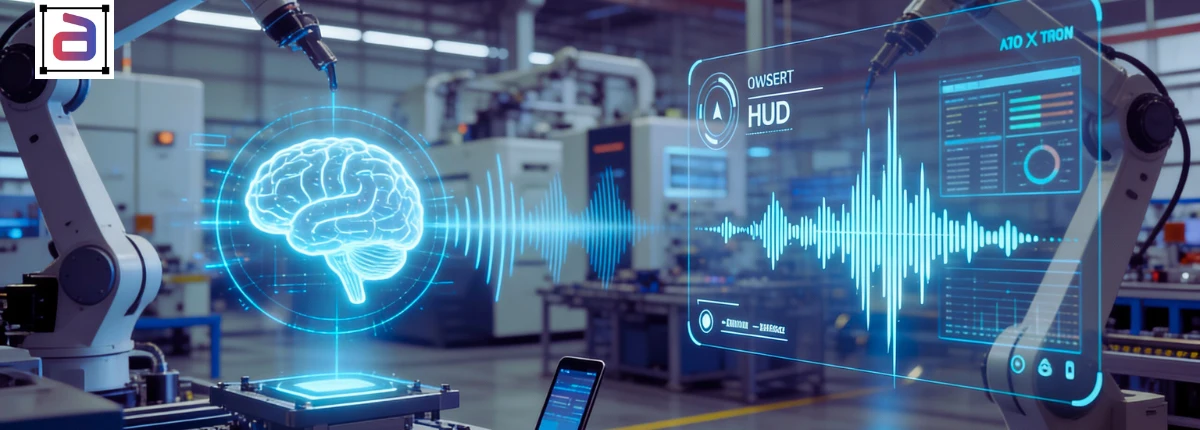
Unplanned downtime remains one of the most expensive risks in manufacturing operations. A single unexpected machine failure can halt production lines, disrupt supply chains, and cost millions in lost output within hours. Audio event labeling enables AI systems to detect subtle acoustic anomalies that indicate equipment degradation well before catastrophic failure.
- The goal: Detect machine failure before it happens and move maintenance upstream.
- The barrier: Factories are acoustically hostile environments with extreme background noise and overlapping machine signals.
- The solution: Expert audio event labeling that captures and prioritizes pre-failure sounds in heavy machinery.
Table of Contents
Key Points
- Predictive maintenance audio annotation must capture the full temporal signature of equipment degradation from early-stage acoustic anomaly to pre-failure sound — labeling only the final-stage sounds misses the detection window that makes prediction useful.
- Factory floor noise annotation must cover the full range of co-occurring machine sounds in the deployment environment so that anomaly detection models learn to identify deviation from the normal acoustic mixture, not from silence.
- False positive rates in predictive maintenance audio AI have operational cost: too many false alerts cause maintenance teams to discount AI signals, eliminating the system’s practical value before it can demonstrate ROI.
- Annotation programs for industrial predictive maintenance must include post-failure audio alongside pre-failure audio to ensure models learn what actual failure sounds like and do not optimise only for early-stage anomaly detection.
The Friction Point: Scaling A Veteran’s Ears
Experienced operators often know a machine is about to fail simply by listening. A worn bearing, a misaligned belt, or a leaking valve produces audible cues long before visible damage or sensor alerts appear.
However, this expertise does not scale. Veteran operators retire, rotate shifts, or oversee multiple production lines simultaneously. When that human intuition disappears, organizations lose an early-warning system they relied on for years.
Audio event labeling allows manufacturers to encode this hard-earned intuition into AI systems that listen continuously, consistently, and without fatigue.
“You can train an operator for years, or you can train a model once and deploy it everywhere.” — Plant Reliability Engineer
Why Sound Is Often The Earliest Indicator Of Failure
Mechanical systems express stress acoustically before they fail mechanically. Changes in vibration, friction, airflow, or rotational balance often manifest as sound anomalies earlier than temperature spikes, pressure changes, or visual defects.
With accurate audio event labeling, AI systems can:
- Identify abnormal machine cycles before alarms trigger
- Flag early-stage component wear invisible to standard sensors
- Detect air, gas, or fluid leaks at inception
- Estimate failure windows with higher confidence
As a result, maintenance strategies shift from reactive and schedule-based to predictive and condition-driven.
Acoustic Anomaly Detection In Industrial Environments
Factories pose one of the most challenging acoustic environments for AI. Multiple machines operate simultaneously, each producing overlapping frequency patterns that change with load, speed, and wear.
Without precise labeling, models struggle to separate meaningful failure signals from ambient industrial noise.
Common Pre-failure Acoustic Events
| Machine component | Pre-failure sound | What it signals | Operational risk |
| Bearings | High-frequency whining or grinding | Lubrication loss or pitting | Shaft seizure |
| Belts | Irregular slapping or squealing | Tension loss or misalignment | Line stoppage |
| Motors | Low-frequency rumble or friction hiss | Rotor imbalance or overheating | Motor burnout |
| Pneumatics | Continuous hissing | Seal degradation | Pressure loss |
Audio event labeling trains models to recognize these patterns even when they appear briefly or are partially masked by other machines.
Temporal labeling: Identifying When Failure Begins
Many critical anomalies do not persist continuously. Instead, they appear at specific moments within a machine cycle, often under load transitions or peak stress.
Temporal labeling focuses on:
- The precise timestamp where deviation begins
- The duration and recurrence of the anomaly
- The relationship between sound and machine state
This level of precision enables AI systems to correlate acoustic events with operating conditions and to prioritize alerts by severity and progression.
“Knowing when the sound changes is just as important as knowing what the sound is.” — Industrial AI Researcher
Overcoming The Signal-to-noise Problem In Factories
Effective predictive maintenance requires isolating weak failure signals from ambient noise and this helps in industrial noise labeling. Generic annotation approaches fail because they ignore machine context.
High-quality audio event labeling includes:
- Multi-channel recordings near known failure points
- Context-aware labeling tied to machine state and load
- Clear separation of ambient noise versus mechanical events
Without this rigor, models generate false positives that maintenance teams quickly learn to ignore, undermining trust.
From Labeled Sound To Predictive Insight
Once models learn to detect pre-failure sounds reliably, manufacturers can unlock advanced capabilities:
- Early-warning dashboards for maintenance teams
- Failure trend analysis across identical machines
- Automated work-order triggers based on sound patterns
- Spare-parts forecasting driven by acoustic degradation
In practice, acoustic event tagging becomes a continuous health signal rather than an afterthought.
The Annotera Edge In Industrial Audio Event Labeling
Annotera builds predictive maintenance datasets in collaboration with mechanical engineers and reliability specialists, not in isolation.
Our approach includes:
- Labeling guided by domain-specific mechanical knowledge
- Identification of subtle acoustic shifts invisible to untrained annotators
- Priority tagging for events correlated with failure progression
- Human-in-the-loop QA to maintain consistency at scale
“The difference between noise and signal often lives in a few milliseconds of sound.” — Reliability Analytics Lead
By combining domain expertise with annotation precision, we help manufacturers deploy AI that maintenance teams trust in real production environments.
Business Impact: Reducing Downtime And Extending Asset Life
For manufacturing leaders, predictive maintenance delivers measurable outcomes:
- Reduced unplanned downtime
- Lower emergency repair costs
- Extended equipment lifespan
- Improved worker safety and compliance
Audio event labeling forms the data foundation that makes these outcomes achievable at scale.
Turn Factory Noise Into Operational Insight
Factories already generate the data needed to prevent failures. The challenge lies in labeling it correctly and acting on it early.
If your operations rely on heavy machinery, expert audio event labeling can convert raw sound into early warnings that protect productivity, revenue, and uptime. Get a quote for industrial predictive maintenance datasets and learn how Annotera helps manufacturers hear problems before they happen.
For more on this, acoustic annotation powering predictive maintenance.