
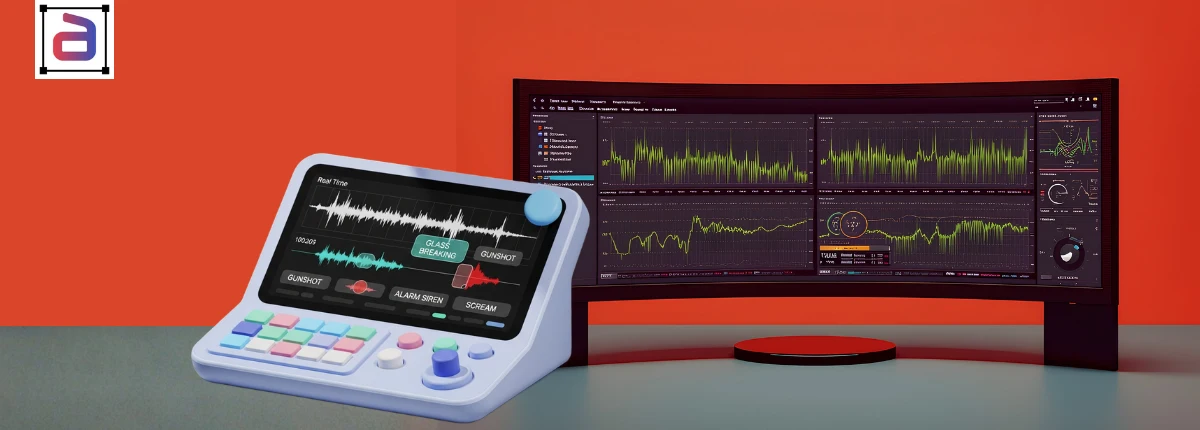
Modern safety operations demand speed. In high-risk environments, seconds often determine outcomes. Audio event tagging enables AI systems to detect and classify critical acoustic events—such as gunshots, glass breaking, or human distress—in real time, dramatically reducing response latency.
- The goal: Reduce response times to critical safety incidents.
- The barrier: Traditional surveillance relies on line of sight and lighting conditions.
- The solution: High-fidelity audio event tagging that trains AI to recognize danger as it occurs.
Table of Contents
Key Points
- Real-time safety audio annotation must prioritise precision over recall for false-positive-sensitive scenarios: a model that generates too many alerts will cause safety operators to stop monitoring the alert feed.
- Safety event audio annotation must cover the same target event at different distances, directions, and background noise levels because safety events in the real world do not occur under controlled acoustic conditions.
- Annotation for safety event detection must include event onset annotation, not just event presence annotation, because response time is determined by how quickly the system detects that a safety event has started.
- Audio safety AI annotation must cover overlapping safety events — a fire alarm and a human shout simultaneously — so that multi-event detection models learn to classify concurrent events correctly.
The Friction Point: The Latency Of Sight
Security teams rely heavily on cameras. However, cameras cannot see around corners, through walls, or in smoke-filled environments. Even when a threat appears on video, confirmation often arrives too late.
Audio fills these blind spots. Sound travels where cameras cannot see. Acoustic event tagging enables AI systems to respond to threats the moment an acoustic signature is detected, rather than waiting for visual confirmation.
“By the time a camera confirms a threat, the incident has often already escalated.” — Security Operations Director
Why Audio Event Tagging Changes Real-time Safety
Audio signals precede visual cues in many emergency scenarios. Gunshots, explosions, forced entry, and distress calls generate distinct acoustic patterns that precede visual clarity.
By tagging and training on these sounds, AI systems can:
- Trigger immediate alerts
- Activate camera focus dynamically
- Notify first responders faster
- Reduce reliance on manual monitoring
As a result, audio event tagging transforms passive surveillance into proactive safety intelligence. Audio event tagging transforms real-time safety by enabling security systems to recognize critical sounds such as gunshots, glass breaks, alarms, and distress calls. High-quality data annotation in surveillance can trigger instant alerts, reduce response times, and improve situational awareness across dynamic, high-risk environments.
The Science Of Acoustic Signatures
Not all loud noises indicate danger. Also, effective safety AI must distinguish between benign and threatening sounds with high precision.
How AI Differentiates Gunshots From Everyday Noise
Acoustic events differ across measurable dimensions such as waveform shape, frequency decay, and temporal patterns. For example, a gunshot produces a sharp impulse with rapid energy decay, while a car backfire exhibits longer reverberation and inconsistent frequency spread.
| Acoustic event | Signature characteristics | Common false positive |
| Gunshot | Sharp impulse, high peak amplitude, rapid decay | Fireworks, backfire |
| Glass breaking | High-frequency shatter burst | Dropped objects |
| Human scream | Sustained harmonic energy, emotional modulation | Loud speech |
| Forced entry | Repetitive impact patterns | Construction noise |
Audio event tagging captures these differences at the data level, enabling models to accurately classify threats.
Integrating Audio Event Tagging Into Existing Security Infrastructure
Safety leaders rarely deploy systems in isolation. Moreover, successful adoption requires seamless integration with existing tools.
Audio event tagging integrates directly with:
- CCTV networks
- Video Management Systems (VMS)
- Access control platforms
- Emergency dispatch software
When an acoustic event triggers detection, systems can automatically:
- Pivot cameras toward the sound source
- Flag video feeds for operators
- Escalate alerts based on severity
This fusion of audio and video reduces response friction and operator overload.
The Challenge Of Real-world Environments In Audio Event Tagging
Urban environments introduce constant background noise. Sirens, traffic, crowds, and machinery can overwhelm poorly trained models. Moreover, without robust audio tagging, AI systems generate false positives that erode trust and slow adoption.
Why Environment-specific Data Matters
Models trained only on clean or simulated audio fail in production. Safety AI must learn from real environments where incidents actually occur.
| Environment | Acoustic challenges |
| Stadiums | Crowd noise, echoes, sudden volume spikes |
| Shopping malls | Music, overlapping conversations |
| Parking garages | Reverberation, engine noise |
| Transit hubs | Announcements, mechanical sounds |
The Annotera Edge In Safety-focused Audio Event Tagging
Annotera builds datasets designed for operational reality, not lab conditions.
We provide:
- Multi-environment audio datasets from real public spaces
- Precise labeling of safety-critical events
- Noise-aware audio annotations to reduce false positives
- Human-in-the-loop QA for consistency and accuracy
“False positives cost trust. High-quality data preserves it.” — AI Safety Program Lead
By training models on realistic acoustic conditions, we help security teams deploy AI they can rely on under pressure.
Reducing Risk, Accelerating Response
For Safety and Security VPs, the objective is simple: detect threats earlier and respond faster. Audio event tagging delivers that advantage by eliminating the visual latency in safety operations. Further, when AI listens intelligently, security teams act decisively.
Build Your Real-time Safety Dataset
If your organization needs faster, more reliable threat detection, high-quality tagging is the foundation. Contact Annotera to design a custom safety-event dataset tailored to your environments and risk profile.
Audio Event Annotation Quality Standards for Safety Systems
Safety-system audio event models carry a higher annotation quality bar than general-purpose audio classifiers because the cost of a missed event is asymmetric. A false negative in a gunshot detection system, an industrial alarm classifier, or a fall-detection model represents a safety failure, not just an accuracy metric. For safety-critical audio annotation, Annotera targets: ≥0.95 per-class recall on the target event classes, ≤0.5-second timestamp accuracy for event onset and offset, and triple-annotator consensus (not two-of-three) for ambiguous events. These standards require a larger annotator pool, longer per-sample review time, and more extensive gold-standard calibration than standard audio annotation, and they are reflected explicitly in the program SLA.
This connects closely with acoustic event labeling for industrial safety use cases.
A closely related read: From Sirens to Silences: Tagging the Audio World.