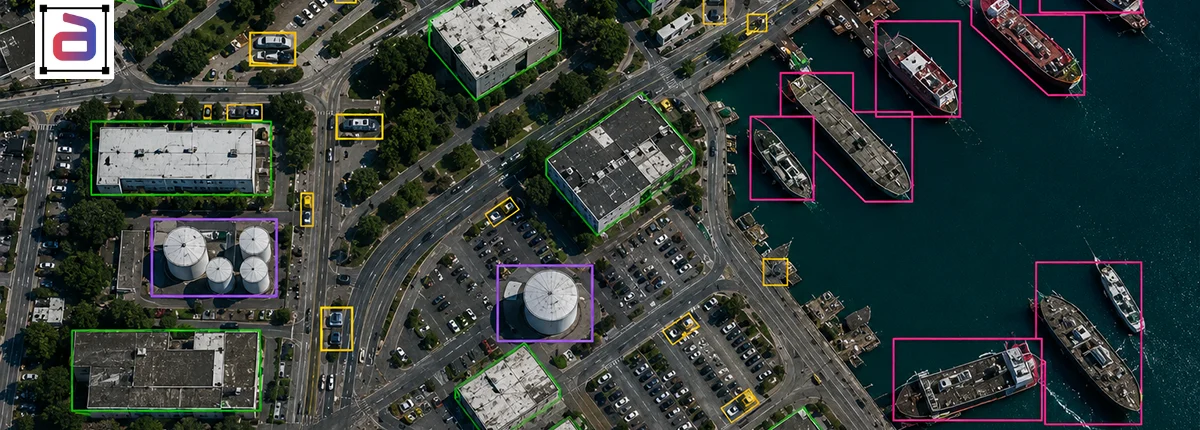
From monitoring urban expansion and tracking environmental changes to supporting defense intelligence and disaster response, aerial and satellite imagery has become a cornerstone of modern AI-powered decision-making. However, the success of these applications depends on one critical factor: the quality of the training data behind them. Bounding Box Annotation for Aerial imagery plays a vital role in training AI models to detect and classify objects from satellite and drone data. However, as datasets grow in size and complexity, traditional annotation approaches often struggle to maintain consistency and accuracy. Learn more about annotating aerial footage from drones.
Bounding box annotation remains one of the most widely used techniques for object detection in geospatial datasets. Yet, what works for conventional computer vision projects often falls short when applied to aerial and satellite imagery. As image volumes grow and object complexity increases, standard annotation rules begin to break down—creating inconsistencies that directly impact model performance. At Annotera, we help organizations overcome these challenges through specialized image annotation services tailored for geospatial AI. As an experienced data annotation company, we understand that accurate annotation at scale requires more than simply drawing boxes around objects. It requires domain expertise, rigorous quality frameworks, and annotation strategies designed specifically for remote sensing applications.
For satellite and aerial imagery projects, that statement has never been more relevant.
Key Points
- Aerial and satellite image annotation follows different rules than ground-level photography.
- Objects appear smaller, more densely clustered, and at varying resolutions.
- Standard bounding box guidelines break down at very high object counts per image.
- Specialized annotation workflows handle tiling, resolution scaling, and object density.
Table of Contents
The Explosive Growth of Geospatial AI
The geospatial analytics industry is experiencing remarkable growth. According to industry estimates, the global geospatial analytics market size was valued at USD 102.67 billion in 2025 and is anticipated to reach USD 234.01 billion by 2033, growing at a CAGR of 10.4% from 2026 to 2033, driven by the increasing adoption of location-based services across industries such as retail, transportation, and logistics. At the same time, Earth observation satellites generate terabytes of imagery every day. Organizations are increasingly turning to AI models to analyze this data at scale, enabling faster and more informed decision-making. However, AI systems are only as effective as the datasets used to train them.
“The quality of data determines the quality of AI.”— Fei-Fei Li
This principle becomes especially important in aerial imagery, where annotation complexity can dramatically affect detection accuracy.
Why Bounding Box Annotation Becomes Challenging in Aerial Imagery
Traditional object detection datasets are typically built using photographs captured at eye level. Objects are clearly visible, relatively large, and easy to distinguish. Aerial and satellite imagery present an entirely different reality. Objects often appear:
- Extremely small
- Densely packed
- Partially obscured
- Rotated at multiple angles
- Affected by shadows and atmospheric conditions
A single satellite image may contain thousands of buildings, vehicles, storage containers, ships, roads, and infrastructure assets. Under these conditions, conventional annotation rules quickly become inadequate.
1. Object Density Creates Annotation Ambiguity
In urban environments, airports, ports, and industrial facilities, objects frequently overlap or appear in close proximity. For example, a parking lot captured from space may contain hundreds of vehicles separated by only a few pixels. Applying standard bounding box guidelines often leads to inconsistent labeling decisions between annotators. Questions arise such as:
- Should partially visible vehicles be labeled?
- How should overlapping objects be separated?
- What defines the exact boundary of densely clustered assets?
Without detailed geospatial annotation protocols, dataset quality begins to deteriorate.
2. Small Objects Leave No Margin for Error
Many critical objects in satellite imagery occupy fewer than 30 pixels. At this scale, even a slight annotation variation can significantly influence model training outcomes. A one-pixel shift may represent a substantial percentage of an object’s total footprint. This challenge becomes magnified when projects require millions of annotations across large geographic regions. Standard annotation practices were never designed to handle such precision requirements consistently.
3. Object Orientation Challenges Traditional Boxes
Unlike conventional photographs, aerial imagery captures objects from overhead perspectives. Vehicles, aircraft, ships, and buildings appear at virtually any orientation. Traditional horizontal bounding boxes often include excessive background pixels, introducing unnecessary noise into training datasets. As geospatial projects scale, organizations increasingly adopt advanced annotation methodologies that account for orientation and object geometry.
4. Resolution Variability Impacts Consistency
Satellite imagery originates from multiple sensors with varying spatial resolutions. An object visible in a high-resolution image may be difficult to identify in another dataset collected by a different satellite platform. Without clearly defined resolution-specific annotation standards, inconsistencies become inevitable. For AI models expected to generalize across multiple data sources, such inconsistencies can significantly reduce performance.
The Hidden Cost of Poor Annotation
Annotation errors do not simply affect dataset quality—they directly impact business outcomes. In geospatial AI applications, inconsistent annotations can lead to:
- False object detections
- Missed infrastructure assets
- Reduced model precision
- Increased retraining costs
- Delayed deployment timelines
- Lower stakeholder confidence
For applications involving public safety, disaster response, national security, or critical infrastructure monitoring, these issues can have far-reaching consequences.
“Garbage in, garbage out.”— Foundational Principle in Data Science
No amount of algorithmic sophistication can fully compensate for poorly annotated training data.
Why Specialized Annotation Frameworks Matter
Successful aerial imagery projects require annotation methodologies specifically designed for geospatial environments. At Annotera, our teams implement structured workflows that address challenges unique to remote sensing data. These frameworks include:
Object-Specific Annotation Standards
Different object classes require different annotation approaches. Buildings, vehicles, shipping containers, aircraft, utility infrastructure, and agricultural assets each demand tailored labeling guidelines to maximize consistency.
Multi-Layer Quality Assurance
High-volume annotation projects require robust validation systems. Our quality assurance framework incorporates:
- Multi-stage reviews
- Expert audits
- Consensus validation
- Accuracy benchmarking
- Continuous quality monitoring
This approach ensures consistency even across millions of annotations.
Domain Expertise
Remote sensing imagery requires specialized interpretation skills. Annotators must understand:
- Satellite sensor characteristics
- Terrain influences
- Seasonal variations
- Object appearance across resolutions
This expertise is often the difference between an average dataset and a production-ready AI training asset.
Why Organizations Choose Data Annotation Outsourcing
As geospatial AI initiatives continue to expand, many organizations are embracing data annotation outsourcing to accelerate project timelines and improve scalability. Partnering with a trusted data annotation company offers several advantages:
- Access to trained annotation specialists
- Faster dataset development
- Consistent quality management
- Flexible project scalability
- Reduced operational overhead
Similarly, working with an experienced image annotation company enables organizations to focus internal resources on AI innovation while annotation experts manage complex data preparation requirements. Bounding Box Annotation for Aerial imagery enables AI systems to identify and track objects across vast geographic areas. Yet, the unique characteristics of satellite and drone imagery often make standard annotation rules difficult to apply consistently at scale. For enterprises processing large volumes of aerial and satellite imagery, image annotation outsourcing has become a strategic enabler of AI success.
How Annotera Helps Build Better Geospatial AI
At Annotera, we specialize in delivering high-quality annotation solutions for complex computer vision applications. Our geospatial annotation teams combine industry expertise, rigorous quality controls, and scalable workflows to support AI initiatives across agriculture, transportation, infrastructure, environmental monitoring, defense, and smart city development. Whether you require bounding box annotation, semantic segmentation, polygon annotation, object tracking, or custom geospatial labeling frameworks, our experts ensure that every annotation contributes to stronger model performance and more reliable outcomes.
Conclusion
Bounding box annotation remains fundamental to object detection, but aerial and satellite imagery introduce complexities that standard annotation rules simply cannot address at scale. Object density, orientation variability, small target sizes, and multi-resolution datasets demand specialized annotation strategies designed specifically for geospatial AI. Organizations that invest in high-quality annotation gain a significant competitive advantage through more accurate models, faster deployment cycles, and greater confidence in AI-driven decisions.
Ready to Build Better Geospatial AI?
These exact challenges played out at scale for a wildfire detection platform — read our case study on building a scalable wildfire monitoring workforce.
As a trusted image annotation company, Annotera helps organizations transform complex aerial and satellite imagery into high-quality AI training datasets. Whether you’re exploring data annotation outsourcing for a new geospatial project or looking to scale existing image annotation outsourcing operations, our experts are ready to help. Contact Annotera today to discover how precision-driven annotation can unlock the full potential of your geospatial AI initiatives. Explore our image annotation services.