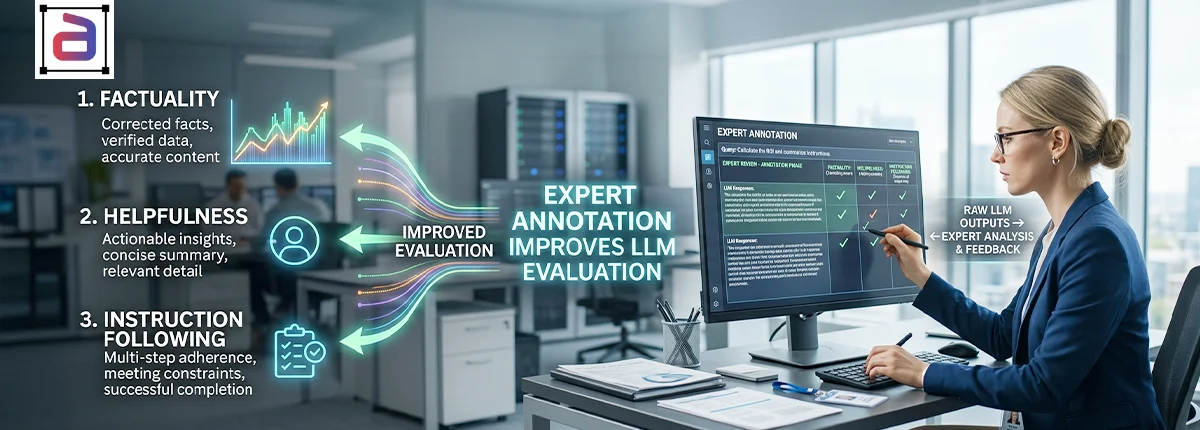

The sectors betting hardest on AI in 2026 — autonomous driving, medical imaging, robotics, financial compliance — share one unforgiving requirement: their models are only as trustworthy as the data underneath them. A perception stack that mislabels a pedestrian, or a diagnostic model trained on a sloppily masked tumor, doesn’t just underperform. It fails in ways that matter.
That pressure has changed what good annotation looks like. Speed and scale still matter — products have to ship — but they no longer win on their own. What separates a model that passes its benchmarks from one that holds up in deployment is the quality, context, and defensibility of its labels. The era of “more data is better” is giving way to something sharper: smart data over big data. Models need context-rich, low-noise training examples, and they increasingly need them across multiple modalities at once — camera, LiDAR, radar, text, and audio fused into a single labeled scene.
At the same time, the bar for responsible labeling has risen. Bias, privacy, and auditability are now board-level concerns, not afterthoughts. The teams that get this right pair advanced tooling with domain-specific human judgment — and they treat annotation as an engineering discipline, not a commodity task to be pushed to the cheapest crowd.
Below are the five data annotation trends defining 2026, and what each one demands from the teams building production AI.
Key Points
- Data annotation in 2026 is shifting from volume-first to quality-first, with safety-critical industries demanding verifiable accuracy over throughput.
- Human-AI hybrid workflows are becoming the standard: automated pre-labeling combined with expert human review at scale.
- Domain expertise has emerged as the primary differentiator between annotation providers as AI moves into specialized industries.
- Regulatory pressure on AI training data traceability is reshaping how enterprises select, audit, and contract annotation services.
Table of Contents
Why Annotation Quality Is the 2026 Bottleneck
A few realities frame everything that follows. The majority of the effort in any serious AI project still goes into preparing and cleaning data, not architecting the model — the modeling is rarely where projects stall. AI-assisted labeling can meaningfully improve accuracy when a skilled reviewer sits in the loop, but left unchecked, it quietly propagates the same errors at scale. Synthetic data is now a standard part of the pipeline, yet the strongest results come from hybrid datasets where synthetic examples are validated against real-world ground truth. And across the board, human–AI collaboration produces more confident, more reliable model decisions than either humans or automation working alone.
None of these points toward “label faster and cheaper.” They point to smarter labeling — with expertise, validation, and oversight built into the process. That is the throughline of all five trends.
The Top 5 Data Annotation Trends to Follow in 2026
1. AI-Assisted Pre-Labeling and Model-Assisted Labeling (MAL)
The biggest shift in day-to-day annotation work is where the human starts. Drawing every bounding box, polygon, or mask from a blank frame is increasingly a thing of the past. Instead, a pre-trained model generates the first-pass labels, and the annotator’s job moves up the value chain — from creating labels to judging them.
The model does the heavy, repetitive work and effectively tells the human where to look. The annotator then applies domain judgment: tightening a loose box, correcting a mask that bled across an edge, resolving an object the model wasn’t sure about. Crucially, every correction is fed back into the pre-labeling model, so each cycle needs fewer fixes than the last. The pipeline gets faster and more accurate at the same time — a compounding loop rather than a one-time speedup.
The catch is that AI cannot handle ambiguity, and ambiguity is exactly where high-stakes models fail. In autonomous driving, automated pre-labeling can rough out vehicles, lanes, and pedestrians — but erratic lighting, occlusion, and unpredictable road behavior still require a human to capture the edge cases that determine real-world safety. In healthcare, a model can flag a suspicious region, but only a domain-trained reviewer can validate whether the label is clinically correct.
This is precisely the model Annotera is built around. Our human-in-the-loop workflow uses automation to accelerate the first pass, then routes every dataset through a three-layer QA framework — annotator review, team-lead spot-checks, and independent validation — so speed never comes at the cost of the edge cases that matter.
2. The Rise of Multimodal and Sensor-Fusion Annotation
Modern systems understand their environment by combining multiple data sources simultaneously. A single RGB image or a block of plain text no longer captures enough — especially in robotics and autonomous systems, where the question isn’t just “can we label this efficiently?” but “can we label across sensors at all?”
Today’s annotators work with 2D camera images, radar returns, and 3D LiDAR point clouds in the same scene, labeling visual appearance, depth, and motion together. Annotation is no longer flat. Objects disappear behind others, reappear, drift, and overlap across frames, and the unit of work has moved from 2D boxes to 3D cuboids and multi-sensor fusion tracked over time.
The reason is straightforward: one sensor rarely sees the whole picture. In fog, low light, or heavy rain, a camera alone fails — but fusing LiDAR, radar, and camera data lets the model reliably detect objects in conditions no single input could handle. Multimodal labeling isn’t about piling on extra data; it produces contextually rich training examples that reflect the messiness of real environments. In healthcare, pairing imaging with patient records sharpens diagnosis and treatment recommendations. In robotics, sensor fusion data enables a system to reason about object movement and spatial relationships precisely enough to act.
This raises the skill bar. Multimodal LLMs that read, reason, and respond need annotators who understand spatial geometry, motion dynamics, and contextual reasoning — a hybrid expertise that generic labelers don’t have. Cross-trained teams are no longer a nice-to-have. Annotera’s robotics and autonomous-vehicle teams are built specifically for this work, handling LiDAR cuboids, multi-sensor fusion datasets, and frame-level tracking for perception stacks from ADAS to L4.
3. Synthetic Data Validation and Hybrid Datasets
Synthetic data has earned its place in fast AI training, but a hard lesson has set in: models trained purely on synthetic examples tend to drift from real-world behavior. They sail through testing and then stumble in deployment. Pure synthetic, on its own, is no longer enough.
The fix isn’t to abandon synthetic data — it’s to validate it. Domain experts review synthetic labels to confirm they reflect real-world context and behavior, and that validation must be most rigorous precisely where synthetic data earns its keep: the rare, unique, high-risk edge cases that field data can’t supply. That demands annotators who do more than draw boxes. They assess spatial realism, judge semantic correctness, validate what holds up, and reject what doesn’t — the foundation for safety-critical work in robotics and geospatial intelligence.
Hybrid datasets are where this lands in practice. Crash and extreme-weather scenarios are hard to capture on the road, so synthetic versions are generated and then checked against real driving data for accuracy. Healthcare uses synthetic data to expand training coverage while protecting patient privacy. Defense and geospatial teams rely on synthetic satellite imagery when real imagery is scarce. In each case, synthetic data trains the model to respond correctly to situations that real data simply doesn’t contain — but only after a human has confirmed it behaves like the real thing. Annotera’s sim-to-real validation workflows are designed for exactly this hybrid approach.
4. Domain-Specific “Specialist” Annotation
A label can be technically correct and still be wrong for the model. What 2026 demands is contextually correct labeling — and that means moving from generalist annotation to specialist annotation. In healthcare, finance, and legal work, the difference between a defensible label and a costly one is domain knowledge.
The pattern gaining ground is the expert-in-the-loop (EITL) workflow, where the people labeling the data also carry real domain credentials — radiologists, financial analysts, legal reviewers. These annotators interpret patterns that generic labelers would miss, recognize edge cases, and apply domain-specific rules correctly. They also satisfy a rising compliance burden: regulated industries increasingly require documentation of who labeled what, why a given decision was made, and how bias was handled. That kind of audit trail is nearly impossible to produce without expert annotators.
The stakes are concrete. In medical imaging, distinguishing benign from malignant patterns is a clinical judgment, not a labeling shortcut — a generic annotator simply isn’t equipped to make that call. In legal AI, misreading terminology leads directly to misclassification, so the annotator has to actually understand the language. Across regulated financial services work, the same principle holds: expertise defines guidelines, validates data, and catches problems at the annotation stage rather than after a model is already in production. The shift is toward knowledge-driven processes where accuracy is expert-led from the start. Annotera staffs domain-trained annotators — not crowdsourced workers — for precisely these use cases, under ISO 27001-aligned security and HIPAA-aware workflows.
5. The Evolution of the Annotation Workforce
The role of the annotator has changed more than any single technique. Repetitive task performers have become data critics, quality architects, and AI curators — because in 2026, labeling is about guiding model behavior, not racking up dataset volume. Annotators surface ambiguous samples, flag potential bias, and check outputs against benchmarks. As applications get more specialized, this evolved workforce becomes the backbone of model reliability.
Quality is the part that the workforce can’t outsource to automation. Annotation guidelines have to adapt as data distributions shift or the model degrades and drifts. Preventing that drift requires something the cheapest labeling arrangements can’t offer: a stable team and a real institutional memory of how quality decisions get made. The best annotation programs now look less like a pool of labelers and more like a structured operation — domain specialists, QC experts, auditors, and reviewers, with feedback loops that continuously refine guidelines and training. Annotators don’t force a label when they’re unsure; they flag it for review, and the dataset’s contextual accuracy is checked against real-world expectations.
Because genuine experts are scarce and hard to retain, more AI teams are partnering with established providers that can supply trained annotation teams, domain experts, documented QA, governance, and a stable delivery model — rather than rebuilding all of that in-house. This is the core of how Annotera operates: 350+ dedicated specialists who stay with your project as it scales, a three-layer quality framework, and a 99%+ first-pass accuracy benchmark backed by structured QA rather than headcount churn.
Conclusion: Quality Is the Strategy
Annotation in 2026 is no longer a volume game. Pushing large amounts of labeled data without quality and accuracy doesn’t move models forward — it just scales errors faster. What works is annotators with domain expertise and contextual understanding who take validation and review seriously. As multimodal and sensor-fusion data enters the mainstream, that kind of expertise stops being optional.
Automation belongs in the pipeline — but without human oversight and domain guidance, unchecked automation propagates errors at scale. The teams that win are the ones investing in annotators who can reach the core of contextual understanding, address bias, and deliver both compliance and scalability. In 2026, the quality of the people training your models will determine the success of your AI. The trends are shifting; the approach has to shift with them.
Building or scaling an AI model in 2026? Annotera delivers production-grade training data across text, image, audio, video, robotics, and LLM & generative AI — with dedicated specialists, three-layer QA, and a working pilot in 48 hours. Start a free pilot.
Frequently Asked Questions
What are the top data annotation trends shaping AI in 2026?
The defining shift is from volume to training-data quality, enforced through stronger inter-annotator agreement and tighter quality control. The dataset that wins isn’t the largest — it’s the most contextually correct. AI-assisted labeling, paired with human validation, reduces bias and improves accuracy; multimodal and domain-specific annotation is in high demand; and data governance and compliance have become baseline requirements, with growing pressure for datasets that meet all applicable standards and regulations.
How does AI-assisted labeling improve the annotation process?
It reduces manual effort and accelerates turnaround time because annotators review a pre-generated first pass rather than starting from a blank frame. That lowers cost per label and makes large volumes manageable. The benefit only holds when a skilled reviewer stays in the loop to correct the model’s mistakes — otherwise, automation simply repeats its errors at scale.
Why is multimodal and sensor-fusion annotation necessary for modern AI?
As data complexity grows, models need to integrate text, video, images, and sensor inputs to capture real-world conditions and stay robust. Relying on a single source leaves blind spots; fusing multiple sources lets a system make accurate judgments where any one input would fail — for example, combining LiDAR, radar, and camera data in poor weather. Cross-referencing modalities also surfaces edge cases and improves overall clarity.
Can AI models be trained effectively using only synthetic data?
Synthetic data is valuable for simulating edge cases that are hard to capture in the real world, and it’s especially useful in early training and testing. But training purely on it risks a domain gap, where the model drifts from real-world behavior. A hybrid approach — synthetic data validated against real data — is consistently more reliable.
Why is domain-specific specialist annotation important for regulated industries?
Medical, legal, and financial work depends on subject-matter expertise. Without it, accuracy slips and generic annotators miss domain nuances that change a label’s meaning. Domain experts reduce critical errors, interpret complex data correctly, and produce the documentation that regulated industries require — all of which improves model reliability and credibility.
How does the right annotation partner improve AI model success?
Look for relevant domain experience and a credible track record. The right partner delivers high-quality, consistent, scalable datasets, brings industry-specific expertise, and reduces turnaround and operational cost through proven tooling and workflows — freeing your team to focus on core model development instead of managing a labeling operation. Annotera fits this profile, with domain-trained specialists, three-layer QA, and a 48-hour pilot to prove fit before you scale.
A closely related read: Scaling Your AI Strategy With Generative AI And Human-in-the-Loop Processes .
A closely related read: Image Categorization vs Tagging vs Annotation: Key Differences Explained.