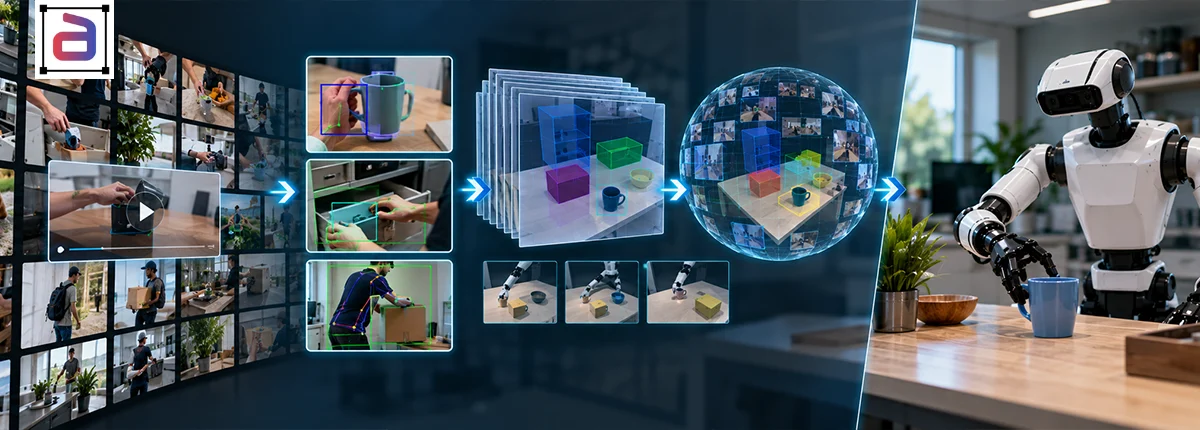

In today’s AI landscape, scaling successfully requires more than just powerful models or large datasets. The most effective approach combines the speed and creativity of Generative AI with the precision and judgment of Human-in-the-Loop (HITL) processes. This partnership helps organizations build AI systems that are not only fast and scalable but also accurate, trustworthy, and ethically sound.
Table of Contents
Key Points
- Generative AI scales annotation throughput for common patterns; HITL processes handle the edge cases, domain-specific nuances, and safety-critical decisions that generative AI cannot reliably annotate.
- The accuracy and trustworthiness of AI systems built with generative AI + HITL workflows is determined by the HITL component: generative AI scales the easy cases, but the hard cases that define model safety and reliability require human judgment.
- Scaling AI strategy with generative AI requires defining the boundary between what generative AI annotates autonomously and what routes to human review: this boundary is a quality policy decision, not a technical one.
- HITL processes must be designed to learn from the cases they review: human decisions on edge cases should update annotation guidelines and trigger retraining of the automated pre-annotation model to reduce the volume of edge cases requiring human review over time.
Why Generative AI Needs Human-in-the-Loop
Generative AI excels at rapid content creation, synthetic data generation, and initial data labeling. However, it often struggles with nuance, context, bias, and rare edge cases. Human-in-the-Loop (HITL) addresses these limitations by incorporating human expertise into the AI workflow, creating a balanced system that delivers both speed and reliability.
Limitations of Using Generative AI Alone
While Generative AI can dramatically accelerate annotation and data creation, relying on it without human oversight carries risks: At the workflow level, this looks like generative AI pre-annotation with human-in-the-loop review.
- Amplifying biases present in training data
- Misinterpreting sarcasm, cultural context, or complex intent
- Poor performance on edge cases and unusual scenarios
- Reduced overall trustworthiness of the AI system
The Value of Human-in-the-Loop
Human-in-the-Loop brings essential qualities that machines cannot fully replicate:
- Contextual understanding and nuanced judgment
- Ethical reasoning and fairness evaluation
- Correction of errors in ambiguous cases
- Continuous improvement through feedback loops
How Generative AI + HITL Creates Better AI Systems
When combined effectively, Generative AI and Human-in-the-Loop deliver significant advantages:
- Speed with Quality — AI handles high-volume routine tasks while humans focus on complex validation.
- Better Accuracy — Human oversight dramatically reduces errors and improves model performance.
- Bias Mitigation — Humans can identify and correct unfair patterns that AI might miss.
- Scalability with Trust — Organizations can scale AI projects faster while maintaining reliability and ethical standards.
Real-World Benefits
Many companies now use this hybrid approach for tasks like sentiment analysis, medical image annotation, autonomous vehicle training data, and content moderation. The result is faster project delivery combined with higher model accuracy and greater stakeholder confidence.
Conclusion
The future of scalable AI is not about choosing between Generative AI and human expertise — it’s about intelligently combining both. This balanced approach allows organizations to move faster while building AI systems that are more accurate, fair, and trustworthy.
If you’re looking to implement effective Generative AI and Human-in-the-Loop workflows for your projects, feel free to reach out to Annotera.
Where Human-in-the-Loop Intervention Delivers the Highest ROI
Not all generative AI outputs benefit equally from human review. The highest-ROI HITL interventions target the failure modes where model errors are most costly and least detectable by automated checks:
- Hallucination detection in grounded generation: LLMs generating answers from retrieved documents frequently hallucinate citations or misattribute facts. Human reviewers flag responses where the model’s claim is not supported by the source document — a check that embedding-similarity metrics systematically miss.
- Preference labeling for RLHF: Ranking model outputs by quality (accuracy, helpfulness, safety, tone) is inherently subjective and culturally variable. Human preference annotators with calibrated rubrics produce training signal that RLHF cannot generate from automated reward models alone.
- Edge case and adversarial input review: Automated red-teaming generates adversarial prompts but humans identify which adversarial outputs are genuinely harmful vs. merely unusual. This distinction is critical for safety-aligned models where over-refusal is as damaging as under-refusal.
- Domain-specific output validation: For medical, legal, and financial generative AI, human expert review catches domain errors that general-purpose reward models are not trained to detect.
Scaling HITL Without Scaling Costs Linearly
The common objection to HITL at scale is cost. The solution is tiered review: route all outputs through an automated confidence scorer, send only low-confidence outputs to human review, and periodically audit high-confidence outputs for drift detection. At 1M outputs per day, this typically requires human review of 3–8% of total volume — making HITL economically viable at generative AI scale rather than a bottleneck. Annotera’s HITL programs are designed around this tiered model, with SLA-bound turnaround on review queues and continuous annotator calibration to prevent quality drift over long-running deployments.
A closely related read: Navigating The ‘Annotation Dilemma’: When To Outsource vs. In-House.
A closely related read: How To Speed Up Labeling Without Losing Quality: Your Guide To Efficient Annotation.
A closely related read: reinforcement learning from human feedback