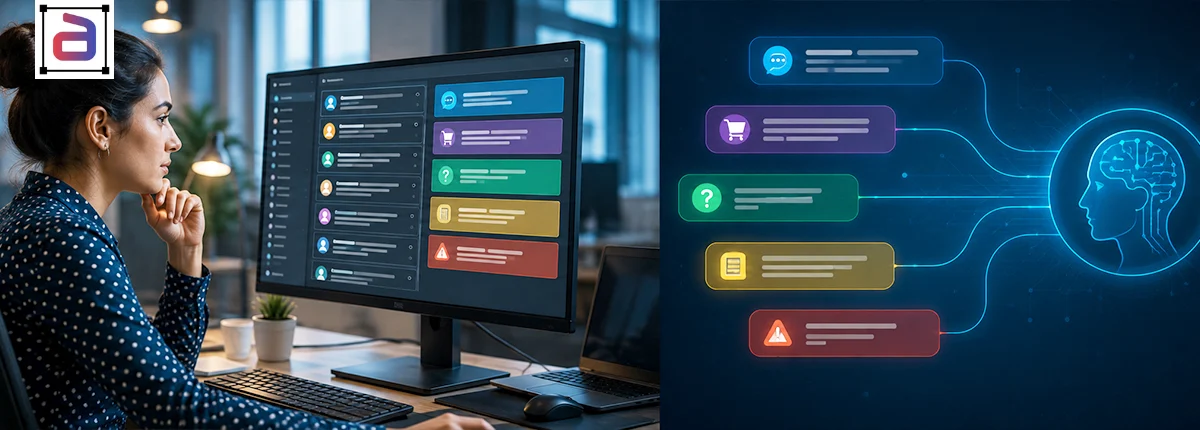
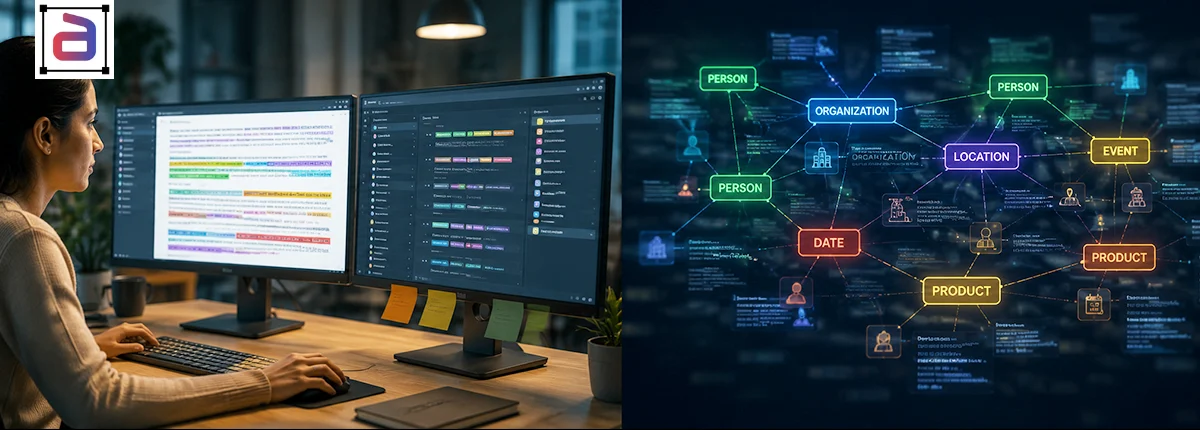
Modern AI systems process enormous volumes of unstructured text—from medical records and financial reports to customer conversations, legal documents, product catalogs, and enterprise knowledge bases. But before AI can understand this information, it must identify the important entities hidden within it. This is where Named Entity Recognition (NER) becomes essential. NER enables NLP systems to locate and classify entities such as people, organizations, locations, products, dates, and other meaningful concepts. However, generic NER models are rarely sufficient for highly specialized applications.
Businesses often need models that understand the terminology, entities, abbreviations, and contextual nuances unique to their industry. Building these models starts with one critical resource: high-quality annotated training data. As the Stanford NLP Group explains, NER “labels sequences of words in a text” that represent entities such as people, companies, genes, and proteins. For organizations developing specialized NLP solutions, data annotation outsourcing can provide the expertise and scalability required to create domain-specific NER datasets.
Key Points
- Domain-specific NER improves NLP accuracy by teaching AI models to recognize industry-specific entities, terminology, abbreviations, and contextual nuances.
- High-quality text annotation is the foundation of NER—clear taxonomies, detailed annotation guidelines, and representative datasets are essential for reliable model training.
- Data annotation outsourcing enables scalable NER development by providing trained annotators, specialized workflows, and rigorous quality-control processes.
- Annotera delivers customized NER annotation solutions that help businesses transform complex unstructured text into accurate, AI-ready training data for specialized NLP applications.
What Is Named Entity Recognition?
Named Entity Recognition is an NLP technique used to identify entity mentions in text and assign them predefined categories. For example: “Microsoft opened a new research facility in Seattle.” A general-purpose NER system might identify:
- Microsoft → Organization
- Seattle → Location
Tools such as spaCy provide trained NER pipelines that can identify entities including companies, locations, organizations, and products, while also allowing developers to add custom entity classes and update models with new examples. This ability to customize entity categories is particularly important for enterprise AI. A healthcare NER model, for example, might need to recognize:
- Diseases
- Medications
- Symptoms
- Medical procedures
- Anatomical structures
- Dosages
A financial model could instead identify:
- Financial instruments
- Regulatory requirements
- Account types
- Transaction references
- Companies
- Currency values
The model is only as useful as its ability to recognize the entities that matter to the specific application.
Why Generic NER Models Fall Short
Pre-trained NER models are excellent starting points, but their predefined categories may not match specialized business requirements. Stanford CoreNLP, for example, provides standard entity categories such as PERSON, LOCATION, ORGANIZATION, MONEY, PERCENT, DATE, and TIME. It also supports more fine-grained entity recognition through additional rules. But imagine a pharmaceutical company analyzing clinical research documents. Recognizing “Pfizer” as an organization is useful, but the business may also need to identify drug compounds, clinical trial identifiers, treatment types, biomarkers, and adverse events. That is the difference between general-purpose NER and domain-specific NER. A specialized model learns from examples that reflect the vocabulary and context of the environment where it will eventually operate.
Domain-Specific NER Starts With a Strong Entity Taxonomy
Before annotation begins, organizations need to determine exactly what the model should recognize. This requires developing an entity taxonomy that defines:
- Entity categories
- Entity descriptions
- Annotation boundaries
- Inclusion and exclusion rules
- Abbreviations and aliases
- Ambiguous terms
- Examples and edge cases
For instance, an e-commerce NER project might classify: “Nike Air Max 270 running shoes” as:
- Nike → BRAND
- Air Max 270 → PRODUCT
- running shoes → PRODUCT_CATEGORY
Without clear rules, different annotators may make different decisions about where an entity begins and ends. A strong taxonomy creates consistency and gives annotators a reliable framework for labeling complex text.
The Critical Role of Text Annotation
Once the taxonomy is established, the next step is creating labeled training data. Annotators identify entity spans and assign the appropriate labels to each mention. Consider: “The patient was prescribed Metformin 500 mg for Type 2 diabetes.” A healthcare-specific taxonomy might identify:
- Metformin → MEDICATION
- 500 mg → DOSAGE
- Type 2 diabetes → CONDITION
The objective is not simply to highlight words. Annotators must understand context and apply consistent entity boundaries. This is why working with an experienced text annotation company can be valuable for organizations developing sophisticated NLP systems.
A Practical Workflow for Building Domain-Specific NER Models
1. Define the Use Case
Start by determining what information the NER system needs to extract and how those entities will be used. A customer-support system may need customer names, product names, order numbers, and complaint categories, while a legal AI platform may require case names, statutes, courts, and legal provisions.
2. Build the Annotation Guidelines
Detailed guidelines should explain exactly how every entity category should be labeled. Include examples of straightforward cases as well as difficult scenarios. This reduces ambiguity and improves inter-annotator consistency.
3. Collect Representative Data
The dataset should reflect the language the model will encounter in production. Include variations such as:
- Formal and informal writing
- Industry terminology
- Abbreviations
- Misspellings
- Different document formats
- Regional language variations
- Rare or difficult entities
A model trained exclusively on clean, standardized text may struggle with real-world inputs.
4. Annotate at Scale
Human annotators label the selected text according to the taxonomy. For large projects, data annotation outsourcing enables organizations to scale annotation without maintaining a large permanent internal labeling team. A professional annotation partner can also support multiple languages, specialized taxonomies, and evolving project requirements.
5. Apply Quality Assurance
Quality control is fundamental to NER dataset development. Reviewers should identify:
- Missing entities
- Incorrect labels
- Incorrect entity boundaries
- Inconsistent annotations
- Duplicate or overlapping labels
- Ambiguous cases
Quality checks can combine automated validation, secondary review, consensus workflows, and expert audits.
Handling Ambiguity and Context
One of the biggest challenges in NER is that the same term can have different meanings depending on context. Consider the word “Apple.”
- “Apple released a new device.” → ORGANIZATION
- “She ate an apple.” → potentially no named entity
Likewise, technical abbreviations may represent different concepts across industries. Domain-specific annotation guidelines should therefore emphasize contextual interpretation rather than simple keyword matching. This is one reason high-quality human annotation remains important even as automated labeling tools become more capable.
Scaling NER With Data Annotation Outsourcing
Creating a specialized NER dataset internally can become expensive and time-consuming when projects involve millions of sentences or multiple domains. Data annotation outsourcing provides an alternative approach. By partnering with an experienced data annotation company, organizations can access trained annotation teams, project managers, quality-control specialists, and scalable workflows. For organizations developing NLP applications, text annotation outsourcing can accelerate dataset creation while allowing internal AI teams to concentrate on model development, evaluation, and deployment. However, outsourcing should not mean sacrificing control. A capable partner should be able to follow customized taxonomies, maintain annotation consistency, protect sensitive data, and provide transparent quality metrics.
Measuring the Quality of an NER Dataset
Before training a model, teams should evaluate the quality and coverage of their annotations. Important considerations include:
- Annotation accuracy
- Inter-annotator agreement
- Entity coverage
- Label consistency
- Boundary accuracy
- Representation of rare entities
- Performance across different text types
The objective should be a dataset that represents production reality—not simply one with a high annotation volume. As spaCy notes, statistical NER systems depend strongly on the examples used during training, and additional tuning may be required for specific use cases. That principle reinforces a fundamental lesson: better examples create better opportunities for reliable entity recognition.
Why Annotera for Domain-Specific NER Annotation?
Building a domain-specific NER model requires more than marking names in documents. It requires thoughtful taxonomy design, contextual understanding, consistent annotation, rigorous quality assurance, and scalable execution. Annotera helps businesses transform unstructured text into high-quality training datasets tailored to their AI objectives. From entity-level labeling and taxonomy-driven annotation to large-scale text annotation outsourcing, our approach is designed to support demanding NLP and AI applications. Whether you are developing conversational AI, intelligent document processing, enterprise search, recommendation systems, compliance solutions, or domain-specific language models, the quality of your training data can directly influence the reliability of your final system.
Build Smarter NER Models With Better Training Data
Generic NER can identify common entities. Domain-specific NER goes further by teaching AI what matters within a particular business context. The foundation is high-quality annotation. With the right taxonomy, representative datasets, expert annotators, and rigorous quality control, organizations can build NER training datasets capable of supporting more precise and useful NLP applications. Ready to build a domain-specific NER dataset? Partner with Annotera for scalable, accurate, and expertly managed text annotation solutions. Contact Annotera today and turn complex unstructured text into AI-ready training data.
A closely related read: Named Entity Recognition (NER) Annotation for Enterprise Knowledge Graphs.