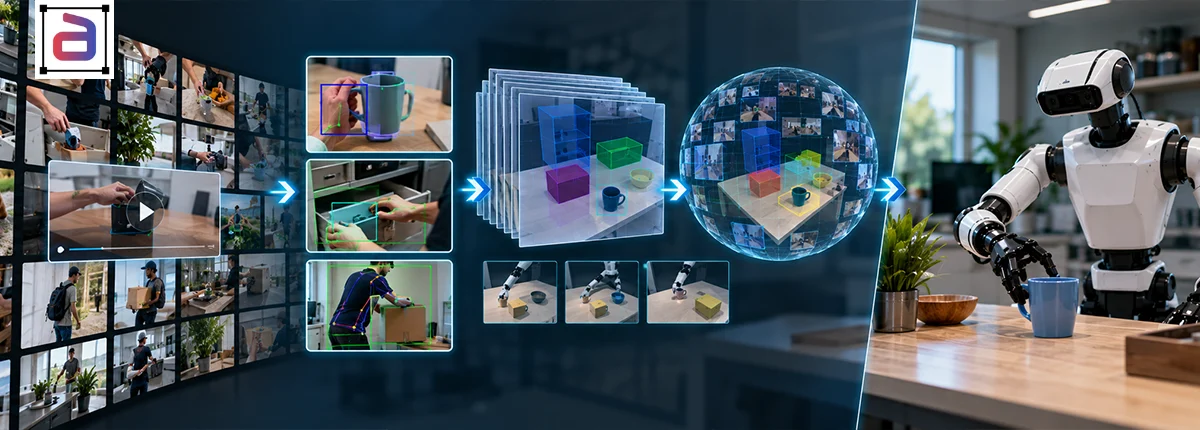
Computer vision is one of AI’s most impactful frontiers. From autonomous vehicles and cashier-less checkout to medical imaging and smart surveillance, it is changing how machines interact with the physical world. But none of these applications work without one often-overlooked step: video annotation. Learn more about egocentric video annotation for wearable AI devices. For robotics programs specifically, egocentric video annotation from Annotera covers POV labeling. For programs that fuse camera, LiDAR, and force/torque data, multi-sensor fusion annotation for robotics handles synchronized labeling across all sensor streams. Learn more about outsourcing best practices for video annotation projects. Learn more about temporal video annotation for action recognition AI.
Raw video is hours of pixels, motion, and noise. For robotics programs that capture human demonstrations via remote teleoperation, teleoperation data annotation handles the labeling of trajectory and interaction data. Without structure, it is meaningless to a model. Video annotation transforms that chaos into labeled ground truth—marking every object, movement, and event so the model can learn, predict, and act. When done well, it is the difference between a system that saves lives and one that causes accidents.
Table of Contents
Key Points
- Video annotation quality for computer vision requires temporal consistency standards that image annotation does not: an object that is correctly detected in isolation but loses its tracking ID across frames produces video training data with broken temporal signal.
- The gap between raw footage and actionable computer vision training data is bridged by annotation that captures not just what is present in each frame but how objects move, relate, and behave across the temporal sequence.
- Video annotation programs must define key-framing strategies that balance annotation precision and throughput: per-frame annotation at full precision is rarely economically viable, and interpolation strategies must be designed to maintain quality across interpolated frames.
- Computer vision model performance on video tasks is determined by the temporal quality of its training data: a model trained on temporally inconsistent video annotation will fail precisely when temporal continuity matters most — in continuous real-world operation.
Why Video Annotation Powers Computer Vision
A single minute of HD footage can contain thousands of frames, each with multiple moving elements: people, vehicles, products, or microscopic cells. Without annotation, the model sees shapes and colors. With it, the model sees context and meaning. A self-driving car can distinguish a pedestrian from a traffic sign. A doctor can rely on AI to flag a tumor in an MRI. A retailer can understand how shoppers navigate a store. Annotation gives machines the context they need to make better decisions.
Core Techniques in Video Annotation
Different tasks demand different labeling approaches. Six techniques cover the range most computer vision projects need.
- Bounding boxes are the simplest and most common form—rectangles around objects like vehicles on a highway or products on a conveyor belt.
- Polygons and polylines add precision by tracing irregular shapes such as road edges or surgical instruments. Semantic segmentation assigns a label to every pixel, making it essential for separating tissues in medical imaging or identifying lane markings in driving footage.
- Keypoint and pose annotation tracks joints and body movements, used in sports analytics, rehabilitation, and ergonomics.
- Temporal annotation labels sequences of actions over time—when a patient lifts their arm during physiotherapy, or a player takes a shot.
- 3D and point-cloud annotation adds depth using LiDAR or multi-camera setups, which is critical for autonomous vehicles and drone navigation.
Each technique adds a layer of intelligence. Together, they move a model from identifying isolated objects to understanding how those objects interact with their environment over time.
Applications Across Industries
- Autonomous vehicles. Self-driving systems depend on annotated video to recognize road signs, pedestrians, cyclists, and vehicles in real time. LiDAR annotation provides spatial awareness to avoid collisions. Temporal annotation helps the model predict what surrounding objects will do next. Safety depends directly on the quality of annotations across millions of frames.
- Healthcare. Annotated MRI and CT scans train models to detect abnormalities such as tumors, clots, and lesions. Hospitals also use annotated surgical footage to train AI tools that assist doctors in the operating room, helping reduce complications and improve patient outcomes.
- Retail. From monitoring store traffic to powering cashier-less checkout, annotation helps retailers understand customer behavior, optimize product placement, and streamline operations. A precisely annotated video lets the model track shoppers and their purchases without human intervention.
- Sports. Teams use annotated footage to analyze player movement, strategy, and biomechanics. Raw game video becomes coaching insight: shot selection, defensive positioning, fatigue patterns, and injury risk.
- Security and surveillance. An annotated video enables systems to detect suspicious activity, track loitering, or flag abandoned objects in real time. Smart-city deployments use it to improve traffic flow and strengthen public safety. For the audio dimension, see our post on high-fidelity audio annotation for security.
The Challenges of Video Annotation at Scale
- Volume. One hour of HD video can contain over 200,000 frames, each of which requires review. Multiply that across weeks of surveillance or seasons of sports footage, and the scope overwhelms any team without structured workflows and automation support.
- Fast-moving and overlapping objects. Traffic footage and sports video include rapid, tangled motion. Two players jostling for the ball or cars changing lanes simultaneously can confuse automated tools and human annotators alike unless clear guidelines are in place.
- Consistency. When multiple annotators work on the same project, interpretations diverge. Was that a hand wave or an attempt to hail a cab? Was the contact a foul or incidental? Inconsistency in labeling degrades model reliability. Gold-standard datasets, peer review, and inter-annotator agreement checks are what keep quality stable.
- Privacy. Annotating medical footage, shopper behavior, or surveillance video demands strict compliance with HIPAA, GDPR, and CCPA. Beyond regulation, organizations must consider the ethical implications and protect public trust.
- Automation vs oversight. AI-assisted tools substantially speed up annotation, but they struggle with occlusion, unusual angles, and rare events. Human expertise validates and corrects those outputs. A human-in-the-loop approach remains the standard for combining speed with accuracy.
From Raw Footage to Trained Model
The journey follows five disciplined stages.
- Collect. Gather raw video relevant to the task—traffic feeds, MRI sequences, game footage, or store cameras.
- Annotate. Apply the right technique per frame: bounding boxes, segmentation, keypoints, or temporal labels. Guidelines, expert oversight, and HITL review prevent errors from reaching the model.
- Train. Feed annotated datasets into the learning algorithm. Annotation richness directly shapes how well the model generalizes.
- Validate. Test outputs against gold-standard sets, including edge-case stress tests (low light, rare events, occlusion).
- Deploy and iterate. Put the model into production and loop real-world corrections back into the annotation pipeline.
Each step depends on the one before it. Skipping or rushing any stage risks undermining the final system.
How Annotera Delivers Video Annotation
Annotera provides end-to-end video annotation for computer vision across industries, from bounding boxes to 3D point-cloud labeling. Our workflows pair domain-trained annotators with multi-layered QA, bias-aware practices, and secure data handling. Whether the project involves surgical footage, driving data, or retail analytics, Annotera scales to meet the complexity and compliance requirements of each domain.
Conclusion
Video annotation is the hidden backbone of computer vision. It turns raw footage into the structured intelligence that models learn from. Without it, AI systems stumble; with it, they see, understand, and act — including in interactive applications like keypoint video annotation for gaming and gesture recognition. and act. The organizations that invest in high-quality annotation today are the ones building the autonomous, diagnostic, and analytic systems that define what comes next.
Ready to power your computer vision project with expert video annotation? Partner with Annotera to turn raw footage into reliable, production-grade training data.
A closely related read: Egocentric Video Annotation