
Achieving Accuracy in High-Density Landmark Sets

As biometric and advanced perception systems evolve, models increasingly rely on dense configurations of reference points to capture subtle structural detail. In these scenarios, accuracy is not driven solely by the model architecture. Instead, it depends heavily on how consistently and precisely landmark annotation techniques are applied across large and complex datasets. For biometric labs […]
Training AI for Factory Automation with Image Boxes
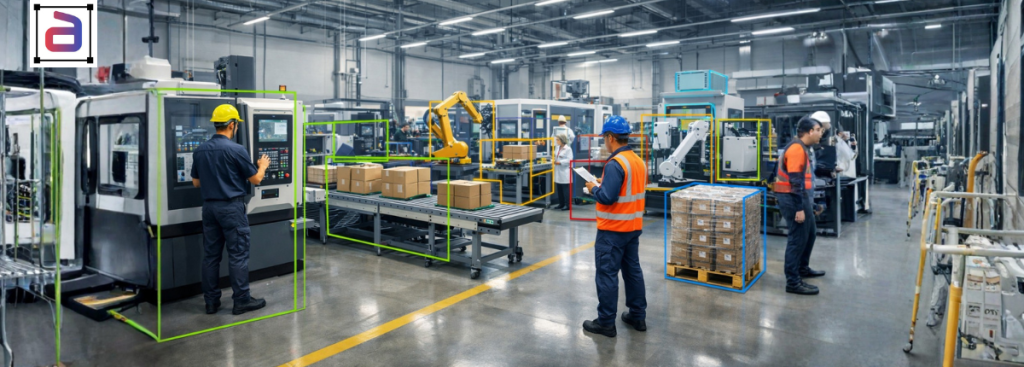
Bounding boxes for manufacturing are critical for enabling computer vision systems on modern factory floors. As manufacturers adopt automation to improve efficiency, safety, and quality, AI models must reliably detect parts, tools, defects, and human presence in complex industrial environments. Image boxes provide the structured visual data needed to train these systems consistently and precisely. […]
3D Cuboid Annotation for LiDAR and Sensor Fusion (Video)
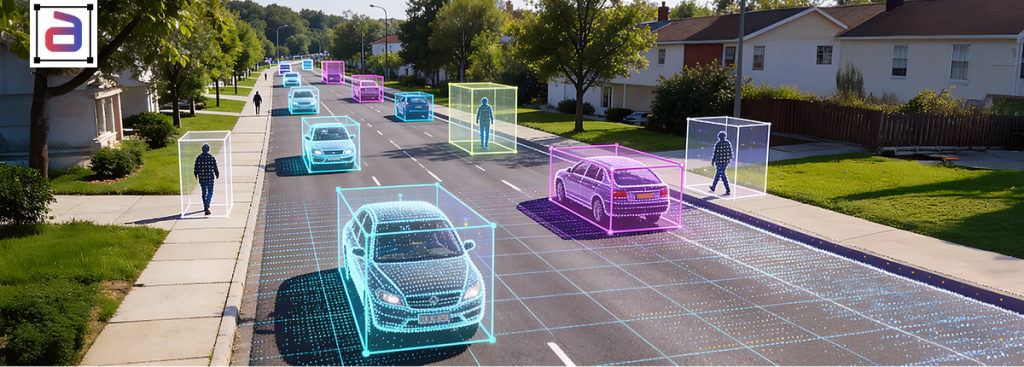
Autonomous vehicles operate through sensor fusion: combining LiDAR point clouds, camera images, radar returns, and depth sensor data into a single world model. The technical challenge is acute. Each sensor modality represents the same physical object in incompatible formats. LiDAR produces sparse 3D coordinates Yaw and heading orientation within 3D cuboid annotation is covered in […]
The Role of Polylines in Linear Feature Extraction

In geospatial and computer vision workflows, extracting linear features accurately is essential for mapping, analysis, and decision-making. Roads, rivers, boundaries, and utility corridors rarely conf Lane annotation for ADAS is a key application. See polyline annotation services for lane detection. Roads, rivers, boundaries, and utility corridors rarely conform to simple geometric shapes. Instead, they extend […]
Training AI for Smart City Path Planning

As cities become increasingly connected, urban mobility systems must balance efficiency, safety, and sustainability. From adaptive traffic signals to autonomous public transport, smart city platforms depend on AI-driven path planning including lane annotation. See polyline annotation services for lane detection. Smart city platforms rely heavily on AI-driven path The static image line detection layer is […]
Polyline Annotation for Static Images: How to Define Line Ground Truth

A straight line in an image may look simple to a human. For a computer vision dataset, however, deciding where that line begins, where it ends For the video and lane detection version of polyline annotation, see polyline annotation services for lane detection. Where that line begins, where it ends, whether a gap breaks continuity, […]
Skeletal vs. Keypoint: Choosing for Pose Estimation
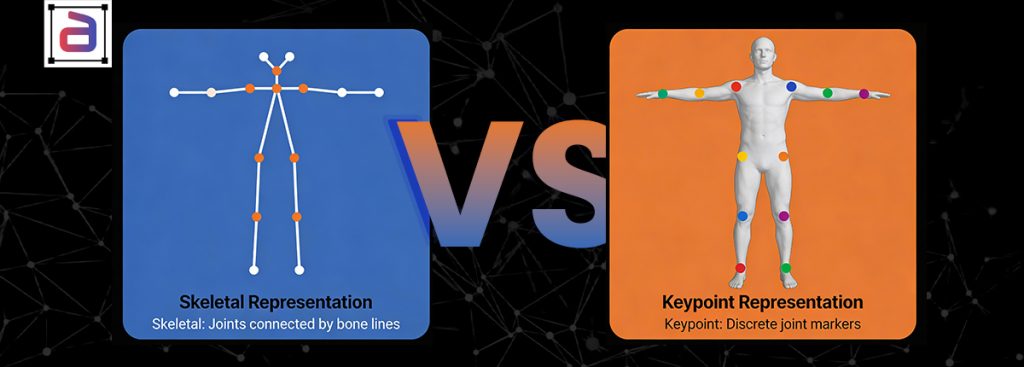
Pose estimation is central to many computer vision applications, from human–computer interaction to motion analytics. However, selecting the right annotation approach often determines whether a model scales successfully or struggles with inconsistency. In this decision-making process, a clear skeletal annotation guide helps teams understand when skeletal representations outperform simple keypoints and when lighter approaches are […]
Training Humanoid Robots with Image Skeletal Data

Humanoid robots must perceive, interpret, and replicate human motion with high fidelity to operate safely and effectively in real-world environments. While sensors and control algorithms enable mechanical capabilities, learning human-like movement requires a structured understanding of visual data. In this context, skeletal labeling for robotics enables AI systems to learn joint relationships, limb coordination, and […]
Human Movement Analysis with Skeletal Annotation
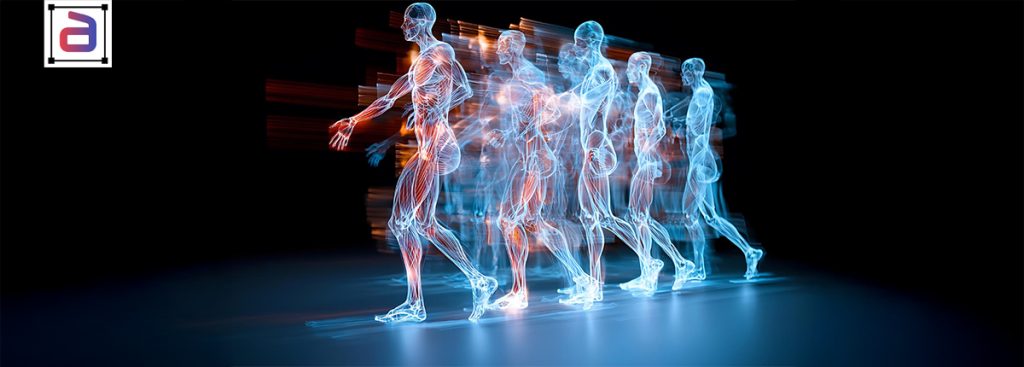
Understanding how the human body moves is fundamental to rehabilitation, performance improvement, and injury prevention. While video capture and sensor data provide raw signals, structured movement modeling turns them into actionable insight. In this context, human skeletal annotation services enable computer vision systems to represent joints, limbs, and motion patterns with clarity and consistency. For […]
Skeletal Annotation for Fitness Apps and AI Trainers

Digital fitness platforms increasingly rely on computer vision to analyze movement, provide real-time feedback, and personalize training experiences. While sensors and wearables add value, accurate visual understanding of the human body remains central to effective coaching. In this context, health skeletal labeling enables AI systems to interpret posture, joint alignment, and exercise form with precision. […]