
Sports Analytics AI: The Importance of Precision Video Annotation for Performance Tracking

The world of sports is no longer driven by instinct alone. Today, elite teams, broadcasters, and sports technology companies are increasingly relying on artificial intelligence to decode player performance, optimize strategies, and gain a competitive edge. Behind this AI revolution lies one foundational element that often goes unnoticed: precision video annotation. From tracking an athlete’s […]
Video Annotation for Retail Analytics: Transforming Customer Behavior Insights

The modern retail landscape is no longer driven by intuition alone. Today, retailers rely on AI-powered analytics to understand how customers move, interact, browse, and buy inside physical stores. Behind these intelligent systems lies one crucial foundation: high-quality video annotation. Learn more about how retailers use video annotation for behavior analytics. From tracking customer journeys […]
The Growing Role of Human-in-the-Loop Video Annotation in AI Surveillance Systems

Artificial intelligence is redefining modern surveillance. Today’s AI-powered surveillance systems can monitor crowded public spaces, detect suspicious activities, analyze behavioral patterns, and respond to potential security threats in real time. From smart cities and transportation networks to retail stores and industrial facilities, intelligent surveillance has become a critical component of modern security infrastructure. Learn more […]
How Video Annotation Powers Next-Generation Autonomous Vehicle AI
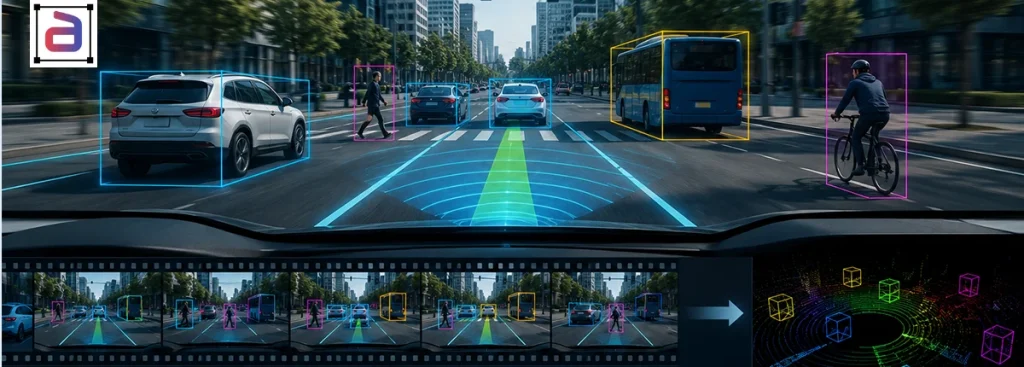
Autonomous vehicles are no longer futuristic prototypes confined to research labs. Today, they are rapidly becoming a defining force in global transportation innovation. Video annotation for computer vision covers the foundational concepts before domain-specific AV programs. Building the annotation programs that train these systems requires mastering the specific challenges — see the guide to mastering […]
Training AI to Categorize Moving Objects in Motion

Key Points Moving object classification requires models to maintain object identity across frames even as appearance changes with motion, rotation, and partial occlusion. Static image classifiers fail on video because they evaluate each frame independently without learning how object appearance evolves across motion sequences. Training data for motion classification must include varied speeds, trajectories, and […]
Video Object Classification Services for Media Teams

Media teams now manage more video than ever. News footage, brand content, documentaries, live broadcasts, and deep archives continue to grow. However, volume alone creates no value. Instead, value appears only when teams can reliably find, organize, and reuse what they already own. Traditionally, teams leaned on frame-by-frame tagging or thin metadata. Yet those methods […]
Video Categorization for Smart City Traffic Management
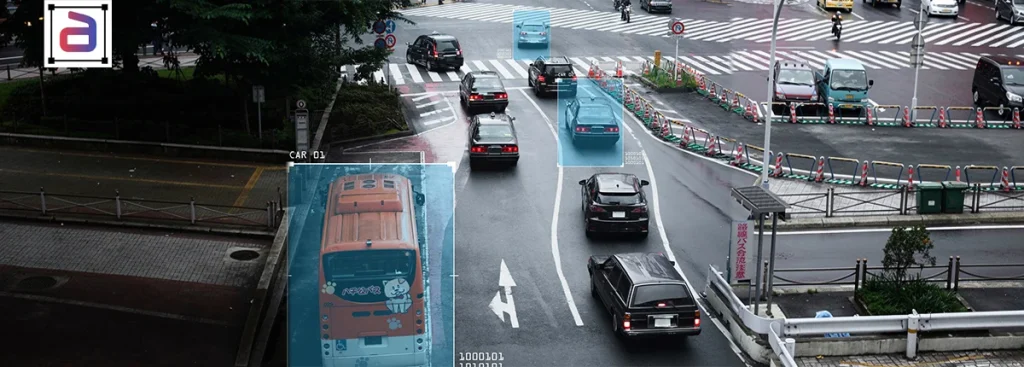
Key Points Smart city traffic management AI requires video annotation that classifies vehicle types, lane positions, speeds, and behaviours simultaneously across multi-intersection camera networks. Traffic annotation at city scale must cover rush hour density, weather-impaired visibility, unusual vehicle types, and intersection-specific signage simultaneously. Real-time traffic AI systems are only as responsive as the annotation latency […]
Scaling Video Tagging for Content Libraries

Key Points Video tagging at content library scale requires annotation infrastructure that handles thousands of hours of footage without the consistency degradation that manual tagging introduces. Tag taxonomy design is the highest-leverage decision in content library annotation: tags that are too granular increase annotation cost; tags too broad reduce search utility. Automated pre-tagging followed by […]
Accuracy vs. Inference: The Trade-offs in Video Sorting

Key Points Optimising video sorting for accuracy requires more annotation effort per frame; optimising for inference speed requires accepting higher per-frame error rates — the trade-off must be explicit. The right balance between accuracy and inference speed depends on application stakes: a real-time security system and a media archive search tool have fundamentally different tolerance […]
Efficient Video Bounding Box Labeling for Large-Scale Surveillance

Key Points Large-scale surveillance annotation requires consistent object classification across thousands of simultaneous camera feeds operating in varied lighting and environmental conditions. Video bounding box quality for surveillance AI determines false alarm rates: loose boxes around pedestrians cause models to trigger on background movement. For the full picture of how annotation powers security AI, see […]