Large language models are rapidly changing how software is written. From generating functions and debugging errors to creating test cases and translating code between programming languages, LLM-powered coding assistants are becoming part of everyday software engineering workflows. But there is a fundamental distinction between generating code and generating reliable software. An LLM can produce code that looks convincing, follows familiar programming patterns, and even passes selected tests while still being inefficient, difficult to maintain, vulnerable to security issues, or misaligned with the original requirement.
Recent research emphasizes that evaluating generated code requires more than functional correctness alone; code quality, maintainability, security, performance, and adherence to requirements also matter. This is where code generation annotation becomes strategically important. By putting AI-generated code through structured human review, organizations can transform expert software-engineering judgment into high-quality training signals. These signals can subsequently support fine-tuning, preference optimization, evaluation, and alignment of coding-focused LLMs.
Key Points
- Human Review Improves Code Reliability — Expert reviewers evaluate AI-generated code for correctness, security, efficiency, maintainability, and adherence to requirements.
- Code Annotation Creates Valuable Training Data — Structured reviews, corrections, and preference rankings generate high-quality RLHF & fine-tuning data for coding-focused LLMs.
- Human Feedback Goes Beyond Automated Testing — Automated tests measure whether code works, while human reviewers can assess readability, complexity, maintainability, and real-world engineering quality.
- Annotera Enables Scalable LLM Code Annotation — Annotera’s LLM & GenAI annotation services help organizations build code evaluation, preference-ranking, and human-feedback datasets for more reliable AI systems.
What Is Code Generation Annotation?
Code generation annotation is the systematic process of reviewing, evaluating, correcting, ranking, and labeling code produced by an AI model. A typical annotation task may contain:
- A natural-language programming instruction
- One or more AI-generated code responses
- Functional requirements
- Dependencies or technical specifications
- Testing information
- Annotation guidelines
Human reviewers evaluate the generated output against predefined criteria and record structured judgments. For example, a reviewer may determine whether the code is:
- Functionally correct
- Relevant to the user’s request
- Efficient
- Readable
- Maintainable
- Secure
- Consistent with coding standards
- Complete in handling edge cases
In preference-ranking workflows, reviewers may compare multiple responses and identify which implementation better satisfies the requirements. This information can become valuable RLHF & fine-tuning data, allowing developers to train models around not only what code should look like, but also what high-quality software engineering behavior looks like.
Why Human Reviewers Still Matter
LLMs are remarkably capable pattern generators, but software engineering involves contextual decisions that cannot always be reduced to surface-level code similarity. Consider two implementations that both produce the expected output. One may use unnecessarily complex logic, while the other may be simpler, more readable, and easier to maintain. Both could technically work. They are not necessarily equally valuable. Human reviewers can recognize these distinctions. A recent study of LLM-based evaluation in software engineering notes that conventional metrics can struggle to capture the quality of generated code and that alignment with human judgments remains an important consideration. Similarly, research published in 2026 identified maintainability, security, and performance efficiency as important dimensions of quality beyond functional correctness.
“The goal is not simply to teach an AI model to write code that works. It is to teach the model to write code that developers can trust, understand, maintain, and use.”
That distinction makes human feedback especially valuable.
How Human Reviewers Annotate AI-Generated Code
An effective code annotation pipeline typically combines technical evaluation with structured human judgment.
1. Create Representative Coding Prompts
The process begins with realistic programming tasks. Depending on the model’s intended application, datasets may include:
- Code completion
- Function generation
- Debugging
- Refactoring
- API integration
- Database queries
- Unit-test generation
- Code translation
- Documentation generation
- Security remediation
Prompts should represent the types of software-development scenarios the model is expected to handle after deployment.
2. Generate Multiple Responses
The same prompt can be submitted to one or more LLMs to generate alternative solutions. Multiple responses are particularly valuable for preference annotation because they allow reviewers to compare different approaches to the same programming problem. One response might be shorter. Another might be more robust. A third might handle edge cases more effectively. The reviewer determines which solution better satisfies the defined criteria.
3. Evaluate Functional Correctness
The first question is straightforward: Does the code actually perform the requested task? Reviewers can examine execution results, test cases, expected outputs, and implementation logic. However, functional correctness should not be treated as the only criterion. A 2026 benchmarking study of code-generation models evaluated outputs across multiple dimensions, including functional correctness, proximity to valid solutions, and overall code quality.
4. Assess Code Quality
Reviewers can evaluate characteristics that automated tests may overlook. These can include:
- Readability
- Simplicity
- Modularity
- Maintainability
- Computational efficiency
- Error handling
- Security
- Coding style
- Dependency management
This produces richer training data than a binary “correct/incorrect” label.
5. Provide Preference Rankings and Rationales
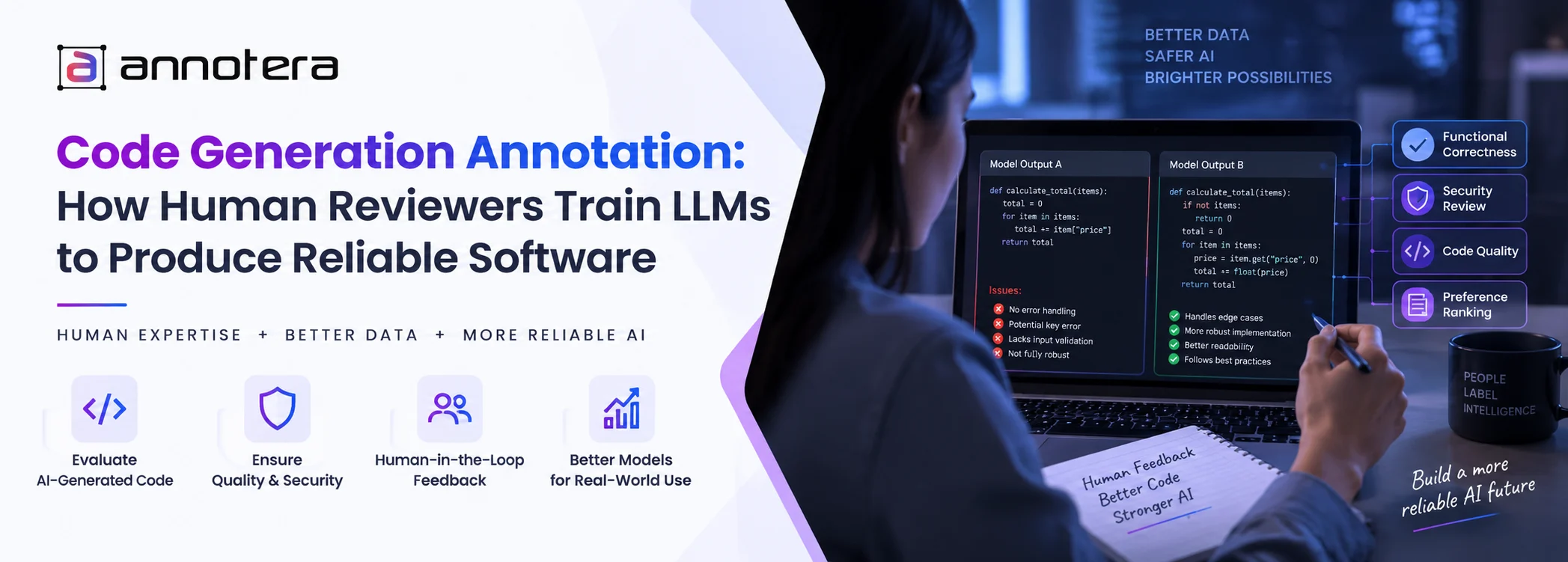
Preference annotation is particularly useful for alignment. Suppose an LLM generates two solutions:
- Response A: Works correctly but contains unnecessary complexity.
- Response B: Produces the same result with cleaner logic, better error handling, and easier maintainability.
A reviewer can rank Response B higher and explain why. These preference signals can help an LLM learn the difference between merely acceptable code and code that better reflects professional engineering expectations. Research on CodeUltraFeedback demonstrates how coding preferences—including instruction following, readability, efficiency, complexity, and coding style—can be captured as structured feedback for model alignment.
From Human Feedback to Better Coding Models
The annotation process creates a feedback loop: Prompt → AI-Generated Code → Human Evaluation → Annotation → Training → Improved Model → Better Code This loop can support supervised fine-tuning, preference optimization, and reinforcement-learning-based approaches. High-quality RLHF & fine-tuning data can teach models which coding behaviors should be reinforced and which should be discouraged. For example, a dataset can teach a model to:
- Follow requirements more precisely
- Avoid unnecessary complexity
- Generate clearer explanations
- Handle edge cases
- Improve error handling
- Produce more maintainable implementations
- Follow specified coding conventions
The objective is not simply to increase the quantity of training data. It is to increase the signal quality of that data.
Why Automated Testing Alone Isn’t Enough
Automated tests are indispensable for evaluating generated software, but they cannot capture every dimension of code quality. A solution may pass its available tests while remaining difficult to maintain or inefficient under different workloads. Research on LLM-generated code quality has specifically highlighted the importance of evaluating non-functional characteristics such as security, maintainability, and performance alongside functional correctness. This is why human annotation and automated validation work best together. Automated systems can test whether code behaves as expected. Human reviewers can help evaluate whether the implementation is appropriate, understandable, and aligned with engineering requirements.
Scaling Code Annotation With Annotera
Creating this type of high-quality dataset at scale requires more than simply assigning labels to code. It requires qualified reviewers, detailed annotation guidelines, calibration procedures, quality assurance, and consistent evaluation frameworks. This is where Annotera can support organizations developing coding-focused AI systems. Our LLM & GenAI annotation services can support workflows involving:
- Code generation evaluation
- Code correction and debugging
- Code preference ranking
- Requirement compliance
- Code quality assessment
- Human feedback collection
- RLHF dataset creation
- Fine-tuning dataset preparation
- AI-generated test evaluation
- Programming-language-specific annotation
Annotera’s human-in-the-loop approach helps convert software-engineering expertise into structured datasets that can be used throughout the AI development lifecycle.
The Future of AI Coding Is Human-Guided
The next generation of coding models will not be defined solely by how much code they can generate. Reliability will increasingly depend on how effectively those models understand requirements, handle edge cases, produce maintainable implementations, and reflect real developer preferences. Code generation annotation provides the human feedback layer necessary to move toward that objective.
Better code generation starts with better evaluation. Better evaluation starts with better human feedback.
For AI companies, enterprise software providers, developer-tool platforms, and organizations building coding-focused LLMs, investing in high-quality annotation can turn human expertise into a scalable training advantage.
Build Better Coding AI With Annotera
At Annotera, we help AI teams transform expert human judgment into structured, high-quality training data. Whether you are developing an AI coding assistant, software-engineering agent, developer copilot, or specialized code LLM, our LLM & GenAI annotation services can help you build the evaluation and training datasets needed to improve model reliability. Ready to build more reliable AI-generated software? Partner with Annotera to develop high-quality code annotation, preference-ranking, and RLHF & fine-tuning data tailored to your AI development goals.
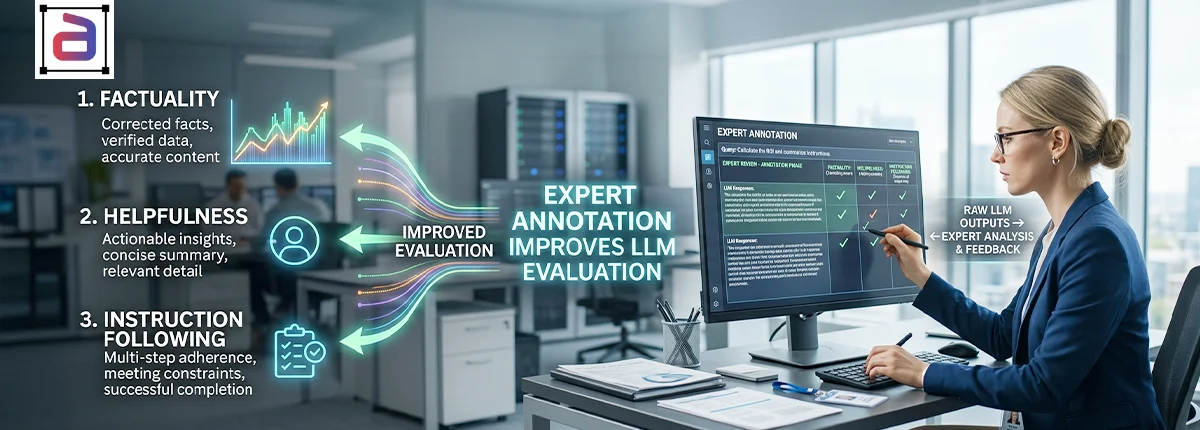
A closely related read: How Expert Annotation Improves LLM Evaluation for Factuality, Helpfulness, and Instruction Following.