As artificial intelligence continues to transform industries, high-quality visual data has become essential for building accurate computer vision models. From autonomous vehicles identifying pedestrians to retail systems recognizing products and manufacturing solutions detecting defects, AI applications depend on accurately labeled images to interpret the world around them.However, developing reliable image datasets involves more than simply collecting pictures.
Every image must be labeled, categorized, and validated according to specific project requirements. This makes image annotation pricing an important consideration for businesses investing in AI and machine learning development. Understanding how annotation costs are calculated helps organizations allocate budgets effectively while maintaining dataset quality. Whether you are developing an object detection model or building a sophisticated visual recognition system, choosing the right annotation approach can significantly influence project efficiency.
Key Points
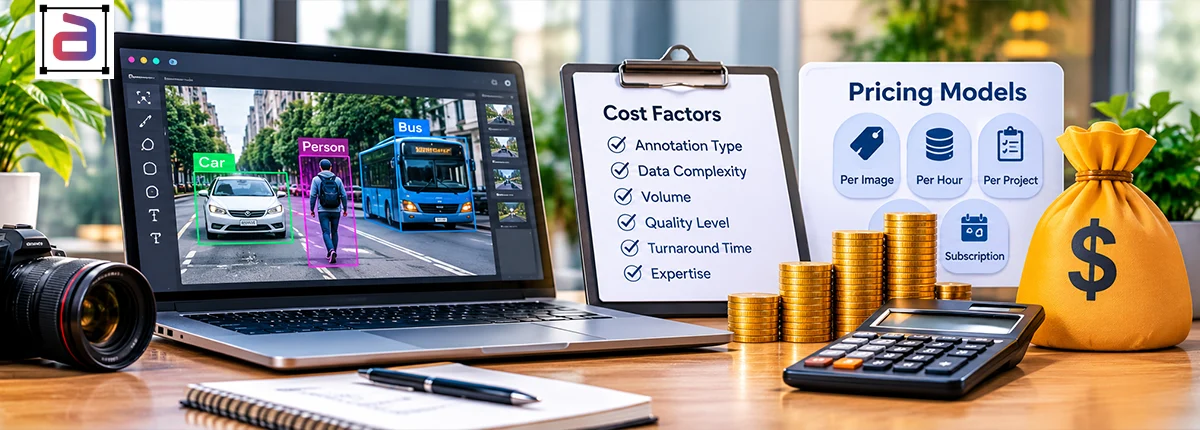
- Image Annotation Pricing Models: Understand different pricing structures, including per-image, per-object, hourly, project-based, and dedicated team pricing.
- Major Cost Factors: Annotation complexity, dataset volume, object density, image quality, quality assurance, delivery timelines, and data security influence overall costs.
- Outsourcing for Cost Efficiency: Image annotation outsourcing services provide access to trained professionals, scalable resources, and structured workflows while reducing internal operational overhead.
- Quality Over Lowest Cost: Choosing the right image annotation company, implementing quality checks, and combining AI-assisted labeling with human expertise help optimize budgets and improve AI model performance.
1. What Determines Image Annotation Pricing?
Image annotation pricing refers to the cost of labeling visual datasets for training, validating, and testing computer vision models. The pricing structure depends on several variables, including annotation complexity, image volume, object density, quality requirements, and delivery timelines. For example, assigning a single category to an image requires considerably less effort than creating detailed polygon boundaries around multiple overlapping objects. Similarly, annotating thousands of straightforward product images differs significantly from labeling complex traffic scenes containing vehicles, pedestrians, road signs, and partially visible objects. An experienced image annotation company evaluates these requirements before recommending a suitable pricing model. The objective should be to achieve an appropriate balance between annotation accuracy, operational efficiency, and overall project expenditure.2. Common Image Annotation Pricing Models
Different annotation projects require different commercial arrangements. Understanding the available pricing models helps businesses select an approach that aligns with their operational and financial requirements.A. Per-Image Pricing
Under this model, businesses pay a predetermined amount for every image annotated. It is particularly suitable for standardized tasks such as image classification, basic object detection, and product categorization.B. Per-Object Pricing
Per-object pricing calculates costs according to the number of individual objects labeled within an image. For example, annotating a photograph containing 15 products may require more effort than labeling an image containing only two products.C. Per-Hour Pricing
In hourly pricing, clients pay for the time spent by annotation professionals working on their datasets. This model is appropriate for specialized projects involving complex visual information, evolving guidelines, or extensive quality validation.D. Project-Based Pricing
Project-based pricing involves agreeing on a fixed cost for completing a clearly defined annotation assignment. The estimate generally considers dataset volume, annotation techniques, complexity, quality standards, and delivery deadlines.E. Dedicated Team Pricing
Organizations with continuous annotation requirements may benefit from dedicated annotation teams. This model provides access to trained annotators, quality analysts, and project management resources for ongoing dataset development.3. Seven Major Factors That Influence Image Annotation Costs
Understanding the factors influencing annotation costs is essential before selecting a service provider.-
Bounding box annotation: Identifies and encloses objects.
-
Polygon annotation: Captures detailed object boundaries.
-
Semantic segmentation: Assigns labels at the pixel level.
-
Keypoint annotation: Identifies specific points on objects or human bodies.
-
Image classification: Assigns predefined categories to entire images.
4. In-House Annotation vs. Outsourcing: Which Offers Better Value?
Building an internal annotation team gives organizations greater direct control but also introduces recruitment, training, infrastructure, and management expenses. Alternatively, image annotation outsourcing services provide access to trained annotation professionals and established workflows without requiring businesses to maintain a large internal workforce.| Parameter | In-House Annotation | Outsourced Annotation |
|---|---|---|
| Recruitment | Internal hiring required | Access to trained teams |
| Infrastructure | Internal investment | Provider-supported resources |
| Scalability | Requires additional hiring | Flexible resource allocation |
| Quality management | Internally managed | Dedicated QA workflows available |
| Operational costs | Ongoing workforce expenses | Project-based or managed pricing |
| Flexibility | Depends on internal capacity | Adaptable to project requirements |
For businesses managing fluctuating annotation requirements, outsourcing can offer operational flexibility and reduce the burden of maintaining internal annotation infrastructure. However, selecting a partner should involve more than comparing quotations. Businesses should also evaluate annotation accuracy, security practices, scalability, and delivery consistency.
5. Six Practical Ways to Optimize Your Annotation Budget
Reducing annotation costs should never come at the expense of training data quality. Businesses can improve cost efficiency through the following strategies:-
Establish clear annotation guidelines: Detailed instructions minimize confusion, inconsistencies, and repetitive corrections.
-
Select the right annotation technique: Use the simplest methodology that satisfies the model’s requirements.
-
Remove unnecessary duplicate images: Improve dataset efficiency by identifying redundant visual samples.
-
Leverage AI-assisted pre-annotation: Use automated labeling to accelerate repetitive tasks, followed by human validation.
-
Implement structured quality checks: Identify annotation errors early to reduce expensive rework.
-
Choose a scalable annotation partner: Work with a provider that can adjust resources according to changing project requirements.
6. Why Choose Annotera for Image Annotation Services?
Selecting the right annotation partner is an important decision that can influence the performance of your computer vision models. At Annotera, we understand that every AI project has different visual data requirements. A retail product recognition system has different annotation needs from an autonomous vehicle perception model or an industrial defect detection application. Our image annotation solutions are designed to support businesses across multiple industries through structured workflows and scalable delivery capabilities.What makes Annotera a valuable annotation partner?
-
Comprehensive annotation capabilities: Bounding boxes, polygon annotation, semantic segmentation, keypoint labeling, and image classification.
-
Trained annotation professionals: Teams equipped to follow project-specific guidelines and labeling requirements.
-
Quality-focused workflows: Review and validation processes designed to improve annotation consistency.
-
Scalable operations: Flexible workforce allocation for growing and changing dataset requirements.
-
Industry-focused expertise: Support for autonomous vehicles, retail, manufacturing, security surveillance, and other computer vision applications.