Natural Language Processing (NLP) is transforming how businesses interact with customers, process information, and automate complex workflows. From intelligent chatbots and sentiment analysis to document processing and large language models (LLMs), modern AI applications depend on one critical foundation: accurately annotated text data.
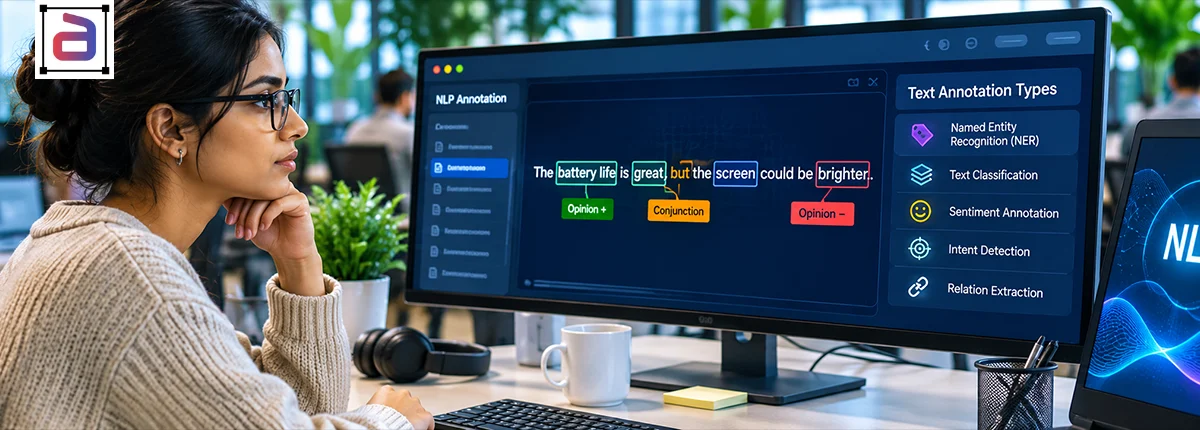
However, not every NLP project requires the same annotation approach. A chatbot designed to understand customer queries needs different labels than an AI system extracting medical entities from clinical documents. Selecting the wrong annotation type can introduce inconsistencies, reduce model accuracy, and increase development costs. So, how do you determine which text annotation method your NLP project actually needs? The answer depends on your AI objectives, data characteristics, model requirements, and expected outcomes. In this guide, Annotera explores the major text annotation types, their applications, and how businesses can select the right approach for building reliable AI training datasets.
Some NLP applications require multiple annotation types. For example, an advanced customer support chatbot may combine intent classification, sentiment annotation, NER, and emotion annotation to understand customer requests more effectively. The key is to define the model’s expected output before designing the annotation workflow.
Key Points
- Choose the Right Annotation Type: Select from sentiment annotation, NER, intent classification, emotion annotation, text classification, and semantic annotation based on your NLP project objectives.
- Align Annotation With AI Goals: Consider business requirements, dataset characteristics, model expectations, and scalability before selecting an annotation approach.
- Prioritize Data Quality and Consistency: Clear labeling guidelines, skilled annotators, and quality assurance are essential for building accurate and reliable NLP training datasets.
- Partner With the Right Annotation Provider: Annotera delivers scalable, quality-focused text annotation outsourcing services to support diverse NLP, conversational AI, and LLM development requirements.
1. Why Choosing the Right Text Annotation Type Matters
Text annotation involves labeling and structuring unstructured textual information so machine learning models can understand language, context, intent, and relationships. Different NLP applications require different levels of information extraction and interpretation. For example:-
A customer feedback platform needs sentiment labels.
-
A chatbot requires intent classification.
-
An information extraction system needs named entity recognition.
-
An advanced conversational AI model may require emotion and semantic annotation.
2. Major Types of Text Annotation for NLP Projects
Understanding the different annotation techniques is the first step toward selecting the right solution.A. Sentiment Annotation: Understanding Customer Opinions
Sentiment annotation identifies the emotional polarity or opinion expressed within textual content. It commonly classifies text into positive, negative, or neutral categories. Best suited for:-
Customer feedback analysis.
-
Product review monitoring.
-
Brand reputation management.
-
Social media listening.
-
Customer experience analytics.
B. Named Entity Recognition (NER): Identifying Important Information
Named Entity Recognition identifies and categorizes specific entities within text, including people, organizations, locations, dates, financial values, and product names. Best suited for:-
Healthcare information extraction.
-
Financial document processing.
-
Legal document analysis.
-
Customer relationship management.
-
Knowledge graph development.
C. Intent Classification: Understanding What Users Want
Intent classification categorizes text according to the user’s underlying objective or purpose. Best suited for:-
AI-powered chatbots.
-
Virtual assistants.
-
Customer support automation.
-
Voice-enabled applications.
-
Conversational AI platforms.
D. Emotion Annotation: Recognizing Human Emotions
Emotion annotation identifies emotional states expressed through written language, such as happiness, frustration, sadness, excitement, anger, and confusion. Best suited for:-
Emotion AI applications.
-
Customer support analytics.
-
Conversational intelligence.
-
Mental wellness applications.
-
Human-computer interaction research.
E. Text Classification: Organizing Unstructured Information
Text classification assigns predefined categories to documents, paragraphs, or messages based on their content. Best suited for:-
Email filtering.
-
News categorization.
-
Content moderation.
-
Document management.
-
Spam detection.
F. Semantic Annotation: Understanding Context and Relationships
Semantic annotation focuses on identifying the meaning of words, phrases, and relationships within textual content. Best suited for:-
Semantic search engines.
-
Knowledge graph development.
-
Advanced NLP systems.
-
Question-answering applications.
-
LLM training and evaluation.
3. Which Text Annotation Type Should You Choose?
The right annotation method depends on your project’s primary objective. Use the following decision guide to identify a suitable starting point.| NLP Project Objective | Recommended Annotation Type |
|---|---|
| Understand customer opinions | Sentiment Annotation |
| Extract names, locations, and dates | Named Entity Recognition |
| Understand chatbot queries | Intent Classification |
| Identify emotional expressions | Emotion Annotation |
| Categorize emails and documents | Text Classification |
| Understand contextual relationships | Semantic Annotation |
| Detect harmful or inappropriate content | Content Moderation Annotation |
4. Five Factors to Consider Before Selecting an Annotation Method
Choosing an annotation type requires more than identifying the AI application. Consider these five factors: 1. Business Objective: Determine whether your system needs to classify information, extract entities, understand intent, or interpret contextual meaning. 2. Dataset Characteristics: Evaluate text length, language, formatting, domain terminology, and data complexity. 3. Model Requirements: Identify the specific labels and output structures required for training or evaluating your NLP model. 4. Annotation Quality: Establish clear labeling guidelines, validation procedures, and quality benchmarks to maintain consistency. 5. Scalability: Consider future dataset expansion, multilingual requirements, and changing model capabilities. A well-planned annotation strategy reduces unnecessary labeling effort and creates datasets aligned with business objectives.5. Why Partner With Annotera for Text Annotation Outsourcing Services?
Selecting the right annotation type is only one part of building a successful NLP solution. Businesses also need consistent labeling, trained annotators, scalable workflows, and dependable quality management. Annotera supports organizations with structured text annotation capabilities designed around diverse AI and NLP requirements. Our approach focuses on:-
Multiple Annotation Capabilities: Supporting sentiment annotation, NER, intent classification, emotion annotation, and text categorization.
-
Quality-Focused Processes: Emphasizing clear annotation guidelines, consistency, and validation.
-
Scalable Workflows: Supporting different dataset volumes and project complexities.
-
Human Expertise: Addressing linguistic nuances, contextual interpretation, and specialized labeling requirements.
-
Flexible Project Support: Aligning annotation workflows with individual AI development objectives.