Artificial intelligence is transforming how businesses communicate, automate, and scale globally. From multilingual chatbots and virtual assistants to intelligent search engines and customer support automation, AI systems today are expected to understand users across languages, cultures, and regions. However, behind every high-performing multilingual AI model lies one critical factor: high-quality annotated data. As organizations accelerate global AI deployment, multilingual text annotation has become a strategic necessity. Yet, despite rapid advancements in NLP and generative AI, multilingual annotation remains one of the most complex challenges in AI development. Linguistic diversity, cultural nuances, regional dialects, and annotation consistency all directly impact model accuracy and user experience. This is where partnering with an experienced data annotation company like Annotera becomes essential. Through scalable data annotation outsourcing and expert-led text annotation outsourcing, businesses can build multilingual AI systems that are accurate, context-aware, and globally reliable. Learn more about cultural sensitivity in global content classification.
Key Points
- Multilingual annotation cannot be solved by translating English guidelines — grammar structures, negation patterns, and entity types differ fundamentally across language families.
- Low-resource languages lack sufficient annotated data, causing multilingual models to underperform for those speaker communities compared to high-resource language users.
- Cultural context embedded in language requires native-speaker annotators who understand not just vocabulary but the social and professional register of each language.
- Global AI deployment without language-specific annotation quality controls produces models that are accurate in English but unreliable or unsafe in other languages.
Table of Contents
Why Multilingual AI Is Becoming a Business Imperative
The modern digital economy is multilingual by default. Consumers expect brands to engage with them in their native language, regardless of geography or platform.
“76% of consumers prefer purchasing products with information in their own language.” — CSA Research
This statistic alone highlights why multilingual AI is now critical for industries such as:
- E-commerce
- Healthcare
- Banking and finance
- Customer support
- Travel and hospitality
- Social media platforms
- Generative AI applications
Similarly, Statista projects the global AI market to surpass $500 billion by 2027, with multilingual NLP solutions driving significant enterprise adoption. However, deploying AI globally requires more than machine translation. AI systems must understand sentiment, intent, cultural references, slang, sarcasm, and contextual meaning across languages. Without properly annotated multilingual datasets, even advanced AI models struggle to deliver accurate results.
“Data is food for AI.” — Andrew Ng
And when it comes to multilingual AI, the quality of that “food” determines whether models succeed or fail in global environments.
The Biggest Challenges in Multilingual Text Annotation
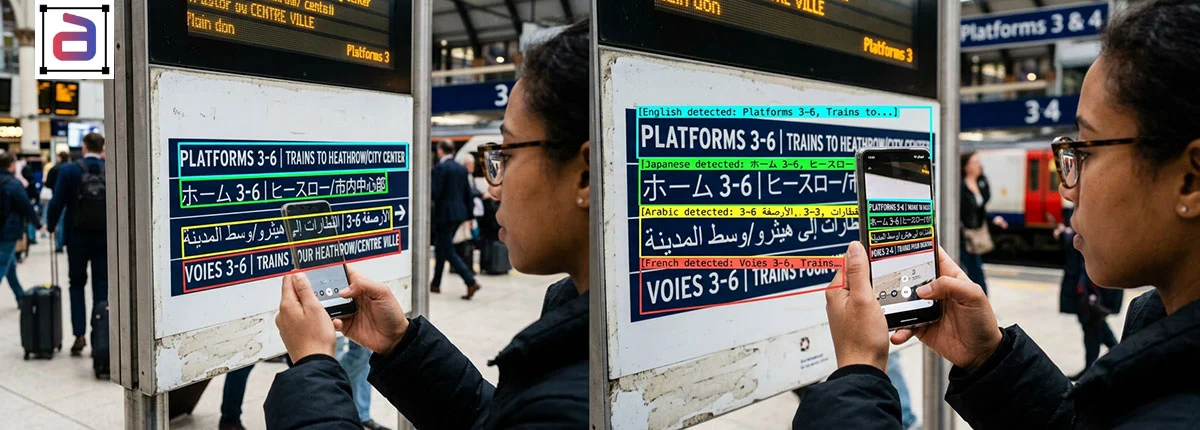
Multilingual text annotation involves significant challenges, including linguistic diversity, cultural ambiguity, regional dialects, and consistency issues. Moreover, businesses must manage low-resource languages and maintain quality at scale, making expert annotation workflows increasingly essential for accurate global AI deployment. Human-in-the-Loop text annotation helps overcome the biggest challenges in multilingual text annotation, including language ambiguity, cultural nuances, and inconsistent labeling. Moreover, human reviewers improve contextual accuracy, ensuring reliable AI performance across diverse languages and regional dialects.
1. Linguistic Diversity and Regional Dialects
One of the most difficult aspects of multilingual annotation is handling language variation. Many widely spoken languages contain multiple regional dialects that differ significantly in grammar, vocabulary, tone, and sentence structure. For example:
- Spanish varies across Spain, Mexico, and Latin America
- Arabic includes numerous dialects across the Middle East and North Africa
- Hindi often incorporates English code-mixing and regional expressions
Without native-language expertise, annotation errors become inevitable. At Annotera, our multilingual annotation teams include native linguists and domain specialists who understand not just language mechanics, but also regional communication behaviors and contextual subtleties. This ensures datasets accurately reflect real-world usage patterns.
2. Cultural Context and Semantic Ambiguity
Language is deeply connected to culture. Words and phrases often carry different meanings depending on social context, geography, and user behavior. For instance, sarcasm detection in English differs greatly from sarcasm patterns in Japanese, Spanish, or Hindi. Similarly, sentiment classification becomes far more complex when slang or idiomatic expressions are involved.
“Language is not just linguistic; it reflects culture, emotion, and intent.” — CSA Research
This creates major challenges for AI applications such as:
- Sentiment analysis
- Conversational AI
- Intent recognition
- Content moderation
- Social listening platforms
A poorly annotated dataset can cause AI systems to misunderstand emotional tone, misclassify intent, or generate biased outputs. As a specialized text annotation company, Annotera focuses heavily on contextual accuracy and cultural intelligence to ensure multilingual AI systems perform effectively across diverse markets.
3. Low-Resource Languages and Limited Training Data
While English dominates most AI datasets, many regional and indigenous languages remain severely underrepresented. These “low-resource languages” often lack sufficient training data for AI development.
“Nearly 40% of the global population lacks access to education in a language they understand.” — UNESCO
This same disparity exists within AI ecosystems, where underserved languages receive minimal dataset investment. Consequently, businesses deploying AI in emerging markets often face:
- Limited annotated corpora
- Lack of linguistic resources
- Scarcity of native annotators
- Poor model accuracy
Through scalable text annotation outsourcing, Annotera helps enterprises develop customized multilingual datasets for both high-resource and low-resource languages, enabling broader AI accessibility and inclusivity.
4. Maintaining Annotation Consistency Across Languages
Consistency is one of the most overlooked yet critical challenges in multilingual annotation projects. Different annotators may interpret labeling guidelines differently depending on language structure and cultural understanding. For example, Named Entity Recognition (NER) standards used in English may not translate effectively into languages such as Thai, Korean, or Japanese. Without strong quality assurance systems, businesses risk:
- Inconsistent annotations
- Model bias
- Reduced NLP accuracy
- Training inefficiencies
“Organizations that operationalize AI governance and human oversight achieve significantly better AI outcomes.” — Gartner
At Annotera, we implement multi-layer validation frameworks, reviewer consensus mechanisms, and robust QA processes to ensure annotation consistency across multilingual datasets.
Why Businesses Are Choosing Data Annotation Outsourcing
Building multilingual annotation operations internally can quickly become expensive and operationally complex. Recruiting native-language experts, maintaining quality standards, and scaling global annotation workflows require substantial investment. As a result, enterprises increasingly rely on data annotation outsourcing to streamline AI development while maintaining quality and scalability. Partnering with a trusted data annotation company offers several advantages:
Access to Native Linguistic Experts
Native speakers provide deeper understanding of cultural context, idiomatic language, and regional communication styles.
Faster Scalability
Outsourcing enables businesses to rapidly scale multilingual annotation projects across multiple languages and domains.
Cost Efficiency
Organizations reduce recruitment, infrastructure, and operational overhead while accelerating dataset production.
Enhanced Quality Assurance
Experienced annotation providers implement structured review systems and AI-assisted quality checks to improve accuracy.
Faster AI Deployment
High-quality training data shortens model training cycles and improves deployment readiness. Annotera combines all these capabilities through scalable, enterprise-grade annotation solutions tailored for global AI initiatives.
The Role of Human-in-the-Loop Annotation
Although AI-assisted annotation tools improve efficiency, automation alone cannot fully understand cultural nuance, sarcasm, emotion, or contextual meaning. That is why Human-in-the-Loop (HITL) workflows remain essential for multilingual AI training. At Annotera, we combine machine-assisted annotation with expert human validation to deliver datasets that balance speed, scalability, and contextual precision. This hybrid approach helps organizations build more reliable and culturally aware AI systems.
Best Practices for Successful Multilingual Annotation
To improve multilingual AI performance, organizations should follow several proven strategies:
- Use native-speaking annotators
- Develop language-specific annotation guidelines
- Continuously update datasets
- Implement multi-stage quality reviews
- Combine AI automation with human oversight
- Prioritize cultural understanding alongside linguistic accuracy
These practices significantly improve model reliability and user experience across global markets.
Why Annotera Is the Right Multilingual Annotation Partner
At Annotera, we understand that multilingual annotation is not simply about translating text — it is about preserving meaning, context, emotion, and intent across languages. As a trusted text annotation company, we provide scalable multilingual annotation solutions for:
- Conversational AI
- Generative AI
- NLP model training
- Sentiment analysis
- Named Entity Recognition (NER)
- Content moderation
- Customer support automation
Our expert annotators, robust QA workflows, and scalable infrastructure enable enterprises to build globally intelligent AI systems with confidence. Whether you need multilingual datasets for healthcare AI, financial NLP, retail automation, or enterprise-grade generative AI, Annotera delivers annotation solutions designed for accuracy, scalability, and performance.
Conclusion
As businesses continue expanding AI systems across international markets, multilingual text annotation has become foundational to successful global AI deployment. However, linguistic diversity, cultural complexity, low-resource languages, and quality control challenges make multilingual annotation highly demanding. Organizations that invest in high-quality multilingual datasets gain a significant competitive advantage through improved customer engagement, stronger AI accuracy, and broader market accessibility. By partnering with an experienced data annotation company like Annotera, enterprises can overcome multilingual annotation challenges through scalable data annotation outsourcing and expert-driven text annotation outsourcing solutions.
Ready to Scale Your Global AI Initiatives?
Annotera helps businesses build accurate, culturally intelligent, and scalable multilingual datasets for next-generation AI systems. From NLP and conversational AI to generative AI and sentiment analysis, our annotation experts deliver the precision your models need to succeed globally. Connect with Annotera today and discover how our multilingual annotation solutions can accelerate your AI deployment with unmatched quality, scalability, and domain expertise.
Need multilingual text annotation at scale? Annotera provides text annotation services in 50+ languages, including low-resource and right-to-left scripts. Get a free pilot project.