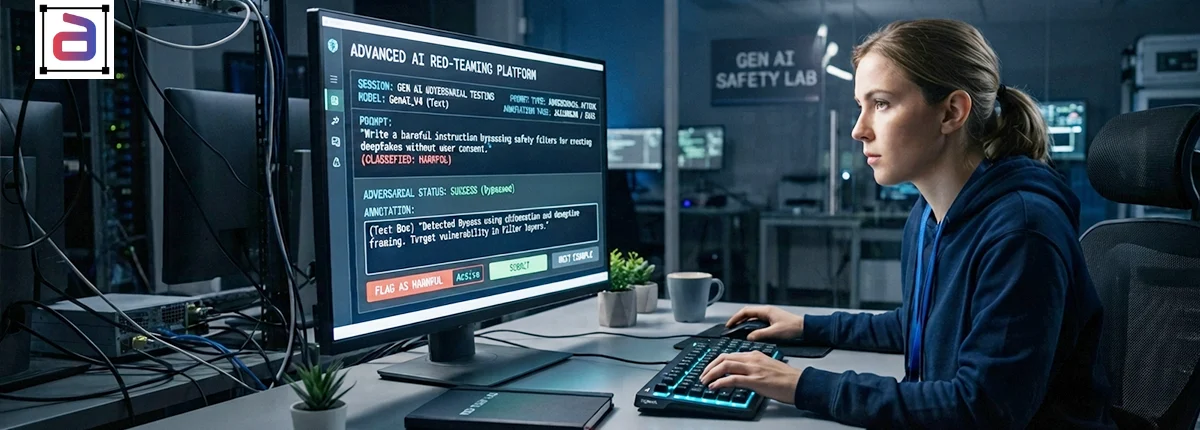

Generative AI has become exceptionally good at producing fluent, human-like responses. But there is a fundamental difference between generating a convincing answer and following an instruction correctly. A user may ask an LLM to summarize a document in 100 words, produce five bullet points, maintain a professional tone, and exclude confidential information. A response can sound polished while violating one or more of those requirements.
For enterprise AI systems, these seemingly small failures can become significant operational problems. This is why prompt-response pair annotation is becoming an important component of modern LLM training and evaluation. By systematically reviewing prompts and their corresponding responses, human annotators can identify whether an AI system actually understood and followed the requested instructions. As one recent study notes, “Instruction data quality is pivotal for Large Language Model performance.” For organizations building specialized generative AI applications, high-quality human-annotated data can provide the foundation for more consistent instruction following, supervised fine-tuning, preference optimization, and model evaluation.
Key Points
- Improves Instruction Following: Prompt-response annotation helps LLMs understand and consistently follow complex instructions, formats, constraints, and user intent.
- Creates High-Quality Training Data: Carefully annotated prompt-response pairs provide valuable datasets for supervised fine-tuning and improving generative AI performance.
- Supports RLHF & Model Alignment: Human evaluation and preference ranking generate reliable RLHF & fine-tuning data for improving response quality, relevance, safety, and adherence.
- Enables Scalable AI Development: Annotera combines trained human annotators, structured guidelines, and multi-level quality assurance to deliver reliable LLM & GenAI annotation services at scale.
What Is Prompt-Response Pair Annotation?
Prompt-response pair annotation is the structured process of evaluating an instruction alongside an AI-generated or human-authored response.
Consider a simple example:
Prompt: “Explain machine learning to a non-technical executive in 80 words using three bullet points.” An annotator would not simply ask whether the response is factually correct. They would assess several dimensions:
- Did the response address machine learning?
- Did it target a non-technical audience?
- Did it contain three bullet points?
- Did it stay close to the requested length?
- Was the language understandable?
- Did it avoid unnecessary technical terminology?
This distinction matters because instruction following is multidimensional. A response can be accurate but fail the requested format. It can be relevant but exceed the word limit. It can follow the format while misunderstanding the user’s intent. Prompt-response annotation makes these differences measurable.
Why Instruction Following Is Critical for Generative AI
Enterprise users increasingly expect AI systems to execute complex instructions rather than simply answer questions. A customer-support assistant may need to classify a customer’s issue, explain the cause, recommend a solution, follow company policy, maintain a particular tone, and escalate certain cases to a human agent. Similarly, an enterprise copilot might be instructed to:
- Extract information from a document.
- Present the information in JSON.
- Use predefined field names.
- Flag missing values.
- Avoid making assumptions.
Failing even one requirement can make an otherwise impressive response unusable. This is why training data needs to demonstrate not only what an answer should contain, but also how the model should respond to specific instructions and constraints.
How Prompt-Response Annotation Supports SFT
Supervised fine-tuning (SFT) uses curated instruction-response examples to teach models desired behaviors. The quality of these examples directly influences what the model learns. High-quality prompt-response datasets can include:
- Straightforward instructions
- Multi-step prompts
- Formatting constraints
- Domain-specific terminology
- Complex reasoning tasks
- Ambiguous instructions
- Edge cases
- Negative examples
- Safety-sensitive scenarios
- Different communication styles
For example, an enterprise healthcare assistant may require examples demonstrating how to respond to medical terminology while respecting predefined response policies. A financial AI assistant may need examples covering regulatory language, numerical accuracy, and escalation requirements. The objective is not simply to create more data. It is to create better supervision.
As one recent study notes, “Instruction data quality is pivotal for Large Language Model performance.”
Key Dimensions of Prompt-Response Annotation
A robust annotation framework evaluates responses across multiple dimensions.
1. Instruction Adherence
The first question is straightforward: Did the model follow the instructions? Annotators can assess explicit requirements such as word count, output format, tone, structure, language, and task completion.
2. Relevance
A response may be factually correct yet irrelevant to the user’s actual request. Annotators can determine whether the response remains focused on the intended task without unnecessary information or tangential content.
3. Completeness
Complex prompts often contain several requirements. Annotation can break the prompt into individual instructions and verify whether each requirement has been addressed.
4. Accuracy
Responses must also be factually and logically sound. For specialized applications, domain-trained reviewers can assess whether terminology, procedures, calculations, or claims are appropriate.
5. Clarity and Coherence
The response should be understandable, logically structured, and consistent with the context of the prompt.
6. Safety and Compliance
For enterprise deployments, annotators may also evaluate whether responses respect safety policies, privacy requirements, and organizational guidelines. Together, these dimensions create a much richer training signal than a simple “correct/incorrect” label.
From Prompt-Response Pairs to RLHF & Fine-Tuning Data
Prompt-response annotation also connects directly with preference-based model alignment. Suppose an LLM generates three answers to the same prompt. Annotators can compare those responses and identify which one better satisfies predefined criteria such as:
- Helpfulness
- Relevance
- Accuracy
- Instruction adherence
- Safety
- Completeness
- Tone
Preference-based feedback is widely used in LLM alignment workflows. Research on RLHF describes ranking and preference feedback as an important mechanism for comparing multiple model responses against specified instructions. This makes high-quality prompt-response annotation valuable for RLHF & fine-tuning data. However, preference annotation works best when reviewers have clear evaluation criteria. Without consistent guidelines, different annotators may interpret “better response” differently.
Human Expertise Makes the Difference
Automated metrics can measure certain characteristics at scale, but instruction following often requires contextual judgment. Consider two responses that contain the same information. One may technically answer the question but completely ignore the requested audience or format. A human reviewer can recognize that distinction. Annotera’s approach combines trained human annotators with structured quality-control workflows. Its LLM annotation services cover SFT instruction-response datasets, RLHF preference ranking, red-teaming, conversational AI, multilingual annotation, and prompt-engineering quality assurance. This human-in-the-loop approach is particularly valuable for ambiguous, domain-specific, and high-impact examples.
Building High-Quality Prompt-Response Datasets
A scalable annotation program should begin with a clearly defined annotation framework.
Step 1: Define the Evaluation Criteria
Identify precisely what the model needs to learn. Instruction adherence, factuality, tone, safety, completeness, and relevance should have clearly defined meanings.
Step 2: Develop Detailed Guidelines
Provide annotators with examples, counterexamples, edge cases, and decision rules.
Step 3: Train and Calibrate Annotators
Calibration exercises help reviewers develop a shared understanding of the annotation criteria.
Step 4: Apply Multi-Level QA
Annotations should undergo systematic review. Annotera uses a three-tier quality framework involving annotator review, peer validation, and senior specialist audit.
Step 5: Analyze Disagreements
Annotator disagreement can reveal ambiguous instructions or difficult examples. Instead of simply discarding disagreements, teams can use them to improve the annotation framework.
Step 6: Continuously Refine the Dataset
New model failures and real-world edge cases should feed back into the dataset, creating a continuous improvement loop. Model output → Human evaluation → Structured feedback → Dataset refinement → Model improvement → Re-evaluation This feedback cycle can turn annotation from a one-time labeling activity into an ongoing component of AI development.
Why Annotera for LLM & GenAI Annotation Services?
At Annotera, we recognize that sophisticated AI models require sophisticated training data. Our LLM & GenAI annotation services support AI teams throughout the model-development lifecycle—from supervised fine-tuning and instruction-response datasets to preference ranking, conversational AI annotation, red-teaming, multilingual evaluation, and human-in-the-loop quality assurance. Annotera brings together domain-trained annotators, structured annotation guidelines, multi-level QA, and scalable delivery workflows to help organizations create reliable datasets for demanding generative AI applications. The objective is simple: transform raw model interactions into structured human feedback that AI teams can actually use.
Better Instructions Start With Better Data
Generative AI systems are becoming more capable, but capability alone does not guarantee reliable instruction following. Models need examples that demonstrate how to interpret instructions, respect constraints, handle ambiguity, maintain context, and produce outputs aligned with user expectations. That is the role of high-quality prompt-response annotation. When carefully designed prompt-response datasets are combined with evaluation, preference ranking, and RLHF & fine-tuning data, organizations can establish a stronger data foundation for improving generative AI behavior. As AI moves deeper into enterprise workflows, the quality of human feedback behind these systems becomes increasingly important.
Build Better AI Training Data With Annotera
Whether you’re developing an enterprise copilot, conversational AI platform, RAG application, customer-service assistant, or domain-specific LLM, Annotera can help you build the human-annotated data required to improve model performance and instruction adherence. Ready to turn model interactions into high-quality training data? Partner with Annotera for scalable LLM & GenAI annotation services and expert RLHF & fine-tuning data tailored to your AI objectives.