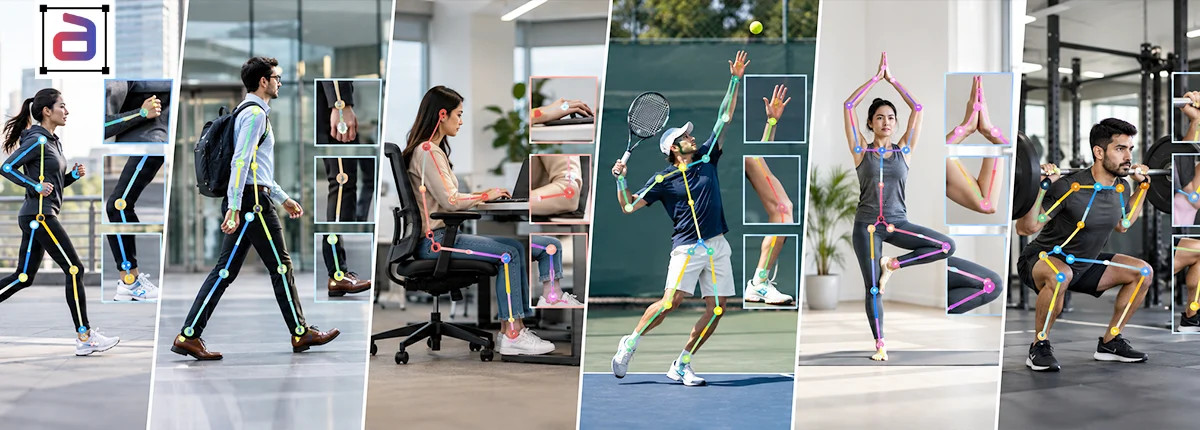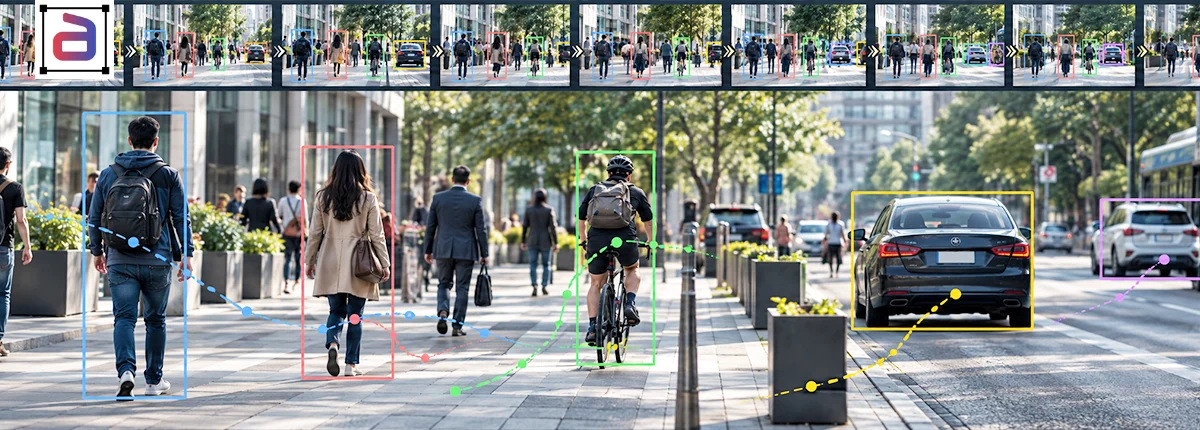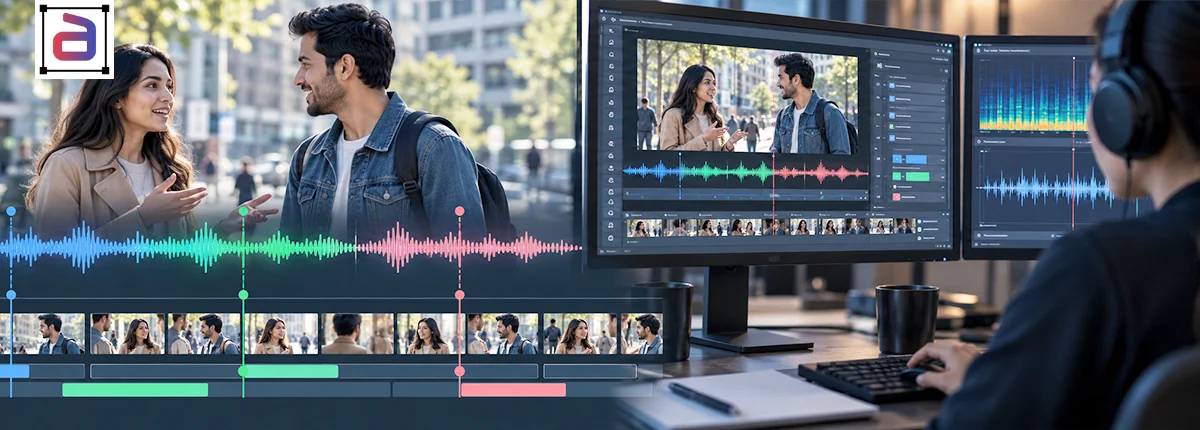
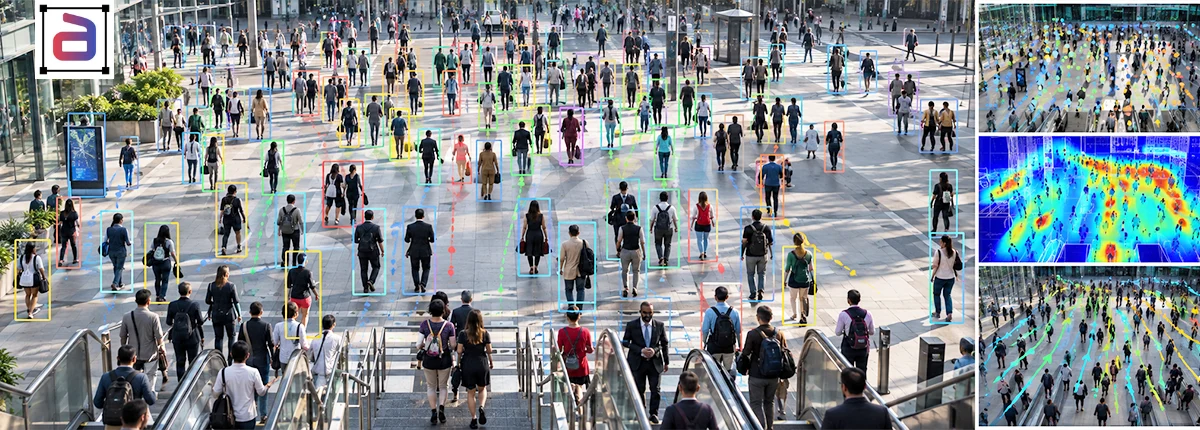
Crowds are constantly moving, interacting, dispersing, and regrouping. For AI-powered video analytics, understanding these dynamics requires far more than simply detecting people in individual frames. Computer vision models need structured data that explains who is present, where they are, how densely they are grouped, and how they move over time. This is where video annotation for crowd analysis becomes essential.
From airports and railway stations to stadiums, shopping centers, public events, and smart cities, organizations are increasingly using video intelligence to understand pedestrian movement and crowd behavior. Yet the accuracy of these systems depends heavily on the quality of the datasets used to train them. As computer vision researcher Fei-Fei Li has emphasized, “Data is the new oil” in the context of modern AI. For crowd-analysis systems, that principle is particularly relevant: sophisticated algorithms still require carefully structured and accurately labeled data to perform reliably.
Key Points
- Accurate Crowd Labeling: Video annotation identifies people, density, trajectories, movement patterns, and contextual events across complex crowd environments.
- Temporal Consistency Matters: Consistent tracking of individuals across frames helps AI models understand movement, occlusion, entry, exit, and changing crowd behavior.
- Scalable Annotation for AI: Video annotation outsourcing helps organizations manage large-scale datasets while maintaining standardized guidelines and quality-control processes.
- Annotera for Crowd Intelligence: Annotera delivers customized video annotation workflows covering person detection, segmentation, tracking, density labeling, and movement annotation for computer vision applications.
What Is Video Annotation for Crowd Analysis?
Video annotation for crowd analysis is the process of adding structured labels to people, objects, movements, regions, and events across video sequences. Unlike simple image annotation, video annotation introduces a temporal dimension. Annotators must maintain consistency as individuals move between frames, become partially obscured, enter or leave a scene, or interact with other people. Depending on the AI application’s requirements, annotation can include:
- Person detection and bounding boxes
- Person segmentation
- Individual identity tracking
- Crowd density classification
- Movement direction and trajectories
- Entry and exit points
- Queue and gathering identification
- Zone-based labeling
- Occlusion and visibility labels
- Unusual movement or event markers
These annotations convert raw video into structured training data that machine learning models can process.
Why High-Quality Annotation Matters for Crowd Analytics
A crowded environment is one of the most challenging scenarios for computer vision. Imagine a railway platform during rush hour. Hundreds of people may appear within a relatively small area. Some individuals may be completely visible, while others are partially hidden behind people, objects, pillars, or signage. A poorly annotated dataset can introduce several problems:
- People may be missed entirely.
- Two individuals may be incorrectly treated as one.
- The same person may receive different identities across frames.
- Density estimates may become unreliable.
- Movement trajectories may contain inconsistencies.
- Occluded objects may be incorrectly labeled.
These errors can propagate into model training and ultimately affect the performance of downstream video analytics systems. For this reason, annotation quality is not simply a data-preparation concern—it is part of the model-development process itself.
Key Video Annotation Techniques for Crowd Analysis
1. Person Detection and Bounding Box Annotation
Person detection provides the foundation for many crowd-analysis systems. Annotators identify individuals and draw bounding boxes around them across relevant frames. These labels help models learn how people appear under different camera angles, distances, poses, lighting conditions, and levels of crowding. In dense scenes, annotation guidelines must clearly define how to handle partial visibility, overlapping individuals, and people appearing at the edge of a frame.
2. Person Segmentation
Bounding boxes provide rectangular representations, but some applications require more detailed spatial information. Segmentation allows annotators to outline the visible region of an individual more precisely. This can be particularly valuable in highly congested environments where people overlap significantly. Pixel-level or instance-level labels can help computer vision models distinguish individuals and understand how people occupy physical space.
3. Crowd Density Annotation
Crowd density is an important component of crowd intelligence. Instead of focusing solely on individual detection, annotation can classify areas according to predefined density levels—for example, low, moderate, high, or extremely high density. Another approach is point-based annotation, where each visible individual is represented by a specific point. Such datasets can support models designed for estimating the number and distribution of people within large scenes. Density annotation can contribute to applications involving:
- Public-space monitoring
- Transportation planning
- Event management
- Retail analytics
- Pedestrian-flow analysis
- Congestion monitoring
4. Movement and Trajectory Annotation
A crowd is not defined only by how many people are present. Movement is equally important. Trajectory annotation captures how individuals or groups move through a scene over time. Labels may represent direction, path, speed category, entry and exit behavior, or changes in movement. For example, an AI model may need to distinguish between normal pedestrian flow and a sudden change in direction involving a large group. As computer vision scientist Richard Szeliski notes, “The goal of computer vision is to extract useful information from images and video.” For crowd analytics, movement annotations provide an important layer of that information.
Temporal Consistency: The Core of Video Annotation
One of the biggest differences between image and video annotation is temporal consistency. Suppose an individual appears in 500 consecutive frames. The annotation team must ensure that the person’s identity remains consistent throughout the sequence. This becomes difficult when the person:
- Walks behind another individual
- Becomes temporarily invisible
- Changes direction
- Moves into a poorly lit area
- Leaves and later re-enters the scene
- Becomes partially visible
Consistent object identity and trajectory labels are essential for training reliable multi-object tracking systems. At Annotera, annotation workflows can be designed around project-specific definitions for identity, occlusion, visibility, object persistence, and frame-level consistency.
Where Crowd Analysis Annotation Is Used
Transportation and Transit
Airports, metro stations, railway platforms, and bus terminals can use annotated video datasets to develop systems for pedestrian-flow and congestion analysis.
Sports and Entertainment
Stadiums and event venues generate complex crowd patterns. Annotation can support analysis of entrances, exits, seating areas, queues, and movement across large spaces.
Retail
Retail environments can use video analytics to understand customer movement, traffic patterns, and high-activity zones while following applicable privacy and data-governance requirements.
Smart Cities
Urban planners and technology providers can use computer vision datasets to study pedestrian movement and understand how people interact with public infrastructure.
Safety and Security
Annotated datasets can help train systems to recognize predefined movement patterns or crowd events that warrant further human review.
The Challenge of Scaling Crowd Annotation
Large-scale video projects can contain millions of frames. Manually annotating these datasets requires trained personnel, detailed guidelines, quality-control mechanisms, and project management. Several factors make crowd annotation particularly demanding:
- Occlusion: People frequently overlap or disappear behind other objects.
- Density: Closely packed crowds make individual detection more difficult.
- Motion blur: Fast-moving individuals may become difficult to distinguish.
- Camera variation: Fixed cameras, moving cameras, elevated viewpoints, and wide-angle footage produce different annotation challenges.
- Long sequences: Maintaining identity consistency across extended video requires careful tracking.
- Quality assurance: Small annotation inconsistencies can become significant when datasets are used at scale.
This is why many AI companies turn to video annotation outsourcing services to expand their annotation capacity without building large internal teams.
How Video Annotation Outsourcing Supports AI Development
With video annotation outsourcing, organizations can access specialized annotation teams and structured quality-control workflows while scaling production according to project requirements. A capable annotation partner can help manage:
- High-volume video datasets
- Custom annotation taxonomies
- Object tracking
- Bounding-box and segmentation tasks
- Crowd-density labeling
- Movement and trajectory annotation
- Multi-level quality checks
- Project-specific annotation guidelines
Outsourcing can be particularly useful when annotation requirements fluctuate during different stages of AI development. Instead of treating annotation as a one-time labeling exercise, organizations can establish a repeatable data-production pipeline that evolves alongside their computer vision models.
Why Choose Annotera for Crowd Analysis Annotation?
At Annotera, we recognize that every computer vision project has different data requirements. A dataset designed for retail footfall analysis may require a very different taxonomy from one created for transportation or stadium analytics. Our video annotation workflows can be customized around the objectives of your AI model. From person detection and segmentation to object tracking, density labeling, trajectory annotation, and frame-level validation, Annotera helps transform complex video into structured, model-ready datasets. Our focus is on three essential principles: Accuracy: Precise annotations aligned with clearly defined project guidelines. Consistency: Standardized labeling across frames, sequences, and large annotation teams. Scalability: Flexible workflows designed to accommodate growing video volumes and evolving AI requirements.
Building Better Crowd Intelligence Starts With Better Data
AI systems can process enormous volumes of video, but their ability to understand those videos depends on the quality of the underlying training data. For crowd-analysis applications, that means accurately labeling people, density, identity, movement, trajectories, and contextual events across time. As computer vision moves deeper into transportation, retail, smart-city infrastructure, sports, and public-space analytics, high-quality video annotation will remain a critical component of AI development. Annotera helps organizations turn complex video into structured intelligence-ready datasets—at scale.
Ready to Build Your Crowd Analysis Dataset?
Whether you need person tracking, crowd-density annotation, movement trajectories, segmentation, or customized video labeling, Annotera can help you create a scalable annotation workflow tailored to your computer vision objectives. Contact Annotera today to discuss your video annotation requirements and discover how our expert annotation teams can accelerate your AI data pipeline.