Construction is undergoing a digital transformation. From AI-powered surveillance systems to autonomous equipment and predictive safety analytics, technology is reshaping how construction projects are managed. Yet behind every intelligent construction monitoring system lies a critical foundation that often goes unnoticed: high-quality annotated data. Polygon annotation for construction enables AI systems to accurately identify complex site elements, including hazard zones, machinery, and infrastructure. Consequently, it improves object localization, enhances safety monitoring, and supports more reliable decision-making across dynamic construction environments.
As construction companies increasingly adopt computer vision solutions, the need for precise image annotation has never been greater. Among the various annotation techniques available, polygon annotation has emerged as a powerful tool for accurately identifying hazard zones, equipment boundaries, and complex site environments that traditional labeling methods struggle to capture. At Annotera, we help organizations unlock the full potential of AI through precise, scalable, and industry-specific annotation services. When safety, compliance, and operational efficiency are on the line, annotation accuracy becomes a strategic advantage rather than a technical requirement.
Key Points
- Polygon annotation traces the exact boundary of each hazard zone or piece of equipment.
- Construction site safety AI uses annotated imagery to detect boundary violations.
- Precise polygon boundaries improve model performance in high-stakes safety contexts.
- Domain-expert annotators reduce label errors on complex construction site imagery.
Table of Contents
Why Construction Site Monitoring Demands Greater Precision
Construction remains one of the world’s most hazardous industries. According to the International Labour Organization (ILO), nearly 3 million workers lose their lives annually (Source: ILO) due to work-related accidents and diseases, with construction accounting for a significant share of workplace injuries and fatalities. Modern AI systems are being deployed to address these challenges by monitoring:
- Hazardous work zones
- Heavy equipment movement
- Worker proximity to dangerous areas
- Personal protective equipment (PPE) compliance
- Unauthorized site access
- Safety protocol violations
However, even the most advanced AI model is only as good as the data used to train it.
“AI is the new electricity. Just as electricity transformed almost everything 100 years ago, today I actually have a hard time thinking of an industry that I don’t think AI will transform.” — Andrew Ng, Founder of DeepLearning.AI
For construction AI to deliver on this promise, it requires training datasets that accurately represent the real-world complexity of construction environments. Construction sites are constantly evolving, and therefore even minor safety risks can escalate quickly. Consequently, AI-powered monitoring systems require highly precise visual data to accurately detect hazards, track equipment movements, and improve overall site safety and operational efficiency.
What Makes Polygon Annotation Essential?
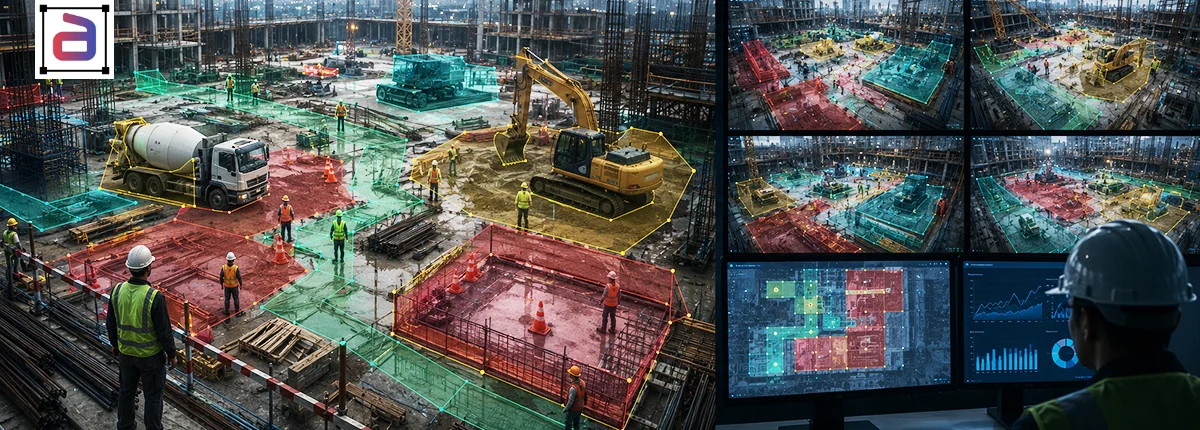
Unlike traditional bounding boxes that place rectangular frames around objects, polygon annotation allows annotators to trace the exact shape and contours of an object or region. Unlike traditional bounding boxes, polygon annotation captures the exact contours of objects and regions. As a result, AI models gain greater spatial accuracy, while simultaneously reducing background noise, making hazard detection and equipment monitoring significantly more reliable. This distinction is critical in construction settings where objects rarely conform to neat geometric shapes. Consider:
- Excavation pits
- Crane operating zones
- Temporary barriers
- Construction materials
- Bulldozers and excavators
- Reinforcement structures
- Restricted work areas
A rectangular box often includes substantial background noise, reducing training accuracy. Polygon annotation, by contrast, captures precise object boundaries and enables AI models to better understand their environment. The result is significantly improved object recognition, segmentation, and spatial awareness.
Detecting Hazard Zones with Greater Accuracy
One of the most valuable applications of polygon annotation is hazard zone detection. Construction hazard zones often have irregular and constantly changing boundaries. Therefore, polygon annotation enables precise zone mapping, allowing AI systems to detect unsafe worker entry more accurately and, consequently, improve real-time safety monitoring and risk prevention. Polygon annotation for construction provides highly detailed object boundaries, allowing AI models to better interpret site conditions. As a result, construction companies can improve hazard detection, equipment monitoring, and overall operational awareness in complex environments. Construction sites contain numerous danger areas that constantly evolve as projects progress. These may include:
- Open trenches
- Excavation zones
- Demolition areas
- High-voltage installations
- Crane swing zones
- Chemical storage regions
These hazard zones are rarely rectangular. Their boundaries often shift daily based on ongoing site activities. Polygon annotation allows annotators to define these areas with precision, enabling computer vision systems to accurately detect when workers enter restricted spaces or when unsafe activities occur near hazardous locations. For safety managers, this means faster alerts, improved incident prevention, and stronger regulatory compliance. More importantly, it creates a proactive safety culture where risks can be identified before accidents occur.
Improving Equipment Boundary Detection
Heavy machinery presents another significant challenge for construction AI systems. Heavy construction equipment often features complex shapes and moving components. Consequently, polygon annotation defines precise machinery boundaries, enabling more accurate tracking, collision avoidance, and spatial analysis while simultaneously improving the overall performance of construction-focused AI systems. In construction projects, polygon annotation helps capture the exact shape of machinery, materials, and restricted areas. Consequently, computer vision systems can generate more accurate insights, supporting safer worksites and more efficient project management. Equipment such as:
- Excavators
- Bulldozers
- Mobile cranes
- Forklifts
- Dump trucks
- Concrete mixers
often feature irregular shapes, moving components, and changing operational footprints. Traditional bounding box annotation frequently captures large portions of empty space around equipment, reducing model precision. Polygon annotation enables AI systems to understand the exact physical boundaries of machinery by outlining:
- Hydraulic arms
- Crane booms
- Attachments
- Vehicle frames
- Operational extensions
This level of detail supports more accurate:
Collision Prevention
AI systems can better calculate distances between workers and machinery. By accurately defining equipment boundaries, polygon annotation enables AI systems to assess proximity more precisely. Consequently, potential collisions between workers, vehicles, and machinery can be detected earlier, thereby enhancing site safety and reducing operational risks.
Equipment Tracking
Construction managers gain clearer visibility into equipment utilization and movement patterns. Precise equipment annotation improves object recognition and movement tracking. As a result, construction managers gain better visibility into equipment utilization, while simultaneously optimizing deployment, reducing idle time, and improving overall productivity across the job site.
Autonomous Navigation
Future autonomous and semi-autonomous construction equipment depends on precise environmental understanding.
Site Safety Monitoring
Potential interactions between equipment and workers can be identified earlier and with greater confidence. According to McKinsey & Company, digital technologies and AI-driven solutions have the potential to increase construction productivity by up to 15 percent while significantly improving safety performance.
The Business Impact of High-Quality Annotation
The value of polygon annotation extends far beyond model accuracy. High-quality annotation directly influences AI performance and business outcomes. As a result, organizations can reduce safety incidents, improve operational efficiency, accelerate model deployment, and ultimately achieve greater returns on their investments in construction technology and automation. As construction sites continuously evolve, polygon annotation for construction delivers the precision needed for reliable AI training. Therefore, organizations can enhance safety compliance, optimize equipment tracking, and improve real-time monitoring capabilities across projects. When construction companies invest in high-quality training data, they unlock benefits across multiple operational areas:
Reduced Safety Incidents
Accurate hazard detection helps prevent costly workplace accidents. Accurate annotation enables AI systems to identify hazards more effectively. As a result, construction teams can respond to potential risks sooner, thereby reducing workplace incidents, improving worker safety, and fostering a more proactive approach to site management.
Better Compliance Management
AI-powered monitoring simplifies adherence to safety regulations and audit requirements. AI-powered monitoring systems help organizations track safety protocols more consistently. Consequently, construction companies can simplify compliance reporting, identify violations promptly, and maintain stronger adherence to regulatory requirements while reducing the burden of manual inspections.
Enhanced Project Visibility
Real-time monitoring provides managers with actionable insights into site operations. Real-time AI monitoring provides deeper insights into construction site activities. As a result, project managers can make informed decisions faster, while simultaneously improving resource allocation, tracking progress more effectively, and identifying potential operational bottlenecks early.
Increased Operational Efficiency
Improved equipment tracking enables better resource allocation and utilization. Accurate annotation enhances AI-driven equipment and workflow tracking. Consequently, construction teams can optimize resource utilization, reduce downtime, and streamline daily operations, thereby improving productivity and ensuring projects stay on schedule and within budget.
Faster AI Deployment
Well-annotated datasets accelerate model training and reduce costly retraining cycles. High-quality annotated datasets reduce training errors and rework. As a result, AI models can be developed, tested, and deployed more efficiently, thereby accelerating time-to-market while improving overall model accuracy and reliability in real-world construction environments. As computer vision adoption grows throughout the construction sector, annotation quality is increasingly becoming a competitive differentiator.
“The data-centric approach to AI focuses on systematically engineering the data needed to build a successful AI system.” — Andrew Ng
Why Leading Organizations Choose Data Annotation Outsourcing
Building construction-specific datasets requires specialized expertise. As AI projects grow in complexity, organizations increasingly seek scalable annotation solutions. Therefore, data annotation outsourcing provides access to specialized expertise, faster turnaround times, and consistent quality, while simultaneously reducing operational costs and internal resource burdens. Annotators must understand:
- Construction site layouts
- Safety zones
- Equipment classifications
- Occlusion challenges
- Dynamic site environments
- Industry-specific annotation guidelines
Maintaining this expertise internally can be resource-intensive and difficult to scale. This is why many organizations are turning to image annotation outsourcing partners to support their AI initiatives. An experienced data annotation company provides:
- Scalable workforce capacity
- Consistent quality assurance
- Faster turnaround times
- Lower operational costs
- Domain-specific expertise
By outsourcing annotation workflows, organizations can focus on innovation while ensuring their AI models are trained on reliable, production-ready data.
Why Construction AI Teams Trust Annotera
At Annotera, we understand that construction environments demand more than generic annotation services. Construction AI projects require precision, consistency, and domain expertise. Therefore, organizations trust Annotera for high-quality annotation services that deliver accurate training data, while ensuring scalability, rigorous quality control, and reliable support for complex computer vision applications. Our teams are trained to handle complex visual scenarios involving:
- Hazard zone segmentation
- Equipment boundary annotation
- Semantic segmentation
- Polygon annotation
- Video annotation
- Instance segmentation
- Quality assurance validation
As a trusted image annotation company, we combine human expertise, rigorous quality control processes, and scalable delivery models to support computer vision projects at every stage of development. Whether you’re developing intelligent site monitoring systems, worker safety platforms, or autonomous construction technologies, Annotera delivers the precise training data required to build AI systems that perform reliably in real-world conditions.
The Future of Construction Safety Is Data-Driven
The construction industry is rapidly embracing AI as a tool for improving safety, productivity, and operational excellence. Yet the effectiveness of these technologies depends on one fundamental factor: the quality of the training data behind them. As construction projects become increasingly complex, data-driven safety solutions are gaining importance. Consequently, high-quality annotated data empowers AI systems to identify risks proactively, improve decision-making, and ultimately create safer, smarter, and more efficient construction environments. Polygon annotation provides the precision necessary to accurately detect hazard zones, define equipment boundaries, and create AI systems capable of understanding complex construction environments. Organizations that prioritize high-quality annotation today will be better positioned to build safer, smarter, and more efficient construction operations tomorrow.
Partner with Annotera
Looking for a reliable data annotation company to support your construction AI initiatives? Annotera delivers scalable polygon annotation, image annotation outsourcing tailored to the unique demands of construction site monitoring and computer vision applications. Contact Annotera today to discover how our expert annotation teams can help you build safer construction sites with AI-powered intelligence and high-quality training data.
A closely related read: Image Annotation Best Practices for Building High-Accuracy AI Models.