
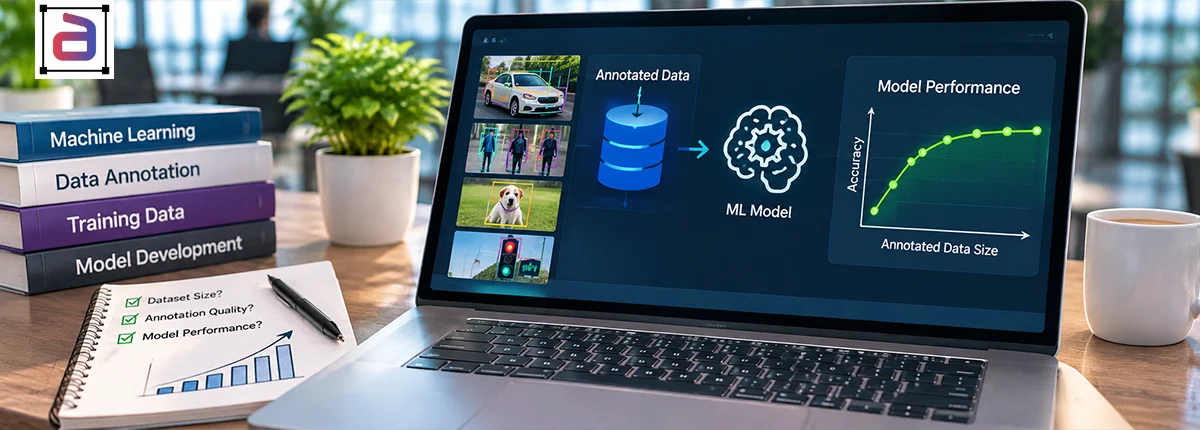
Building a successful machine learning model is not just about choosing the right algorithm or investing in advanced computing infrastructure. The real foundation of model performance lies in the quality, diversity, and quantity of its training data. But how much annotated data is actually enough to train an accurate machine learning model? This is one of the most common questions AI developers, data scientists, and businesses encounter when developing intelligent applications. While some machine learning projects can achieve promising results with a few hundred carefully labeled examples, others require thousands or even millions of annotated data points. The challenge is understanding that more data does not automatically translate into better performance. What matters is having the right data, accurately labeled and representative of real-world scenarios.
At Annotera, we believe that building reliable AI starts with building reliable datasets. Let’s explore the factors that determine annotation requirements and how businesses can identify the right dataset size for their machine learning initiatives.
Key Points
- No One-Size-Fits-All Dataset Size: The amount of annotated data required depends on machine learning complexity, model architecture, and performance expectations.
- Data Quality Matters More Than Quantity: Accurate, diverse, and consistently labeled datasets help machine learning models achieve better performance and generalization.
- Start Small and Scale Strategically: Pilot datasets, learning curve analysis, and active learning help identify the right annotation volume while optimizing costs.
- Data Annotation Outsourcing Supports AI Scalability: Partnering with an experienced data annotation company like Annotera ensures high-quality annotations, scalable operations, and reliable AI training datasets.
1. Why Does Annotated Data Matter in Machine Learning?
Machine learning models learn by identifying patterns and relationships within training datasets. In supervised learning, annotated data provides the labels that help algorithms understand what they are expected to recognize, classify, or predict. For example:
- Computer Vision: Annotated images help models identify vehicles, pedestrians, products, and other objects.
- Natural Language Processing: Labeled text enables models to understand sentiment, classify customer queries, and recognize named entities.
- Speech Recognition: Transcribed and annotated audio helps AI systems recognize spoken language and understand speech patterns.
- Autonomous Driving: Annotated video, LiDAR, and sensor data help vehicles interpret road environments and identify potential hazards.
Without sufficient and reliable annotations, models may struggle to generalize beyond their training examples. Andrew Ng, a leading AI researcher and founder of DeepLearning.AI, has consistently advocated for a data-centric approach to artificial intelligence. His central argument is that systematically improving training data can deliver significant performance gains without constantly changing model architectures.
This highlights an important consideration: the objective should not simply be to collect more data, but to create better training data.
2. How Much Annotated Data Do Different ML Applications Need?
There is no universal dataset size that guarantees optimal machine learning performance. Requirements depend on task complexity, model architecture, class distribution, and the diversity of real-world scenarios. The following figures are illustrative starting points for planning initial annotation projects, rather than fixed industry benchmarks.
| ML Application | Indicative Initial Dataset |
|---|---|
| Image classification | 500–5,000 images |
| Object detection | 2,000–20,000 images |
| Text classification | 1,000–10,000 text samples |
| Sentiment analysis | 1,000–10,000 text samples |
| Named Entity Recognition | 1,000–10,000 sentences |
| Speech recognition | 10–100+ hours of transcribed audio |
Consider a retail company developing an image recognition system to identify products on store shelves. A relatively focused dataset may be sufficient for an initial prototype. However, if the system must recognize products across different lighting conditions, shelf arrangements, packaging variations, and camera angles, considerably more representative examples will be necessary. Similarly, an NLP model identifying customer intent across multiple languages will require broader linguistic coverage than a basic English-language classification system. The important takeaway is that annotation volume must reflect the complexity of the intended application.
3. Industry Statistics: What Large-Scale Datasets Reveal
Existing machine learning benchmarks demonstrate how annotation requirements increase when models must understand complex real-world environments. One prominent example is Microsoft’s Common Objects in Context (COCO) dataset. According to the original COCO research published at ECCV 2014, the dataset contains approximately:
- 328,000 images collected from everyday environments.
- 2.5 million labeled object instances.
- 91 proposed object categories, covering diverse visual scenarios.
The dataset was developed to advance object recognition and scene understanding through detailed instance-level annotations. Another important benchmark is ImageNet, which contains more than 14 million labeled images across thousands of object categories in its broader dataset. These examples demonstrate the scale of annotation required to develop comprehensive computer vision benchmarks. However, businesses should not assume that every commercial ML application needs millions of labeled samples. A domain-specific model trained using representative, accurately annotated examples may achieve its objectives with a considerably smaller dataset. The lesson is simple: dataset size should be determined by the problem being solved, not by the size of another organization’s training dataset.
4. Five Factors That Determine Your Annotation Requirements
Before investing in large-scale annotation, organizations should evaluate five important factors.
A. Complexity of the Task
Basic binary classification generally requires fewer examples than complex tasks such as semantic segmentation, object tracking, or multimodal AI. Tasks involving multiple object categories, overlapping objects, and contextual relationships demand more comprehensive annotations.
B. Data Diversity
A model must encounter enough variation to perform reliably outside controlled training environments. For example, autonomous driving datasets should include daytime and nighttime footage, different weather conditions, road types, traffic patterns, and unusual driving scenarios. A smaller but diverse dataset can be more useful than a significantly larger dataset containing repetitive examples.
C. Annotation Accuracy
Inconsistent labels can introduce noise into training data and negatively affect model performance. Clear annotation guidelines, trained annotators, independent reviews, and quality assurance checks help maintain labeling consistency. Partnering with an experienced data annotation company can help organizations establish these processes while maintaining dataset reliability.
D. Model Architecture
Pretrained models and transfer learning can reduce the amount of task-specific annotated data required. For example, fine-tuning an existing computer vision model may require fewer labeled images than developing an entirely new model from scratch. However, domain-specific annotation remains important when working with specialized applications.
E. Performance Expectations
A prototype and a production-grade AI application do not necessarily require the same dataset size. Organizations targeting higher precision, recall, and reliability must evaluate whether their training datasets adequately represent common scenarios, rare events, and challenging edge cases.
5. How to Identify the Right Amount of Annotated Data
Instead of annotating millions of samples immediately, businesses should adopt an iterative approach.
- Step 1: Start with a Pilot Dataset Collect an initial sample representing the primary categories, scenarios, and variations relevant to the project.
- Step 2: Establish Annotation Standards Develop detailed labeling guidelines, category definitions, and quality benchmarks to minimize inconsistencies.
- Step 3: Train and Evaluate the Model Use the initial dataset to train a baseline model and measure its performance using appropriate evaluation metrics.
- Step 4: Analyze Learning Curves Gradually increase the training dataset size and observe how model performance changes. If additional annotated examples deliver meaningful improvements, expand the dataset.
- Step 5: Prioritize Difficult Examples Use error analysis and active learning to identify samples where the model performs poorly. Annotating these underrepresented or challenging examples can improve model generalization. This approach helps organizations control annotation costs while making data collection more purposeful.
6. How Data Annotation Outsourcing Helps Businesses Scale AI Projects
Managing annotation operations internally can become challenging when projects require large volumes of data, specialized domain knowledge, and consistent quality standards. This is where data annotation outsourcing offers a strategic advantage. Working with a professional annotation partner helps businesses:
- Scale operations efficiently: Increase annotation capacity according to project requirements.
- Access specialized expertise: Work with trained annotators experienced in image, video, audio, text, and multimodal labeling.
- Maintain quality standards: Implement quality assurance, consensus reviews, and validation workflows.
- Accelerate project delivery: Process large datasets without building extensive in-house annotation teams.
- Optimize operational costs: Allocate resources toward relevant and high-quality training data.
At Annotera, we understand that every AI project has different data requirements. Our annotation approach focuses on accuracy, consistency, scalability, and the specific needs of machine learning applications. From image and video annotation to text, audio, and multimodal data labeling, Annotera helps businesses transform unstructured information into structured, AI-ready datasets.
Conclusion: Better Training Data Builds Better Machine Learning Models
So, how much annotated data do you need for machine learning? The answer depends on your application’s complexity, model architecture, data diversity, and performance objectives. While some projects can begin with hundreds of carefully selected examples, complex AI applications may require thousands or millions of accurately labeled data points. The most effective strategy is to start with a representative dataset, evaluate model performance, identify data gaps, and expand annotation efforts based on measurable improvements.
At Annotera, we help businesses build high-quality, scalable training datasets that support smarter AI development. Whether you are developing computer vision models, NLP applications, speech recognition systems, or advanced multimodal solutions, our annotation expertise can help you establish a stronger foundation for machine learning. Ready to build better training datasets for your next AI project? Connect with Annotera today and discover how our data annotation services can help turn your raw data into reliable machine learning intelligence.
A closely related read: Machine Translation Quality Annotation: Human-in-the-Loop Evaluation for MT Pipelines.