Retail is being transformed by artificial intelligence and computer vision. From personalized recommendations and visual search to autonomous checkout and smart store layouts, these technologies rely on one foundational element: high-quality image and video annotation. AR try-on experiences depend on a specific landmark annotation layer explored in landmark labeling for retail AR. For shelf-level inventory and planogram compliance, polygon annotation for retail shelf auditing covers the annotation techniques that drive inventory accuracy at scale.
Key Points
- Retail image annotation must cover the visual product attributes that drive purchase decisions for each product category: colour fidelity, texture detail, and fit representation requirements differ substantially across fashion, electronics, and home goods.
- Video annotation for retail customer experience AI must capture dwell time, product interaction, and navigation patterns that reveal shopping intent, not just presence detection.
- Retail computer vision annotation programs must be updated with each catalogue season to maintain model accuracy on current inventory: a model trained on spring annotation will misclassify new autumn products as unknown objects.
- Image annotation for retail visual search must cover the full range of product presentation contexts: catalogue photography, user-uploaded images, and editorial photography each have different visual characteristics that require separate annotation coverage.
Table of Contents
Why Image and Video Annotation Matters in Retail
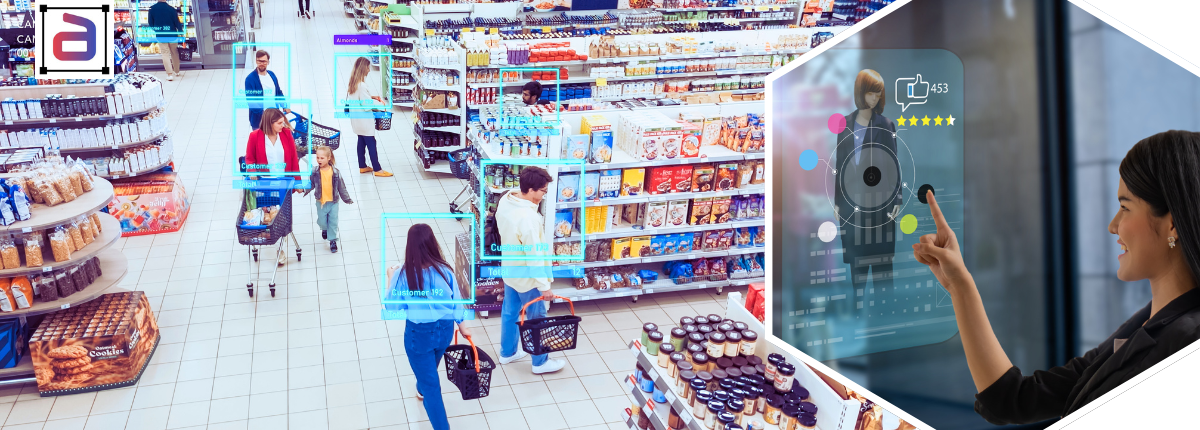
Modern retail AI systems can only perform as well as the data they are trained on. High-quality annotation converts raw images and videos into structured, labeled datasets that allow algorithms to accurately recognize products, interpret customer behavior, and optimize store operations. Without it, even advanced models deliver poor results, leading to frustrated customers and lost revenue. Learn more about video annotation for retail customer behavior insights.
Key Applications of Image Annotation in Retail
Image annotation powers several critical retail technologies: One of the most demanding of these use cases is autonomous checkout annotation.
- Product Tagging & Catalog Management — Detailed labeling of attributes like color, material, pattern, fit, and style improves search accuracy and reduces abandoned carts.
- Visual Search — Enables customers to search by uploading photos. Requires precise annotation of shapes, colors, textures, and design elements.
- Augmented Reality (AR) Try-Ons — Helps create realistic virtual fitting experiences for fashion and home goods, increasing buyer confidence and lowering return rates.
- Inventory & Shelf Monitoring — Supports automated stock tracking, planogram compliance, and out-of-stock detection.
Key Applications of Video Annotation in Retail
Video annotation adds the dimension of time and motion, unlocking deeper insights:
- Customer Behavior Analysis — Understand dwell time, navigation patterns, and product interaction.
- Foot Traffic & Store Optimization — Identify peak hours and improve store layout and staffing decisions.
- Loss Prevention — Detect suspicious activity and reduce shrinkage through intelligent video surveillance.
- Autonomous Checkout Systems — Enable cashier-less stores by tracking products picked up by customers in real time.
Common Annotation Techniques in Retail
- Bounding Boxes — Quick and effective for product and people detection.
- Semantic Segmentation — Pixel-level labeling for accurate shelf and environment understanding.
- Polygons & Instance Segmentation — Precise outlining of complex product shapes.
- Keypoints & Pose Estimation — Track body posture and gestures for interactive experiences.
- Facial Expression Recognition — Used for mood analysis and personalized engagement.
Major Challenges in Retail Annotation
- Handling massive scale — millions of SKUs and thousands of hours of video
- Avoiding dataset bias that can lead to unfair or irrelevant recommendations
- Meeting strict privacy regulations (GDPR, CCPA, etc.)
- Maintaining consistency across seasonal collections and fast-changing trends
Best Practices for High-Quality Results
- Implement multi-stage quality control with expert reviewers
- Use hybrid workflows (model pre-labeling + human validation)
- Create detailed, regularly updated annotation guidelines
- Conduct regular bias audits and fairness checks
- Partner with experienced providers who understand retail-specific needs
Retail-Specific Annotation Requirements
Retail AI annotation differs from general computer vision in ways that matter for model performance:
- SKU-level product recognition: Retail models must distinguish between thousands of near-identical products — same category, different SKU, subtle packaging differences. Annotation requires product-aware annotators who can apply consistent labels across lighting variations, partial occlusion, and shelf placement changes.
- Customer behaviour annotation: Footfall analysis, dwell time detection, and queue monitoring require frame-level action recognition annotation across crowded, overlapping scenes. Annotators must apply consistent labels for ambiguous behaviours (browsing vs. selecting, queuing vs. loitering) using detailed behavioural rubrics.
- Planogram compliance: Shelf compliance models require annotations that capture facing count, product position, and gap detection — structured annotations that go beyond simple bounding boxes into attribute-level labeling.
- Loss prevention: Concealment detection models require annotation of subtle, often partially occluded behaviours. Annotators must label positive examples (actual concealment events) and hard negative examples (innocent similar behaviours) with high consistency to prevent false positives that affect customer experience.
Video Annotation for In-Store AI Systems
Retail video annotation for customer experience systems operates at high frame rates (25–30 fps) across multi-camera coverage with significant overlap. Key annotation requirements include: consistent identity tracking across camera handoffs, temporal action segmentation for behaviour sequences, and synchronised multi-camera labeling for 3D footpath reconstruction. Annotera delivers retail video annotation with frame-level IAA reporting and format compatibility with major retail AI platforms. Learn how annotation enables smarter autonomous shopping.
Conclusion
High-quality image and video annotation has become a strategic advantage for retailers. It directly impacts personalization, operational efficiency, customer satisfaction, and revenue. As competition in AI-powered retail intensifies, the quality of your training data will increasingly determine who wins.
If you’re scaling retail AI initiatives and need reliable, accurate image and video annotation support, feel free to reach out to Annotera.
A closely related read: how image annotation strengthens visual search, shelf analytics, and loss prevention in retail.
A closely related read: How Data Annotation Powers AI in Retail: Tagging To Recommendations.
A closely related read: AI in Retail: How Accurate Product Categorization Boosts Search Relevance.
Video Annotation for In-Store AI Systems
In-store AI operates on a different data modality from e-commerce. Where product image annotation works on clean, controlled photography, in-store computer vision works on CCTV footage: low resolution, variable lighting, partial occlusion, and real-time motion. The annotation requirements are correspondingly more demanding.
Queue monitoring systems need video annotations that label queue length, wait time indicators, and shopper movement patterns frame by frame. Loss prevention systems need annotations that distinguish between legitimate shopping behaviors and threshold events that warrant escalation. Automated checkout systems need object detection and tracking annotations that handle the specific challenge of products being placed on a conveyor belt at varying speeds and angles.
Each of these applications requires its own annotation taxonomy, and maintaining consistency across that taxonomy when annotators are reviewing hours of in-store footage demands the same guideline precision and calibration rigor as any other high-volume annotation program. The annotation that powers in-store AI is less visible than the annotation behind product recommendation engines, but the volume and complexity are comparable. See the related guide on how data annotation powers retail AI from tagging to recommendations for the e-commerce counterpart to this annotation stack.