
Image Annotation Tools Compared: Open-Source vs. Commercial vs. Managed Services

Artificial intelligence is only as reliable as the data used to train it. Whether an AI system identifies pedestrians on busy roads, detects abnormalities in medical images, or recognizes products on retail shelves, its performance depends heavily on the accuracy of its training datasets. At the center of this process lies image annotation, which transforms […]
Keypoint Annotation for Hand and Finger Tracking in Industrial Glove-Based Interfaces

Industrial workplaces are entering a new era of human-machine interaction. Traditional keyboards, touchscreens, and handheld controllers no longer meet every operational need. Workers often wear protective equipment, handle heavy machinery, or operate in environments where conventional interfaces become impractical. As a result, glove-based interfaces have emerged as a promising solution. These systems rely heavily on […]
Skeletal Annotation for Elderly Care AI: Detecting Falls and Monitoring Mobility in Smart Care Facilities

The global elderly population is growing faster than healthcare systems can adapt. Smart care facilities now face mounting pressure to improve patient safety while maintaining quality care. As a result, artificial intelligence has emerged as a critical tool for monitoring residents and reducing risks. At the center of this transformation are keypoint skeletal annotation services, […]
Semantic Segmentation for Flood and Disaster Zone Mapping: Training AI for Emergency Response

When disaster strikes, every minute matters. Whether responding to catastrophic floods, hurricanes, wildfires, or landslides, emergency teams depend on accurate information to make life-saving decisions. Yet traditional disaster assessment methods often struggle to keep pace with rapidly evolving situations. By the time manual surveys are completed, conditions on the ground may have already changed. This […]
What Is Panoptic Segmentation? Stuff, Things and How It Works
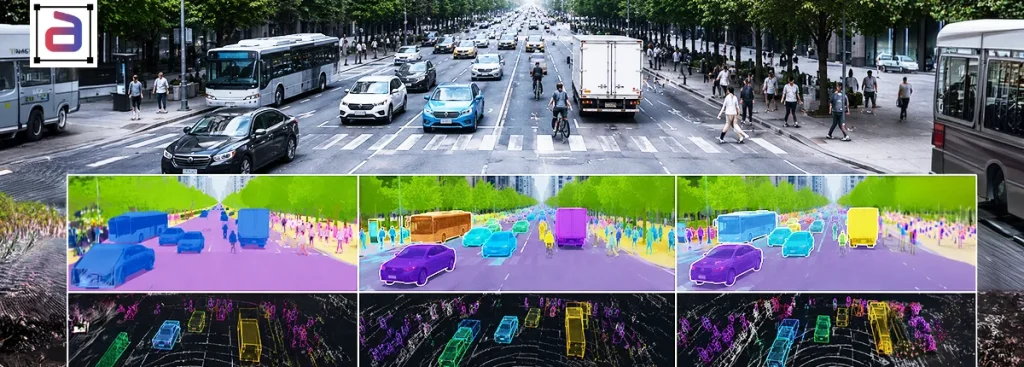
A self-driving car needs to know where the road ends and the sidewalk begins, and it also needs to know that the three pedestrians at the crossing are three separate people. Semantic segmentation answers the first question and instance segmentation the second. Panoptic segmentation answers both at once. This guide explains what panoptic segmentation is, […]
Image Segmentation in Machine Learning: Semantic vs Instance Explained
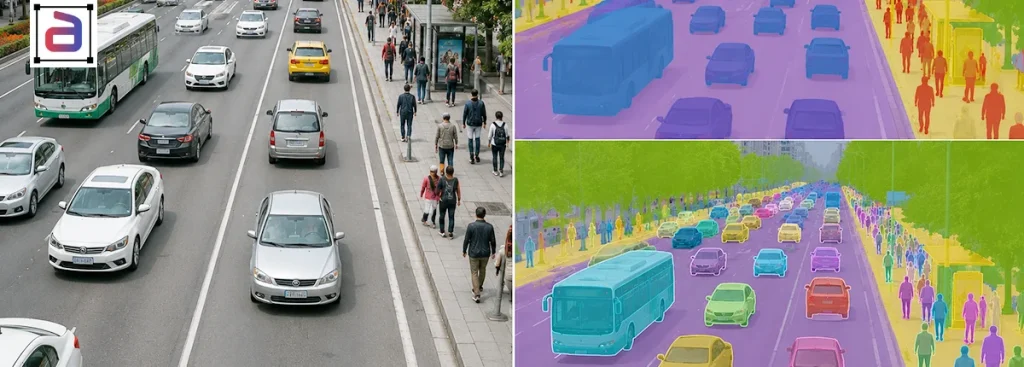
Bounding boxes tell a model roughly where an object is. Image segmentation tells it exactly which pixels belong to the object, which is what self-driving cars, medical imaging tools and robots need when shape and boundaries matter. This guide explains what image segmentation is, how segmentation works in machine learning, the difference between semantic and […]
Polygon Annotation for Construction Site Monitoring: Detecting Hazard Zones and Equipment Boundaries

Construction is undergoing a digital transformation. From AI-powered surveillance systems to autonomous equipment and predictive safety analytics, technology is reshaping how construction projects are managed. Yet behind every intelligent construction monitoring system lies a critical foundation that often goes unnoticed: high-quality annotated data. Polygon annotation for construction enables AI systems to accurately identify complex site […]
Tight vs. Loose Bounding Boxes: How Annotation Tolerance Directly Impacts Object Detection mAP
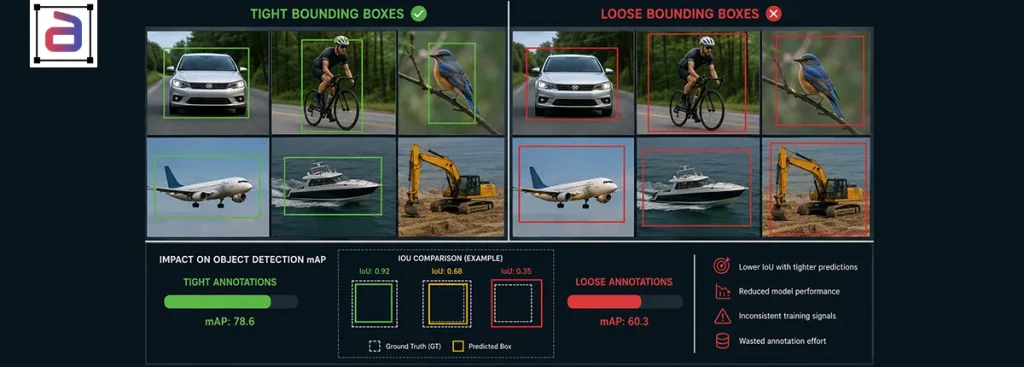
In the race to build more accurate object detection models, organizations often focus on larger datasets, more powerful GPUs, and increasingly sophisticated neural network architectures. Yet one critical factor continues to determine whether a computer vision model succeeds or fails in production: annotation quality. Bounding box annotation is the foundation of object detection, defining how […]
Image Classification for Food AI: How Training Data Powers Nutrition Apps and Restaurant Automation
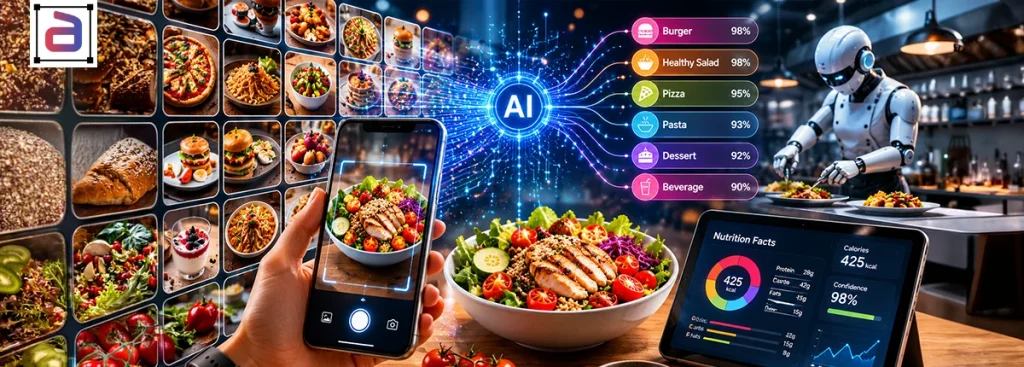
The way we interact with food is changing rapidly. Consumers can now identify meals, count calories, track nutrition, and even receive personalized dietary recommendations simply by snapping a photo. Meanwhile, restaurants are leveraging AI to automate order verification, monitor food quality, reduce waste, and streamline operations. At the center of these innovations lies a powerful […]
Multi-Label Image Classification for Fashion AI: Annotating Attributes, Styles, and Occasions

Fashion is no longer driven solely by creativity and consumer trends. Today, artificial intelligence is transforming how fashion brands design, market, recommend, and sell products. From visual search engines and virtual stylists to personalized shopping experiences, AI is becoming a competitive necessity for retailers worldwide. Image classification for Fashion AI enables machines to identify garments, […]