
Domain-Specific LLM Annotation: Preparing Training Data for Legal, Healthcare, and Financial AI

Large language models (LLMs) are rapidly moving from general-purpose chatbots to specialized systems designed for legal research, clinical documentation, financial analysis, compliance, customer support, and enterprise decision workflows. But specialization requires more than simply feeding industry documents into an existing model. A legal AI system must understand contractual language, legal terminology, obligations, jurisdictions, and citations. […]
Prompt-Response Pair Annotation: Improving Instruction Following in Generative AI Systems

Generative AI has become exceptionally good at producing fluent, human-like responses. But there is a fundamental difference between generating a convincing answer and following an instruction correctly. A user may ask an LLM to summarize a document in 100 words, produce five bullet points, maintain a professional tone, and exclude confidential information. A response can […]
Building Culturally Aware Multilingual LLMs Through Native-Language Annotation

A multilingual AI model can speak dozens of languages and still fail to understand the people who use them. Why? Because language is more than vocabulary and grammar. It carries culture, social norms, humor, emotion, regional expressions, traditions, and context. A response that sounds perfectly acceptable in one linguistic environment can feel unnatural, insensitive, or […]
Code Generation Annotation: How Human Reviewers Train LLMs to Produce Reliable Software

Large language models are rapidly changing how software is written. From generating functions and debugging errors to creating test cases and translating code between programming languages, LLM-powered coding assistants are becoming part of everyday software engineering workflows. But there is a fundamental distinction between generating code and generating reliable software. An LLM can produce code […]
Red-Teaming Data Annotation: Creating Adversarial Examples for Safer Generative AI

Generative AI is moving from experimental technology to an integral part of customer service, software development, research, content creation, and enterprise decision-making. But as models become more capable, simply measuring how well they perform on standard datasets is no longer enough. A model may produce impressive answers under normal conditions and still behave unpredictably when […]
How Expert Annotation Improves LLM Evaluation for Factuality, Helpfulness, and Instruction Following

Large language models are becoming increasingly capable—but capability alone does not guarantee reliability. An LLM can produce fluent, well-structured responses while still presenting inaccurate facts, missing important context, or failing to follow a user’s instructions precisely. For enterprises deploying AI in customer service, knowledge management, healthcare, finance, research, and other high-value applications, these seemingly small […]
Annotating Multi-Turn Conversations for Context-Aware Generative AI Models

A conversation with an AI rarely ends after one question. Users ask follow-ups, change requirements, correct themselves, refer to information mentioned several turns earlier, and expect the AI to remember what has already been established. For generative AI systems, this creates a fundamental challenge: understanding language is not enough; models must understand conversational context. A […]
Beyond Response Ranking: Building High-Quality Preference Data for Complex LLM Behaviors
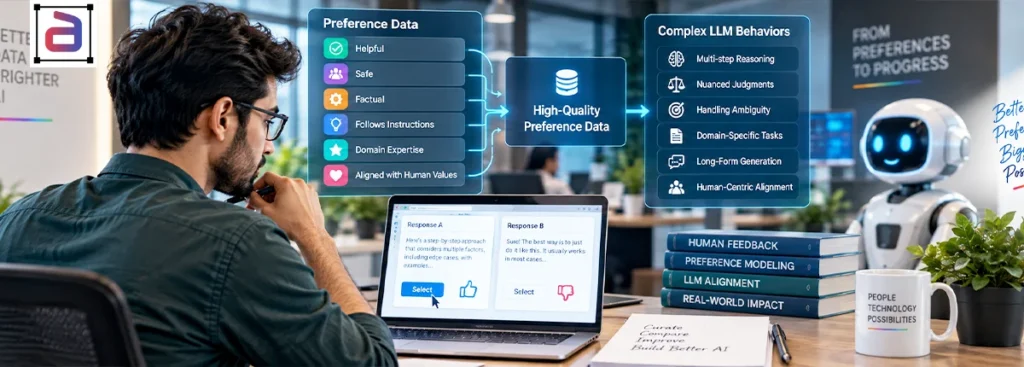
Large language models are becoming increasingly capable, but capability alone does not guarantee that an AI system will behave the way users expect. A model may produce fluent text yet misunderstand an instruction, provide an incomplete answer, overlook important context, or sound confident while presenting questionable information. This is where preference data becomes essential. Human […]
How Supervised Fine-Tuning Data Quality Shapes the Performance of Enterprise LLMs

Enterprise LLMs are moving from experimentation to mission-critical applications. From intelligent customer support and document automation to enterprise search, coding assistants, and knowledge management, organizations are increasingly fine-tuning foundation models to perform specialized tasks. But there is a fundamental question that every enterprise AI team should ask before fine-tuning: Is the training data good enough? […]
Benchmarking Domain-Specific LLMs: Creating Evaluation Datasets for Healthcare, Finance, and Legal AI

Large Language Models (LLMs) are transforming industries, but generic AI models are no longer enough for high-stakes sectors like healthcare, finance, and legal services. Organizations now require domain-specific LLMs capable of understanding specialized terminology, regulatory frameworks, and nuanced decision-making. However, developing these models is only half the challenge—the real measure of success lies in how […]